 MineArchive
Cost Book System
| Category | Labour & Roles |
|---|
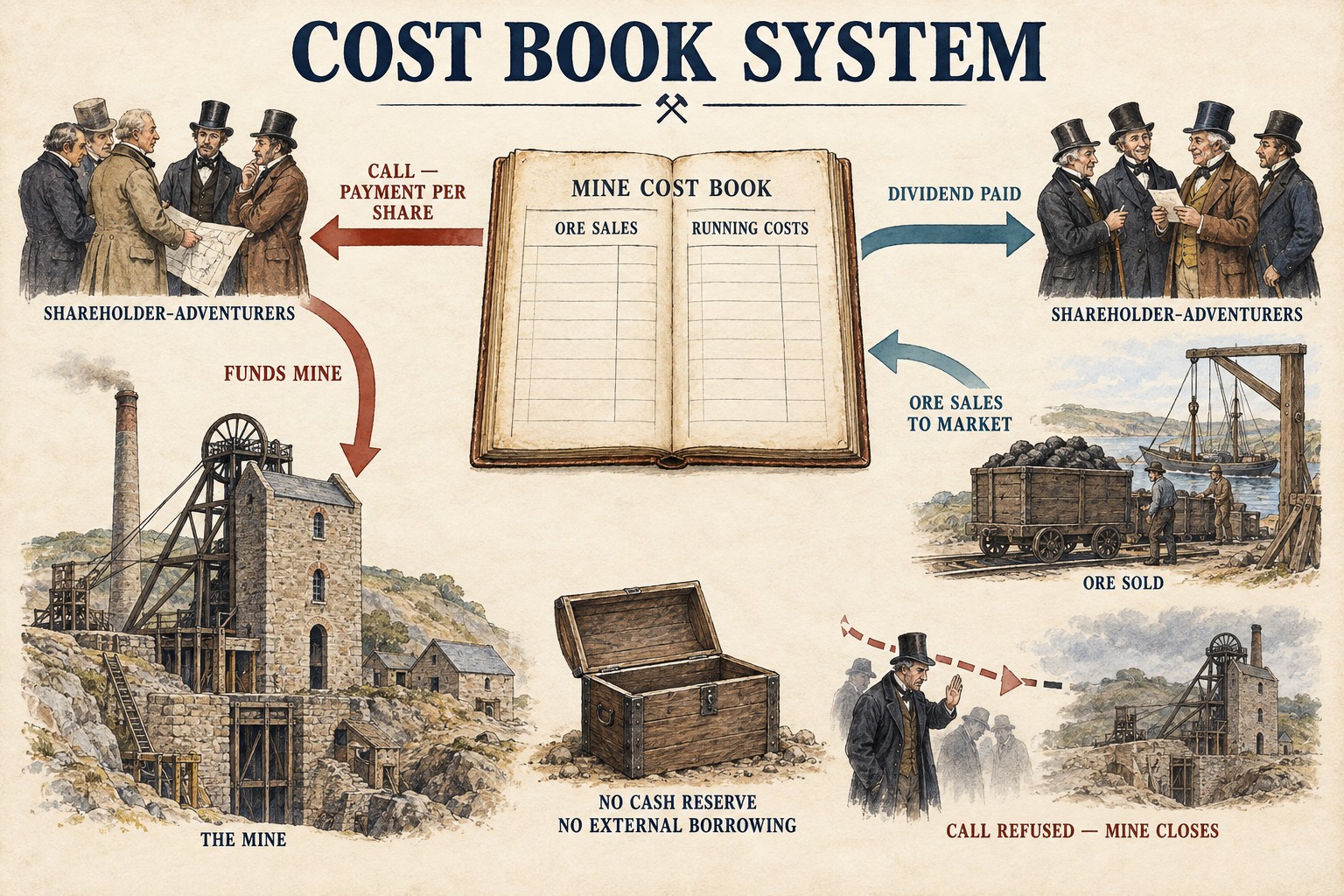
The traditional financing method for Cornish and Devon mines, in which shareholders ('adventurers') funded the mine's running costs directly out of their own pockets, with no bank borrowing and no cash reserve held back.
Historical usage
The cost book system grew out of the informal financing arrangements of medieval Cornish tin streaming and had become the standard way of running a Cornish or Devon metal mine by the 18th century, remaining dominant into the 19th despite growing strain from the much larger capital demands of deep, mechanised mining.
How it worked
Shareholders, known as adventurers, bought shares in a mine and met periodically to review its accounts, recorded in the mine's 'cost book'. If costs exceeded income the adventurers were asked to pay a 'call' — an extra payment per share — to keep the mine running; if the mine was in profit, a dividend was paid out instead. The mine held no cash reserve of its own and could not borrow externally, so it depended entirely on ore sales and adventurers' calls to keep operating.
Why it was used
The system let a mine be financed and run by a group of local investors without needing a bank or formal company structure, sharing both the running costs and the risk among the adventurers in direct proportion to their shareholding.
Risks & limitations
Because the mine held no reserve and could not borrow, it was structurally fragile: if adventurers grew impatient waiting for a dividend and refused to pay a further call, the mine simply ran out of money and closed, whatever its underlying potential — a recurring cause of mine failure that had nothing to do with the ore itself running out.
Regional variation
The cost book system was distinctively Cornish and Devonian, rarely used in the same form elsewhere in Britain, where mines were more commonly run as conventional limited companies or by a single owner or landlord.
Related terminology
Adventurer, Consols, Count House, Tribute and Tutwork
Mines associated with this term
Included only where MineArchive's own research gives a reasonable evidential basis — not every mine where this might plausibly apply.
- Marke Valley Mine — Cornwall (well documented example)
Named in this record’s history: “…was formed in 1837 to develop the sett on the customary Cornish cost-book system, with 9,000 shares and a 21-year lease at a royalty of…” - Wheal Mary Ann — Cornwall (well documented example)
Named in this record’s history: “…the course of the lode itself; drainage and winding were on the Cost Book System usual to Cornish mining, with miners working underground pitches on…” - West Crinnis Mine — Cornwall (well documented example)
Named twice in this record, first in the summary: “A copper mine two miles east of St Austell, run on the cost-book system from an office in Birmingham, which took in the older Wheal Regent…” - Wheal Owles — Cornwall (well documented example)
Named in this record’s history: “…of adit and 1,020 fathoms of engine rods; it worked on the Cornish cost-book system, with 80 shares paying a dividend of £920 (£11 10s. per share) in…”
Sources
- (secondary) Mining Bosses and Businesses — Cornish Mining World Heritage Site
- (secondary) Some Cornish Mining Terms — navsbooks
Record created: 22 August 2026 · Last researched: 22 August 2026