 MineArchive
Wheal Owles
| Also known as | West Wheal Owles, Cargodna Mine |
|---|---|
| Location | St Just, on the coast between Botallack and the Cot Valley, Cornwall — 50.1342, -5.6878 (exact) |
| Commodities | Tin, Copper |
| Type | Metal |
| Worked | c. 1830–1893 |
| Maximum depth | given variously as around 190 fathoms and as over 200 fathoms (see claims) |
| Operators | John Boyns (1830–?) |
Overview
Wheal Owles was a St Just tin mine on the cliffs south of Botallack, worked on a large scale from around 1830 until it flooded catastrophically on 10 January 1893, killing twenty men and boys when miners broke through into the long-abandoned, water-filled workings of neighbouring Wheal Drea. It never reopened, and today its surviving engine houses are best known as a filming location for the BBC's Poldark.
History
John Boyns began working the site around 1830, reorganising earlier, undated workings into setts known as Wheal Boys and the Growse. By 1836 the mine employed 131 people — 110 men and 21 women — and it grew through the mid-19th century as several smaller adjoining ventures were consolidated into a single large sett, eventually employing around 500 people and producing over 100 tons of tin ore a month at its peak. By 1873 the operation ran eleven steam engines across twenty-five sunk shafts, linked by 3.5 miles of adit and 1,020 fathoms of engine rods; it worked on the Cornish cost-book system, with 80 shares paying a dividend of £920 (£11 10s. per share) in 1855. Profitability declined through the 1880s as tin prices fell, and on 10 January 1893 a catastrophic flood killed twenty men and boys (see Disasters, below). Wheal Owles never reopened, despite a later attempt to float it as 'Wheal Owles and Boscean United'. The date of c. 1830 is for the mine as such: undated earlier workings on the same ground predate it, in a parish where mining had gone on for centuries before any of the setts took the names they are known by now.
Geology
Wheal Owles worked tin-bearing lodes on the Cornwall and West Devon orefield at St Just, principally the Cargodna lode, with some bismuth and uranium ores recorded alongside argentiferous (silver-bearing) galena in cross-veins.
Geological setting: Veins and Lodes (well documented example)
Workings
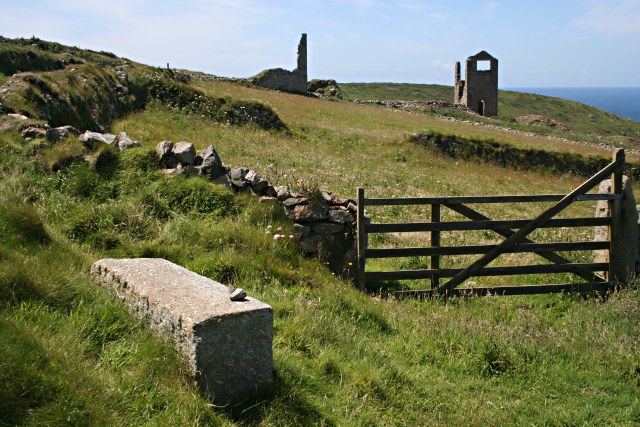
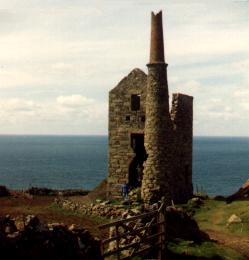
At its 1873 peak the mine had twenty-five shafts, 3.5 miles of adit and 3,288 fathoms of tramroad underground. The surviving Cargodna Pumping House — a Grade II listed granite engine house of about 1870, roughly 8.1 by 5.8 metres, with dressed granite quoins and voussoirs and an arched brick cylinder-door head — pumped the Cargodna section where the 1893 disaster began.
Closure
Production ceased immediately after the January 1893 flooding described under Disasters, below; the mine did not reopen despite the later attempt to refloat it under a new name.
What remains
The site lies within the Cornwall and West Devon Mining Landscape World Heritage Site, inscribed in 2006. Four engine houses and parts of several others survive on the cliffs at Wheal Owles, including the Grade II listed Cargodna Pumping House. The National Trust has managed the neighbouring Botallack and Crowns ground since 1997, and conservation on this stretch of coast has been a matter of stabilising the standing engine houses rather than restoring them.
The surviving engine houses stand on the coast path between Botallack and the Cot Valley, visible from the neighbouring Wheal Edward and Botallack sites. The flooded underground workings, including the site of the 1893 disaster, remain inaccessible.
Redevelopment
There is no visitor centre or formal public access scheme on site. Its present-day public profile comes chiefly from use as a Poldark filming location, where its engine houses stood in for the fictional Wheal Leisure and Wheal Grace.
Related mines
- Boscean Mine — Wheal Owles miners broke into flooded workings in 1893, water that the sources trace to Boscean.
- Parkenoweth Mine — Parkenoweth was one of the lodes and workings absorbed into the wider Wheal Owles group.
- Wheal Drea — Wheal Drea's own long-flooded workings caused the catastrophic 1893 Wheal Owles disaster when miners broke into them by mistake.
- Wheal Edward — Wheal Edward's workings were directly linked underground to Wheal Owles and closed in the wake of the 1893 disaster.
Nearby mines
- Wheal Drea — 0.1 miles (0.1 km) SE
- Boscean Mine — 0.3 miles (0.4 km) S
- Botallack Mine — 0.4 miles (0.7 km) N
- Boswedden Mine — 0.5 miles (0.9 km) SW
- Wheal Cunning — 0.6 miles (0.9 km) S
Straight-line distance, within 9 miles (15 km). Show on the map.
Disasters & major incidents
-
Wheal Owles flooding disaster
10 January 1893 · Flooding / Inundation · 20 fatalities
Miners broke through into the flooded, long-abandoned workings of Wheal Drea, trapping and drowning twenty men and boys underground.
What's uncertain
Points where sources disagree or the record could not be settled; both accounts are kept. All open questions in the archive.
- One account gives the mine's deepest workings as around 190 fathoms. (disputed) 4
- Another account gives a maximum depth of over 200 fathoms (about 1,200 feet). (disputed) 5
- The mine never reopened after the 1893 flooding despite a later attempt to float it as 'Wheal Owles and Boscean United'; ownership of the sett later passed to Geevor Tin Mines plc, though no further extraction is recorded there. (uncertain) 4
Recorded claims
Individual factual claims, each attached to the source(s) that support it below. Where sources disagree, both are kept.
- On the morning of 10 January 1893, miners working the Cargodna section broke into the flooded workings of the abandoned Wheal Drea mine. The inrush of water pushed a powerful blast of air ahead of it that blew out every light underground; twenty men and boys died and their remains were never recovered. 1
- An official investigation found the mine's plans had not properly accounted for magnetic variation when the workings were plotted, so the true position of the flooded Wheal Drea workings was misjudged. Manager Richard Boynes was fined £15 under the Metalliferous Mines Regulation Act 1872 for keeping inaccurate plans; no inquest was held. 1
- James 'Farmer' Hall, working at the 50-fathom level when the inrush struck, used a tram wagon to guide five miners to safety through the darkness; he died in 1895 of a lung disease attributed to his years underground. 2
- The dead were spread across three levels: eight men on the 65-fathom level (including the youngest victim, William Davey), four on the 75-fathom level, and eight on the 85-fathom level. 2
- The Cargodna Pumping House, the mine's surviving engine house, is Grade II listed and dates from around 1870. It is built of granite rubble with dressed granite quoins and voussoirs, measures roughly 8.1 by 5.8 metres, and has an arched brick head over its cylinder door opening. 3
- One account gives the mine's deepest workings as around 190 fathoms. (disputed) 4
- Another account gives a maximum depth of over 200 fathoms (about 1,200 feet). (disputed) 5
- The mine never reopened after the 1893 flooding despite a later attempt to float it as 'Wheal Owles and Boscean United'; ownership of the sett later passed to Geevor Tin Mines plc, though no further extraction is recorded there. (uncertain) 4
- The BGS catalogue of abandoned mine plans holds several Wheal Owles records, among them a plan of Wheal Owles and Wheal Drea together and a vertical longitudinal section through Wheal Owles and West Wheal Owles, as well as Geevor Tin Mines Limited’s later survey of the cliff and undersea sections of West Wheal Owles and Wheal Edward. 6
Photographs & further reading
The official Grade II listing record for the surviving engine house, with a full architectural description.
View sourceA wider survey of West Penwith engine houses including a photograph of Wheal Owles seen from neighbouring Wheal Edward.
View sourceSources
- (secondary) Wheal Owles Flooding - St Just - 1893 — Northern Mine Research Society
- (secondary) Wheal Owles Mine Disaster, 1893 — West Penwith Resources
- (primary) Cargodna Pumping House, West Wheal Owles (list entry 1115109) — Historic England
- (secondary) Wheal Owles Mine, Cornwall — Cornwall Calling
- (secondary) Wheal Owles — Wikipedia
- (primary) BGS mine plans catalogue: PLAN OF WHEAL OWLES AND WHEAL DREA — British Geological Survey
Record created: 20 August 2026 · Last researched: 6 September 2026