 MineArchive
Uranium
| Category | Commodities |
|---|---|
| Commodity page | Uranium → |
A dense, radioactive metal (U), mined in Britain on only a small, largely historical scale — chiefly at South Terras in Cornwall, worked first as an incidental iron-mine curiosity and then, briefly, as one of the most valuable ore sources on Earth.
Historical usage
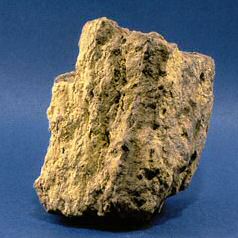
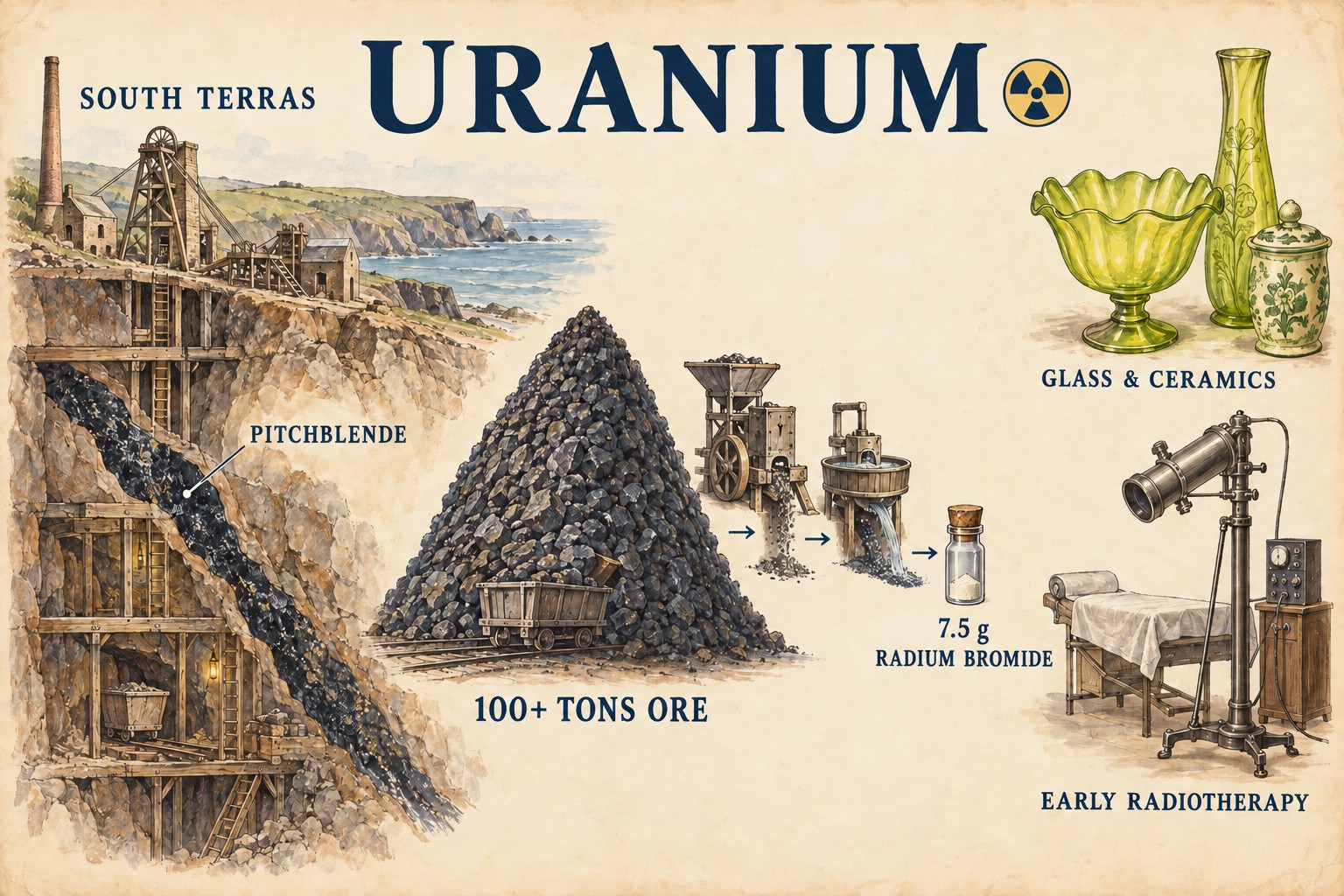
South Terras, near St Austell, began as an ordinary iron mine in 1870, but uraninite (pitchblende) was identified in its workings in 1885 — initially of only minor interest, since uranium's main use at the time was as a yellow-green colourant for glass and ceramics. Everything changed after Pierre and Marie Curie isolated radium from pitchblende in 1898: radium's extraordinary value for early cancer treatment created the first uranium rush, and South Terras became Britain's only significant source, supplying ore to the Curies' own circle — Marie Curie's colleague Dr Marcel Pochon supervised operations there — and, in 1906-07, providing over 100 tons of pitchblende ore to extract 7.5 grams of radium bromide, worth over £30,000, for the newly founded London Radium Institute, funded partly by King Edward VII after his own successful radium treatment for skin cancer. The mine finally closed around 1930, and the site remains one of the most radioactive in Britain.
How it worked
Uranium ore was crushed and worked underground like any other metal ore, but the radium content that made South Terras valuable existed only in staggeringly small concentrations — hundreds of tons of pitchblende had to be processed by chemical leaching and repeated concentration to yield a few grams of radium, reflecting radium's status as one of the rarest and most expensive substances ever extracted.
Why it was used
Before nuclear fission was understood, uranium ore's entire commercial value rested on its radium content, prized for pioneering cancer radiotherapy and, more frivolously, for luminous paint; the fissile potential that would later make uranium itself the valuable commodity was not exploited until nuclear fission was discovered in 1938, well after South Terras had ceased significant production.
Value over time
Uranium ore's value underwent one of the most dramatic transformations of any commodity on this site. Before 1898 it was a minor curiosity, valuable only as a glass and ceramic colourant; after the Curies isolated radium, the tiny fraction of radium locked within uranium ore became worth more than almost anything else on Earth, driving South Terras's brief but historically significant boom. A second, much larger transformation followed nuclear fission's discovery in 1938, which shifted uranium's value onto the metal itself rather than its radium content — but this second uranium rush passed South Terras by entirely, since its deposit had never been large enough to interest the reactor and weapons programmes that followed.
Hazards & challenges
Uranium ore emits ionising radiation and decays into radon, a radioactive gas that accumulates in enclosed underground workings and is a well-documented cause of lung cancer with prolonged exposure; South Terras's miners worked with no understanding of these risks and no protective measures, and the site's residual radioactivity remains high enough today that it continues to be studied as a natural analogue for uranium-contaminated land.
Risks & limitations
Radium's yield from any given tonnage of ore was vanishingly small, so a mine's viability depended entirely on radium's exceptional price — radium peaked at more than $3 million an ounce in 1919 — rather than on the scale of the uranium deposit itself; South Terras's ore body was in any case too small to have been economic for the later, fission-driven uranium industry even had it still been working.
Regional variation
South Terras is, by a wide margin, Britain's only significant uranium mine — the country was never part of the mid-20th-century uranium rushes that developed much larger deposits in Canada, Australia and Central Europe.
Related terminology
Mines associated with this term
Included only where MineArchive's own research gives a reasonable evidential basis — not every mine where this might plausibly apply.
- East Pool Mine — Cornwall (well documented example)
Uranium was among the minor products of East Pool's lodes, one of the several by-products of exceptionally mineralised ground between Camborne and Redruth. - South Terras Mine — Cornwall (well documented example)
Britain's only significant uranium and radium mine, supplying ore for the pioneering London Radium Institute in 1906-07. - Wheal Edward — Cornwall (well documented example)
Decades after closing, the mine gave up a mineral nobody had been looking for — pitchblende, found in workings driven for copper and tin. - Wheal Owles — Cornwall (well documented example)
Uranium ores were recorded alongside the tin, bismuth and silver-bearing lead of the Cargodna lode.
See every mine that worked uranium →
Sources
- (primary) Two abandoned metalliferous mines in Devon and Cornwall, UK: radon hazards and geology — American Association of Radon Scientists and Technologists
- (secondary) Abandoned Cornish mine may hold clues to uranium clean-up — Chemistry World
- (secondary) South Terras mine — Wikipedia
- (secondary) The story of uranium since 1789 — International Atomic Energy Agency (INIS)
Record created: 22 August 2026 · Last researched: 22 August 2026