 MineArchive
Radon
| Category | Ventilation & Mine Gases |
|---|
A naturally occurring radioactive gas, produced by the decay of uranium and thorium present in trace amounts in almost all rock, which can accumulate to dangerous concentrations in poorly ventilated underground workings — especially across Cornwall and Devon's granite mining country, where it remains one of the most hazardous legacies of abandoned hard-rock mining.
Historical usage
Radon's danger to miners was recognised abroad long before it was understood in Britain — 16th-century writers already described a mysterious wasting lung disease among miners in the silver and cobalt mines of the Ore Mountains on the German-Czech border, later identified as radon-induced lung cancer. In Britain the specific hazard was really only quantified from the late 20th century onward, once radiation-monitoring equipment made it possible to survey old workings directly. Surveys of abandoned Cornish and Devon mines in the 1990s and 2000s found some of the highest radon concentrations ever recorded outside a nuclear facility: readings at South Terras, Cornwall's former uranium and radium mine, exceeded 3 million becquerels per cubic metre between 1992 and 2000, among the highest ever measured at a non-nuclear site in Europe, while the Gunnislake Old Adit, part of the same mining district as Devon Great Consols, recorded levels of up to 69,000 Bq/m3 in the same period — hundreds of times the workplace action level of 400 Bq/m3. Geevor Tin Mine's own lodes are known to carry genuine uranium mineralisation, pitchblende and coffinite alongside the tin ore, a reminder that South Terras's uranium was an unusually rich example of a hazard latent across much of the wider granite-hosted tin and copper district, not a one-off curiosity.
How it worked
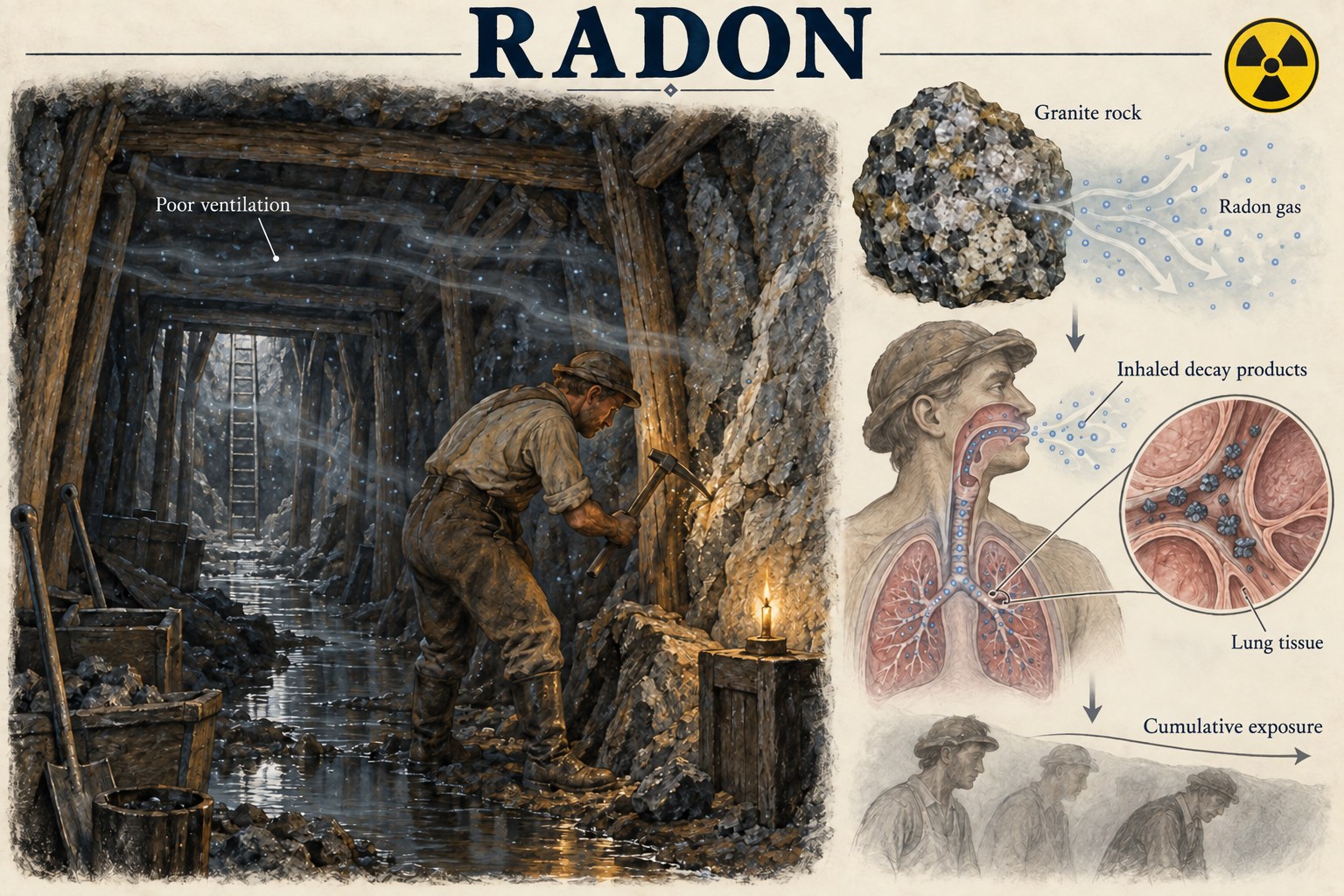
Radon gas seeps continuously out of uranium- and thorium-bearing rock and groundwater; in the open air it disperses harmlessly, but in an enclosed underground working with poor air circulation it can build up steadily, and its own radioactive decay products ('radon daughters') lodge in miners' lungs when inhaled, irradiating lung tissue directly from within over years of repeated exposure.
Why it was used
Recognising radon as a distinct hazard, separate from the general foul or explosive 'damp' miners had always guarded against, mattered because no lamp, canary or ventilation practice developed for firedamp or chokedamp gave any warning of it — it is odourless, invisible and undetectable without specialist instruments, its presence discovered only in retrospect through its long-term effect on miners' lungs.
Risks & limitations
Radon exposure is cumulative, and its overwhelming effect, lung cancer, often takes decades to appear, making it hard to connect to any specific mine or period of work; studies pooling data on more than 50,000 underground miners internationally found more than three times the expected number of lung cancer deaths among them, with the risk compounding sharply for smokers.
Regional variation
Overwhelmingly concentrated in Cornwall and Devon's granite country, where naturally elevated uranium in the underlying rock — the same granite that hosts the region's tin and copper lodes — produces some of the highest radon readings recorded anywhere in Britain, in mine workings and ordinary homes alike; comparable hazards exist wherever else granite or uranium-bearing ground has been mined, but at nothing like the same intensity.
Related terminology
Mines associated with this term
Included only where MineArchive's own research gives a reasonable evidential basis — not every mine where this might plausibly apply.
- Geevor Tin Mine — Cornwall (well documented example)
Geevor's tin lodes carry genuine uranium mineralisation — pitchblende and coffinite alongside the ore — making elevated radon a latent hazard across the wider working, not just at dedicated uranium sites like South Terras. - Marblaegis Mine — Nottinghamshire (well documented example)
Named in this record’s workings: “…doors, brattice panels and block walls directing the air and keeping radon in check. The British Geological Survey holds a sketch plan of the…” - South Terras Mine — Cornwall (well documented example)
Radon measurements taken between 1992 and 2000 recorded levels exceeding 3 million Bq/m3 deep within the mine's adit, among the highest ever recorded at a non-nuclear site in Europe. - Devon Great Consols — Devon (historical documentary reference)
The Gunnislake Old Adit, part of the same historic mining district, recorded radon levels of up to 69,000 Bq/m3 during 1990s surveys.
Sources
- (primary) Miner Studies - Health Effects of Exposure to Radon — NCBI Bookshelf / National Academies Press
- (primary) Radon levels in abandoned metalliferous mines, Devon, southwest England — PubMed
- (primary) Two abandoned metalliferous mines in Devon and Cornwall, UK: radon hazards and geology — American Association of Radon Scientists and Technologists
- (secondary) Radon in a disused mine in Cornwall, UK — Management of Environmental Quality / Emerald Publishing
Record created: 22 August 2026 · Last researched: 22 August 2026