 MineArchive
Marblaegis Mine
| Location | North of East Leake, with the Silver Seal entrance at Bunny, Nottinghamshire — 52.8444, -1.1772 (approximate) |
|---|---|
| Commodity | Gypsum |
| Type | Mineral |
| Worked | 1951 (first consent)–Still active |
| Maximum depth | Unknown. |
| Operators | British Gypsum, Marblaegis Company Limited (1951–?) |
Overview
A working gypsum mine under some 3,852 hectares of south Nottinghamshire, feeding British Gypsum's plaster and plasterboard works at East Leake. It takes the Tutbury gypsum by room and pillar, a quarter of the seam left standing in a grid of rectangular pillars to hold the surface up, and it works nothing at all beneath the buildings above it: the village of Rempstone is entirely surrounded by mine that stops short of the houses. Gypsum was first consented here in 1951, to the Marblaegis Company Limited. There are two entrances, the drift at the East Leake works and the Silver Seal adit at Bunny, and permission to work until February 2042.
History
Gypsum has been dug around East Leake since medieval times, plaster was made in the village from the 1880s, modern working began in 1914 and plasterboard was being manufactured by 1917; British Gypsum has its head office there. The Silver Seal mine was opened in 1938 and eventually met the Marblaegis workings, after which gypsum stopped being drawn out at Bunny. The first planning permission for the complex came in 1951, for gypsum extraction in the Glebe mines area, to the then operator the Marblaegis Company Limited; British Gypsum Limited was established in the early 1960s and is now a subsidiary of Saint-Gobain SA. A review of the old mining permissions, submitted in October 1998, was determined in March 1999 and brought Glebe and Marblaegis under one set of conditions, and the main permission for the two mining areas followed in April 2001. In February 2012 the county council granted an extension of 118 hectares into the Costock area, where extraction began in July 2013. Glebe Mine, the northern part of the complex, has since been closed, its workable deposits exhausted. By 2017 the geology showed that the consented reserves would not be worked out by the cessation date of 31 December 2025: about 13 million tonnes remained, 6 million tonnes of mill rock north of Rempstone, 5 million south of it and 2 million to the east, with a further 4 million tonnes of cement rock. The county's planning and licensing committee took the case on 21 February 2017 and the mine's life was extended by seventeen years, to 22 February 2042. Demand for mined gypsum had fallen away in the meantime, undercut by desulphogypsum recovered from the flue gases of coal-fired power stations and recycled into plasterboard from the early 1990s; as coal-fired generation closed, British Gypsum's minerals and estates manager Jeremy Elvins put the case for making the shortfall up from mined and quarried stone again. Output stands at about 250,000 tonnes a year against an installed capacity of more than 600,000 tonnes put in place in the late 1980s. Twenty-six people work at the mine, and the works it feeds employs 264 staff and about 125 contractors.
Geology
The mine works the Tutbury gypsum, one of the two commercial gypsum resources in the upper forty metres of the Mercia Mudstone in Nottinghamshire. The Newark gypsum to the north-east runs in as many as seven seams of less than a metre each and can only be taken opencast; the Tutbury is normally a single seam averaging three metres thick, lying south-west of the Newark deposit and running across the county east of the Soar valley and south of Gotham and Bunny into Leicestershire, usually within sixty metres of the surface. Eastwards the seam lies deeper and thinner and its quality falls as anhydrite and chloride increase, so the reserves divide into higher-grade mill rock, fit for plaster and plasterboard, and lower-grade anhydritic stone fit for cement rock. Working a shallower and a deeper area at the same time lets the two grades be blended to the plant's specification.
Geological setting: Evaporite Deposits (well documented example)
Workings
Shallow underground working by room and pillar, about a quarter of the seam left in place as rectangular pillars in a regular grid to support the strata above. No gypsum is taken from beneath a building: property protection pillars are left under houses and listed buildings, and the village of Rempstone is entirely surrounded by workings that stop short of it. The mine is entered by the drift in the main gypsum works north of East Leake and by the Silver Seal adit east of the A60 at Bunny, which serves as an emergency exit and the route for heavy equipment; the mine's own office stands on the East Leake works site, alongside British Gypsum's head office, its technical centre and its geological and mining department. The face has been worked by drilling and blasting — about thirty horizontal and inclined holes up to 3.5 metres deep, charged with ammonium nitrate fuel oil and fired in groups on delayed detonators — and since 2006 by an electric cutting machine whose toothed drum rises to the full height of the tunnel. Cut rock is carried by conveyor into a shuttle car, then to a mobile primary crusher, an underground conveyor and a secondary crusher before it is raised; at the surface it is screened, the fine material sold as cement rock and the coarse kept for plaster and plasterboard. The workings advance in panels about 200 metres wide. A large electric fan inside the Silver Seal entrance ventilates the mine, with fast-acting roller shutter doors, brattice panels and block walls directing the air and keeping radon in check. The British Geological Survey holds a sketch plan of the underground layout, deposited by Rio Tinto Zinc.
Closure
Still worked. The cessation date was 31 December 2025 until the county council extended it by seventeen years to 22 February 2042, on evidence that some 13 million tonnes of consented reserves remained — enough for about 26 years at the expected rate. Within twelve months of the last of that mineral being worked, the entrances, boreholes and ventilation shafts must be closed, sealed or capped with an impervious barrier; the workings are then expected to take several years to flood.
What remains
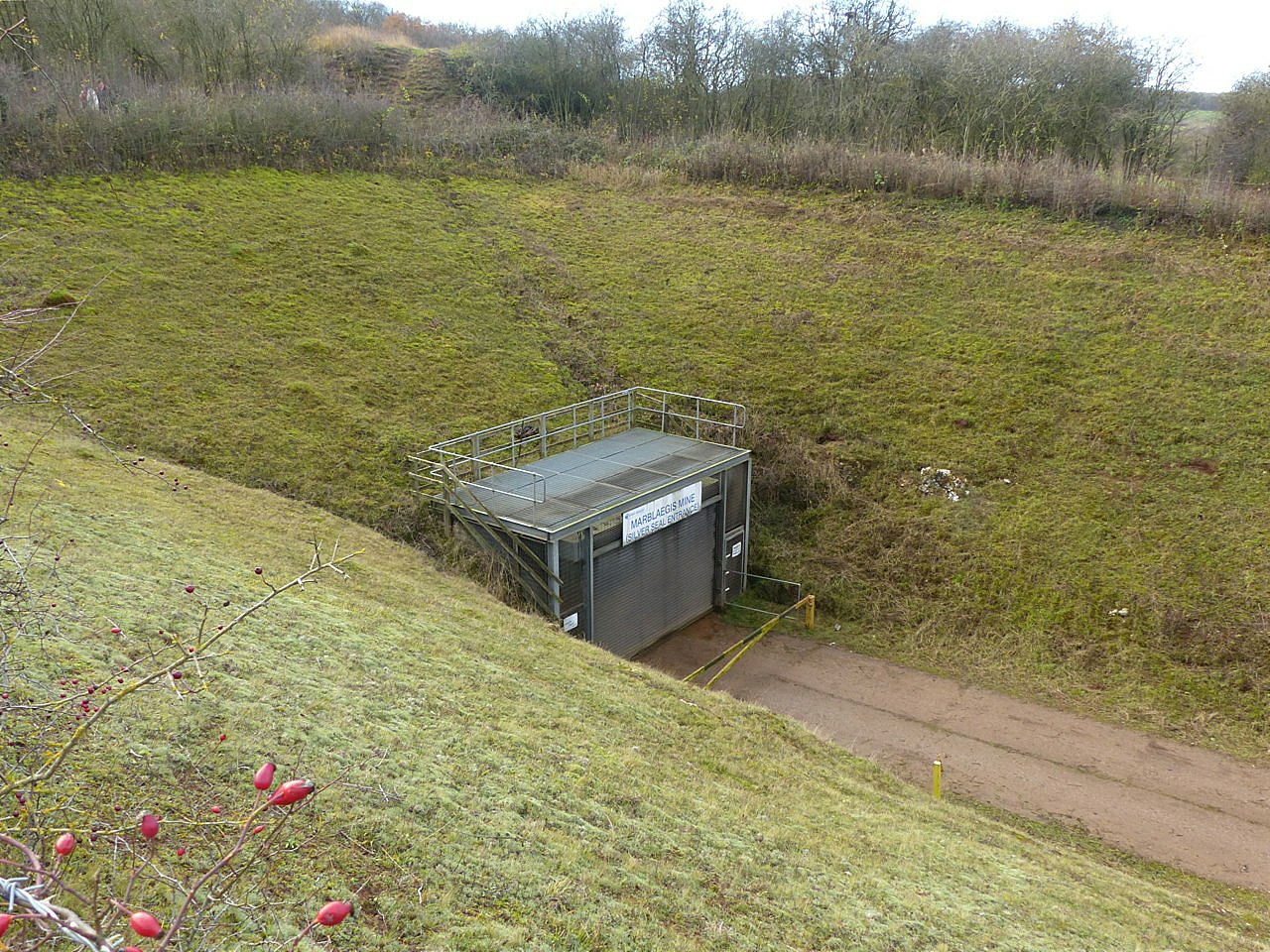
In production, the face advancing under farmland between Costock, Rempstone and East Leake. Glebe Mine, the northern part of the complex, is closed and exhausted. The cutting at the Silver Seal entrance has been tidied and sown as a wildflower meadow under a joint project between British Gypsum and the Nottinghamshire Wildlife Trust; that entrance stands within the Marblaegis Mine Bunny Local Wildlife Site, designated for its scrub grassland and short perennial vegetation, and Bunny Old Wood, which the trust owns, lies over part of the workings.
A working mine rather than a ruin. The drift and the mine offices stand in the gypsum works north of East Leake and the Silver Seal adit is gated, with its ventilation shaft beside it, at Bunny. The rest is farmland: the workings lie in the Nottingham-Derby Green Belt under a mix of arable and pasture.
Redevelopment
None; the mine is still worked.
Related mines
- Kilvington Quarry — The two were Nottinghamshire's only gypsum workings when the county's minerals plan was adopted in 2005 — Kilvington taking the Newark gypsum from the surface, Marblaegis the Tutbury seam underground — both British Gypsum's.
Nearby mines
- Longcliffe Quarry — 8.9 km S, Leicestershire
- Cotgrave Colliery — 11.9 km NE
- Trowell Moor Colliery — 12.8 km NW
- Mountsorrel Quarry — 13.2 km S, Leicestershire
- Wollaton Colliery — 14.0 km NW
Straight-line distance, within 15 km. Show on the map.
Recorded claims
Individual factual claims, each attached to the source(s) that support it below. Where sources disagree, both are kept.
- Worked by British Gypsum, feeding the plasterboard works at East Leake. 1,2
- The Silver Seal mine opened in 1938 and later met the Marblaegis workings, after which gypsum was no longer drawn out there. 2
- A shaft near Bunny, attached to the Silver Seal adit, ventilates the mine. 3
- Works the Tutbury gypsum, normally a single seam averaging three metres thick in the upper forty metres of the Mercia Mudstone. 4
- Worked by pillar and stall, a quarter of the mineral left in place as pillars to prevent subsidence. 4
- Installed capacity is more than 600,000 tonnes a year, of which about 250,000 tonnes are extracted. 1
- Twenty-six people are employed at the mine, with 264 staff and 125 contractors at the works it supplies. 1
- Permission to work has been extended by seventeen years, from the end of 2025 to 2042. 1
- The British Geological Survey holds a sketch plan of the mine's underground layout. 5
- Wholly owned and operated by British Gypsum Saint-Gobain, a subsidiary of Saint-Gobain Gyproc. 6
- The mine's locality point is at SK554278, 1.6 km north of East Leake, with Costock 2.4 km to the south-east and Gotham 3.2 km to the north-west. 6
- Gypsum is the one mineral recorded from the mine. 6
- The Marblaegis mine office stands on British Gypsum's East Leake site, which also holds the company's head office, technical centre and geological and mining department. 7
- Listed in the aggregates trade directory as British Gypsum Ltd at East Leake. 8
- The mine covers some 3,852 hectares, of which the active workings, including the Costock extension, extend to about 580 hectares. 9
- The first planning permission for the complex was granted in 1951, for gypsum extraction in the Glebe mines area, to the Marblaegis Company Limited. 9
- Nottinghamshire County Council's planning and licensing committee took the extension on 21 February 2017, moving the cessation date from 31 December 2025 to 22 February 2042. 1,9
- Proven reserves stood at about 13 million tonnes in 2017 — 6 million tonnes of mill rock north of Rempstone, 5 million south of it and 2 million to the east, with 4 million tonnes of cement rock besides — enough for some 26 years. 9
- The village of Rempstone is completely encircled by the mine, with no workings beneath the settlement itself, including the Grade II listed All Saints' Church and Clifton Lodge. 9
- Electric face cutting was introduced in 2006, alongside the drilling and blasting used before it. 9
- The mine is ventilated by a large electric fan inside the Silver Seal entrance, with airflow directed to keep naturally occurring radon in check. 9
- Older mines within the complex — Glebe, Barton, Sheppards, Winsers, Goodacres, Weldon and Thrumpton — cover a further 1,780 hectares. 9
Photographs & further reading
The county's account of the Newark and Tutbury gypsum deposits, how each is worked, and where Marblaegis sits in the trade.
View sourceThe second entrance near Bunny, with an account of its 1938 origin and its present role as emergency exit and equipment route.
View sourceThe mine's coordinates and grid reference, its ownership, and gypsum as the one mineral recorded from it.
View sourceThe fullest public account of Marblaegis: its extent, planning history from 1951, reserves, working method, ventilation, blasting and the conditions attached to working until 2042.
View sourceSources
- (secondary) Local government extends licence for gypsum mine near East Leake wallboard plant in UK — Global Gypsum
- (observational) Marblaegis Mine (Silver Seal entrance) (photograph, 2021) — Geograph Britain and Ireland
- (observational) Mine shaft near Bunny (photograph, 2021) — Geograph Britain and Ireland
- (secondary) Nottinghamshire Minerals Local Plan, chapter 10: Gypsum — Nottinghamshire County Council
- (primary) Sketch plan showing layout underground at Marblaegis gypsum mine, East Leake, Nottinghamshire (MP23674) — British Geological Survey
- (secondary) Marblaegis Mine, East Leake, Rushcliffe, Nottinghamshire, England, UK — Mindat (Hudson Institute of Mineralogy)
- (primary) British Gypsum visitor guide: East Leake (21 July 2023) — British Gypsum
- (secondary) Marblaegis Mine (directory entry, captured 23 January 2021) — Agg-Net
- (primary) Marblaegis Mine, Gotham Road, East Leake: report to Planning and Licensing Committee, 21 February 2017 (agenda item 5) — Nottinghamshire County Council
- (secondary) East Leake — Wikipedia
Record created: 23 September 2026 · Last researched: 24 September 2026