 MineArchive
Evaporite Deposits
| Category | Deposit Types |
|---|
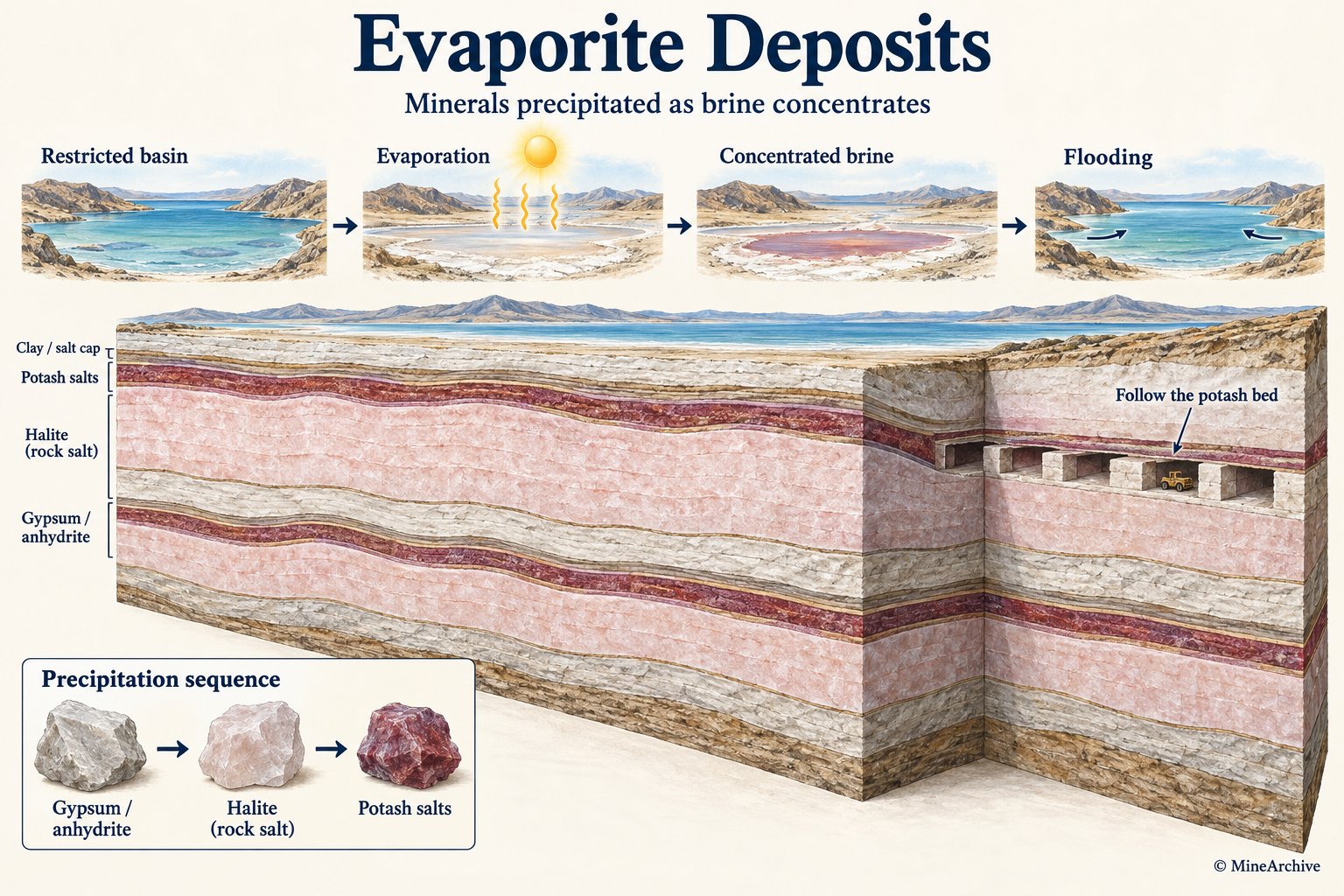
A layered sequence of different salt minerals left behind as an isolated body of seawater slowly evaporates — not a single deposit type but an ordered stack of several, each mineral precipitating out in a predictable sequence as the remaining brine becomes more concentrated, from common rock salt through to the rarer potash salts prized by the fertiliser industry.
How it forms
When a sea or lake becomes cut off, or nearly cut off, from open water in a hot, dry climate, evaporation removes water faster than it can be replenished, steadily concentrating the dissolved salts left behind. As concentration rises, different minerals reach their individual saturation points in a fixed order — the least soluble first, the most soluble last — so a single evaporating basin naturally deposits a layered sequence rather than one uniform mineral. Britain's most important evaporite sequence, worked today at Boulby, was laid down by the Zechstein Sea across what is now north-east England and the southern North Sea during the Late Permian, around 258-252 million years ago, through repeated cycles of the sea flooding in and evaporating down again over some 5-7 million years.
Why minerals concentrate here
This is a straightforwardly chemical, solubility-driven process: calcium sulphate (forming anhydrite or gypsum) is markedly less soluble than sodium chloride (halite, ordinary rock salt), which is in turn far less soluble than the potassium- and magnesium-bearing salts (sylvite, carnallite) that make up potash — so a concentrating brine deposits sulphates first, then halite, and only the rarer, most soluble potash minerals right at the very end, once the brine has been reduced to a small fraction of its original volume. This is why potash is comparatively rare and typically found as a thin bed within, or above, a much thicker body of ordinary rock salt, rather than the other way around.
Typical shape of the deposit
A stack of laterally extensive, gently layered beds — anhydrite, then a much thicker halite formation, then a thinner potash-bearing formation, sometimes capped by further salt-and-clay beds — following the shape and extent of the original evaporating basin. At Boulby the potash-bearing formation itself is only around 7 metres thick on average (varying roughly 1-20m), sitting above some 40 metres of halite, itself above a basal 4.5-6 metre anhydrite bed.
What this means for mining
Because potash occurs as a specific, comparatively thin bed within a much larger, layered evaporite sequence, working it means locating and following that one bed precisely rather than simply mining any convenient part of the wider salt body — potash extraction at Boulby happens roughly 1,200-1,500 metres underground, considerably deeper than the shallower rock-salt-only working practised at sites like Winsford. Extraction generally follows the same broad, systematic room-and-pillar logic as any other bedded deposit, but seam selection is unusually precise, since the wrong horizon yields ordinary salt rather than the far more valuable potash.
Associated commodities
Gypsum (Among the least soluble evaporite minerals, precipitating earliest in the sequence.), Potash (The rarest, most soluble minerals in the sequence, precipitating last as the brine reaches maximum concentration.), Salt (Halite is the dominant, thickest member of a typical evaporite sequence.)
Related geology
Related Mining Terms & Methods
Room and Pillar (Bedded evaporite extraction generally follows the same broad, systematic room-and-pillar logic as other bedded deposits.)
Diagrams
Images
MineArchive examples
Included only where MineArchive's own research gives a reasonable evidential basis — not every mine where this geology might plausibly apply. Showing the 10 strongest examples of 20 linked mines.
- Fauld — Staffordshire (well documented example)
The record describes bedded gypsum and its fine form alabaster worked from the Needwood escarpment — an evaporite deposit, the type this record describes. - Long Meg Mine — Cumbria (well documented example)
Gypsum and anhydrite in the Permo-Triassic beds of the Eden valley — a textbook evaporite sequence, and the reason the mine could change from one mineral to the other without changing ground, as this record's geology explains. - Marston Old Mine — Cheshire (well documented example)
Worked two nearly horizontal beds of rock salt, the upper first and from 1781 the purer lower bed. - Billingham Anhydrite Mine — Stockton-on-Tees (well documented example)
A Permian Zechstein anhydrite bed — calcium sulphate without its water — worked not as a mineral to sell but as a feedstock to be roasted into sulphuric acid. - Boulby Mine — North Yorkshire (well documented example)
The mine's own recorded geology explicitly describes working evaporite seams — potash, rock salt and polyhalite — left by the Zechstein Sea. - Brightling and Mountfield Gypsum Mines — East Sussex (well documented example)
The Purbeck sulphate seams are textbook evaporites — sabkha salt flats formed by evaporation in a hypersaline coastal setting, and still worked as such. - Chellaston Alabaster Mines — Derbyshire (well documented example)
The mine's own recorded geology explicitly describes the Tutbury Gypsum bed as an evaporite deposit where ancient seawater dried out. - Cocklakes Mine — Cumbria (well documented example)
Gypsum and anhydrite in the Permo-Triassic evaporites of the Eden valley, quarried while shallow and mined as the seams deepened — the depth-controlled relationship between the two minerals this record's geology sets out. - Droitwich Salt Wells — Worcestershire (well documented example)
Triassic evaporite brine, part of the same broad salt-basin sequence worked as rock salt elsewhere in the Cheshire and Worcestershire basins, but here rising to the surface under its own artesian pressure rather than needing to be mined. - Kilroot Salt Mine — County Antrim (well documented example)
Kilroot works a Triassic rock-salt bed laid down as an evaporite sequence beneath what is now Belfast Lough.
See all 20 linked mines.
Sources
- (secondary) 7.1: Evaporites — Geosciences LibreTexts
- (secondary) Zechstein evaporite deposits - Woodsmith, Boulby — PorterGeo Database
Record created: 22 August 2026 · Last researched: 22 August 2026