 MineArchive
Boulby Mine
| Location | Boulby, North Yorkshire — 54.5534, -0.8245 (exact) |
|---|---|
| Commodities | Potash, Polyhalite, Salt |
| Type | Mineral |
| Worked | 1970s–Still active |
| Maximum depth | 1,400 m (4,600 ft); polyhalite ore horizon 1.2-1.5 km deep |
| Operators | Imperial Chemical Industries (1969–1990), Cleveland Potash Ltd (1990–?) |
Overview
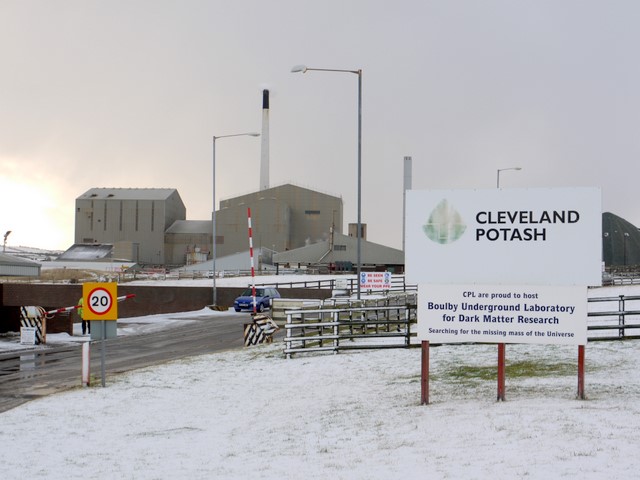
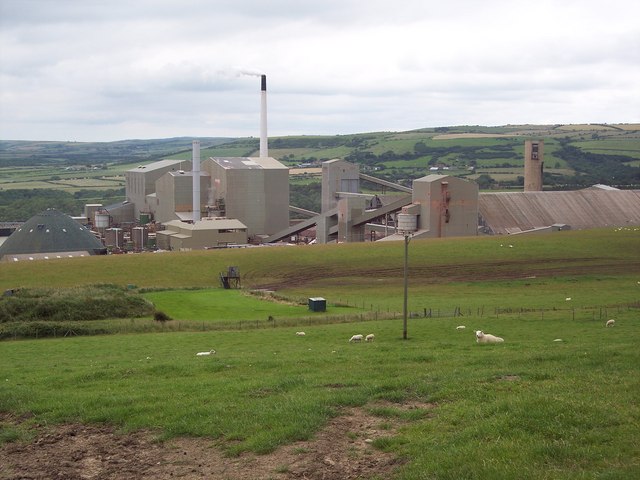
Boulby Mine, on the North Yorkshire coast, is the deepest mine in Great Britain at 1.1 km down, and the only mine on this site still fully operational today. Sunk by ICI from 1969 to work potash for fertiliser, it now also produces rock salt and polyhalite, and its extreme depth and isolation from cosmic radiation have made part of the mine a working physics laboratory searching for dark matter.
History
ICI began sinking Boulby's two shafts in 1969, reaching first potash production in 1973 and full production by 1976, extracting potash from seams left behind when the ancient Zechstein Sea evaporated some 250 million years ago. ICI operated the mine as Cleveland Potash Ltd, initially in a joint venture with Anglo American, before selling its stake to Anglo American; in 2002 the business passed to ICL Fertilizers (a division of Israel Chemicals Ltd), which still operates it today, latterly also as the world's only polyhalite mine, extracting a multi-nutrient fertiliser mineral alongside its original potash. The mine has also hosted the Boulby Underground Laboratory since the 1990s, using the depth and rock cover to shield sensitive dark-matter detection experiments from cosmic rays.
Geology
The mine works evaporite seams — potash, rock salt and polyhalite — left by the Zechstein Sea around 250 million years ago, reached via twin shafts sunk to around 1.1 km.
Geological setting: Evaporite Deposits (well documented example)
Workings
Two shafts, sunk from 1969, reach an ore horizon between 1.2 and 1.5 km down with seams averaging around 7 metres thick; hundreds of miles of roadways extend outward and further down from the shaft bottoms, including workings that run out beneath the North Sea. The mine's roadways total around 1,000 km and run out beneath the North Sea. The descent in the man-riding shaft takes about seven minutes, and underground temperatures reach around 40 degrees C.
Closure
Unknown.
What remains
Boulby remains a fully working mine today, producing potash, rock salt and polyhalite for ICL UK, and continues to host the Boulby Underground Laboratory dark-matter physics facility.
Related mines
- Woodsmith Mine — Both work the same North Yorkshire polyhalite deposit: Boulby is the only mine producing polyhalite from it today, and Woodsmith is being sunk on the same bed a few miles to the south-east.
Nearby mines
- Grinkle Mine — 0.3 miles (0.5 km) S
- Boulby Alum Quarries — 0.9 miles (1.5 km) NW
- Port Mulgrave Mine — 2.7 miles (4.3 km) E
- Loftus Mine — 3.1 miles (5.0 km) W
- Carlin How Mine — 3.2 miles (5.2 km) W
Straight-line distance, within 9 miles (15 km). Show on the map.
Disasters & major incidents
-
Boulby Mine underground fire, 2016
13 April 2016 · Fire · 0 fatalities
A fire involving polystyrene blocks broke out 1,100m below the sea bed and around 8km from land at Boulby potash mine in the early hours of 13 April 2016; eleven workers were found by the mine rescue team, seven of them treated in hospital for smoke inhalation and shock before being discharged the same day. No deaths. -
Boulby Mine gas blowout, 2016
17 June 2016 · Other · 1 fatality
Miner John Anderson, 56, was killed at Boulby Mine on 17 June 2016 by a sudden, powerful release of trapped gas — a 'gas blowout' around 15 metres across that displaced an estimated 1,000 tonnes of mineral, described by one expert witness as the biggest such blowout he had ever seen. It followed a separate fire at the mine only two months earlier that had injured seven workers.
Recorded claims
Individual factual claims, each attached to the source(s) that support it below. Where sources disagree, both are kept.
- Boulby is Britain's deepest mine, reaching around 1.1 km below the surface, with an ore horizon between 1.2 and 1.5 km down. 1
- ICI sank the mine from 1969, operating it as Cleveland Potash Ltd; ownership passed to Anglo American and then, in 2002, to ICL Fertilizers, which still runs it today. 1,2
- Boulby is described by its operator as the world's only polyhalite mine, extracting the multi-nutrient fertiliser mineral alongside its original potash. 2
- The mine's depth and rock cover shield the Boulby Underground Laboratory, a working dark-matter physics facility, from cosmic radiation. 1
- Boulby reaches about 1,400 m (4,600 ft), making it the deepest mine in the United Kingdom and the second deepest of any kind in Europe; the underground physics laboratory sits higher, at about 1,100 m. 1,3
- Located at about 54.553 N, 0.825 W. 1
Photographs & further reading
The fullest general account of the mine, covering the shafts, the polyhalite workings, the underground physics laboratory and the recorded accidents.
View sourceSources
- (secondary) Boulby Mine — Wikipedia
- (secondary) History - The World's Only Polyhalite Mine — ICL Boulby
- (observational) The world's only Polyhalite Mine, at Boulby: aerial 2018 — Geograph Britain and Ireland
- (primary) BGS mine plans catalogue: Boulby — British Geological Survey
- (secondary) Boulby potash mine workers injured in fire below sea bed — BBC News
- (secondary) Boulby potash miner John Anderson killed in 'gas blowout' — BBC News
- (secondary) Cleveland Potash fined £3.6m after contractors seriously burned in electrical explosions at Boulby mine — Teesside Live (Gazette)
- (secondary) Officials claim Boulby mine victim John Anderson 'was not following safety guidelines' - inquest — Teesside Live (Gazette)
Record created: 20 August 2026 · Last researched: 9 September 2026