 MineArchive
Boulby Mine gas blowout, 2016
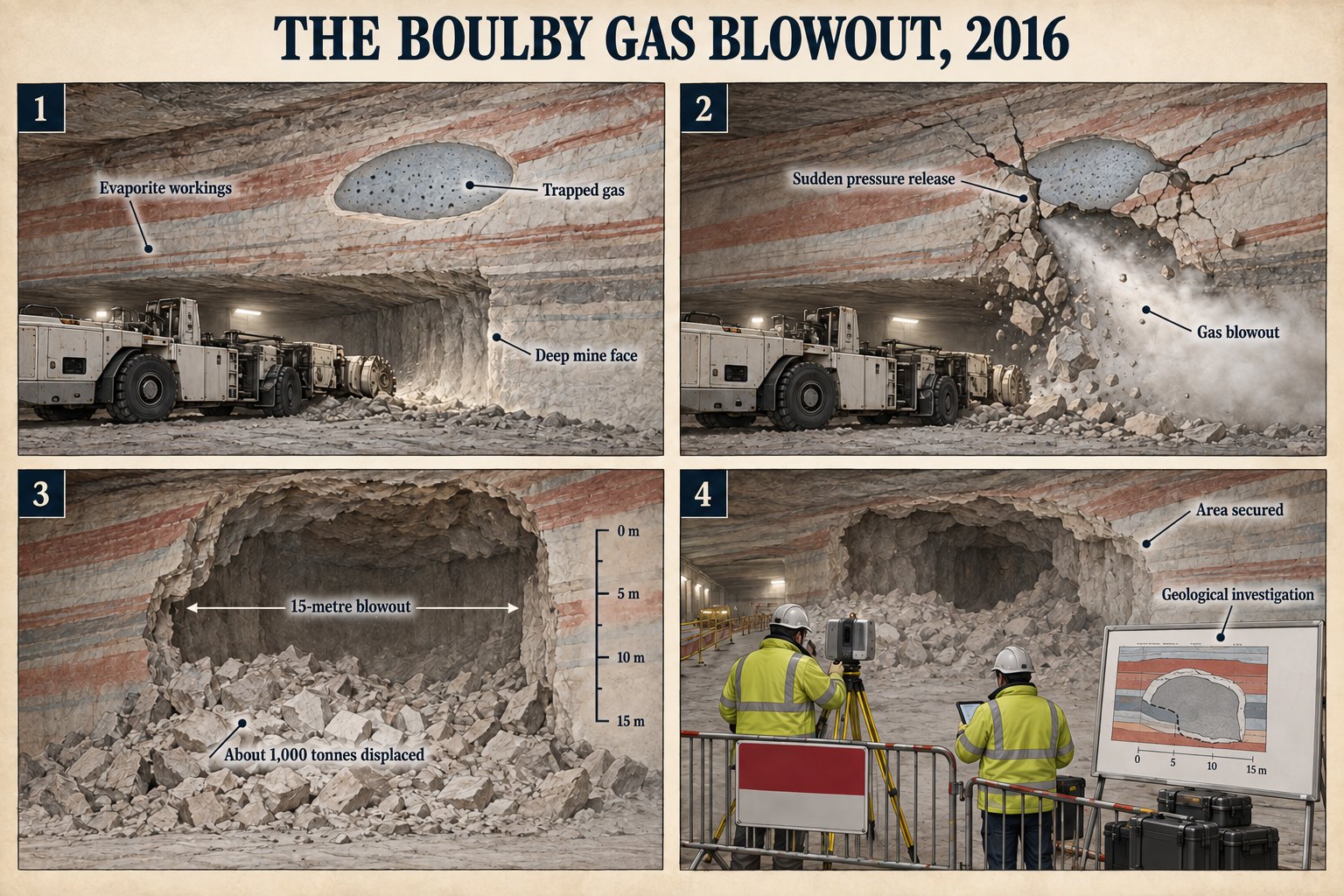
Miner John Anderson, 56, was killed at Boulby Mine on 17 June 2016 by a sudden, powerful release of trapped gas — a 'gas blowout' around 15 metres across that displaced an estimated 1,000 tonnes of mineral, described by one expert witness as the biggest such blowout he had ever seen. It followed a separate fire at the mine only two months earlier that had injured seven workers.
| Date | 17 June 2016 |
|---|---|
| Mine | Boulby Mine |
| Region | North Yorkshire |
| Primary type | Other |
| Associated types | Gas / Asphyxiation |
| Fatalities | 1 (John Anderson, 56, of Easington, was killed instantly by the force of the blowout.) |
| Injuries | None from this incident; a separate fire at the mine on 13 April 2016 had injured seven workers with smoke inhalation. |
| Context | During active mining |
Cause
A sudden, powerful release of gas trapped within the rock — a geological hazard specific to deep evaporite mining — displaced around 1,000 tonnes of mineral in a blowout roughly 15 metres across.
Contributing factors
An inquest later heard evidence, disputed by the family, that Anderson had not been following safety guidelines at the time, and that had he done so it was considered unlikely he would have been killed.
What happened
On the morning of 17 June 2016, a gas blowout occurred in the workings at Boulby Mine, killing John Anderson. An expert witness at the subsequent inquest described it as the biggest blowout of its kind he had ever encountered.
Investigation & inquiry
Teesside Coroner's Court held an inquest into Anderson's death; the jury returned a verdict of misadventure. No fine was imposed in connection with this specific incident.
Legal & regulatory aftermath
The blowout came only two months after a separate underground fire at Boulby, on 13 April 2016, had sent seven workers to hospital with smoke inhalation, and the Health and Safety Executive issued improvement notices after that fire. The mine's safety record faced further scrutiny afterwards: in 2022, mine operator Cleveland Potash was fined £3.6 million after separate electrical incidents in August 2016 and February 2019 left two contract electricians with severe burns, one placed in an induced coma. Taken together, the period from 2016 marks the most scrutinised run of safety incidents in the mine's history.
Recorded claims
Individual factual claims, each attached to the source(s) that support it below. Where sources disagree, both are kept.
- A gas blowout roughly 15 metres across, displacing an estimated 1,000 tonnes of mineral, killed miner John Anderson on 17 June 2016 — described by an expert witness as the biggest such blowout he had ever seen. 1
- An inquest at Teesside Coroner's Court returned a verdict of misadventure; officials giving evidence said Anderson had not been following safety guidelines and was unlikely to have been killed had he done so, which the family disputed. 2
- The blowout followed a separate fire at the mine on 13 April 2016 that injured seven workers with smoke inhalation, and preceded a 2022 £3.6 million fine over two later (2016 and 2019) electrical incidents that left two contractors severely burned. 3,4
Related terminology
Mining terms this disaster is structurally linked to, with the nature of the relationship.
- Potash (direct cause)
The 2016 blowout was caused by pressurised gas breaking out of the evaporite beds during mining, the same hazard mechanism this term describes.
Sources
- (secondary) Boulby potash miner John Anderson killed in 'gas blowout' — BBC News
- (secondary) Officials claim Boulby mine victim John Anderson 'was not following safety guidelines' - inquest — Teesside Live (Gazette)
- (secondary) Boulby potash mine workers injured in fire below sea bed — BBC News
- (secondary) Cleveland Potash fined £3.6m after contractors seriously burned in electrical explosions at Boulby mine — Teesside Live (Gazette)
Record created: 20 August 2026 · Last researched: 20 August 2026