 MineArchive
Potash
| Category | Commodities |
|---|---|
| Commodity page | Potash → |
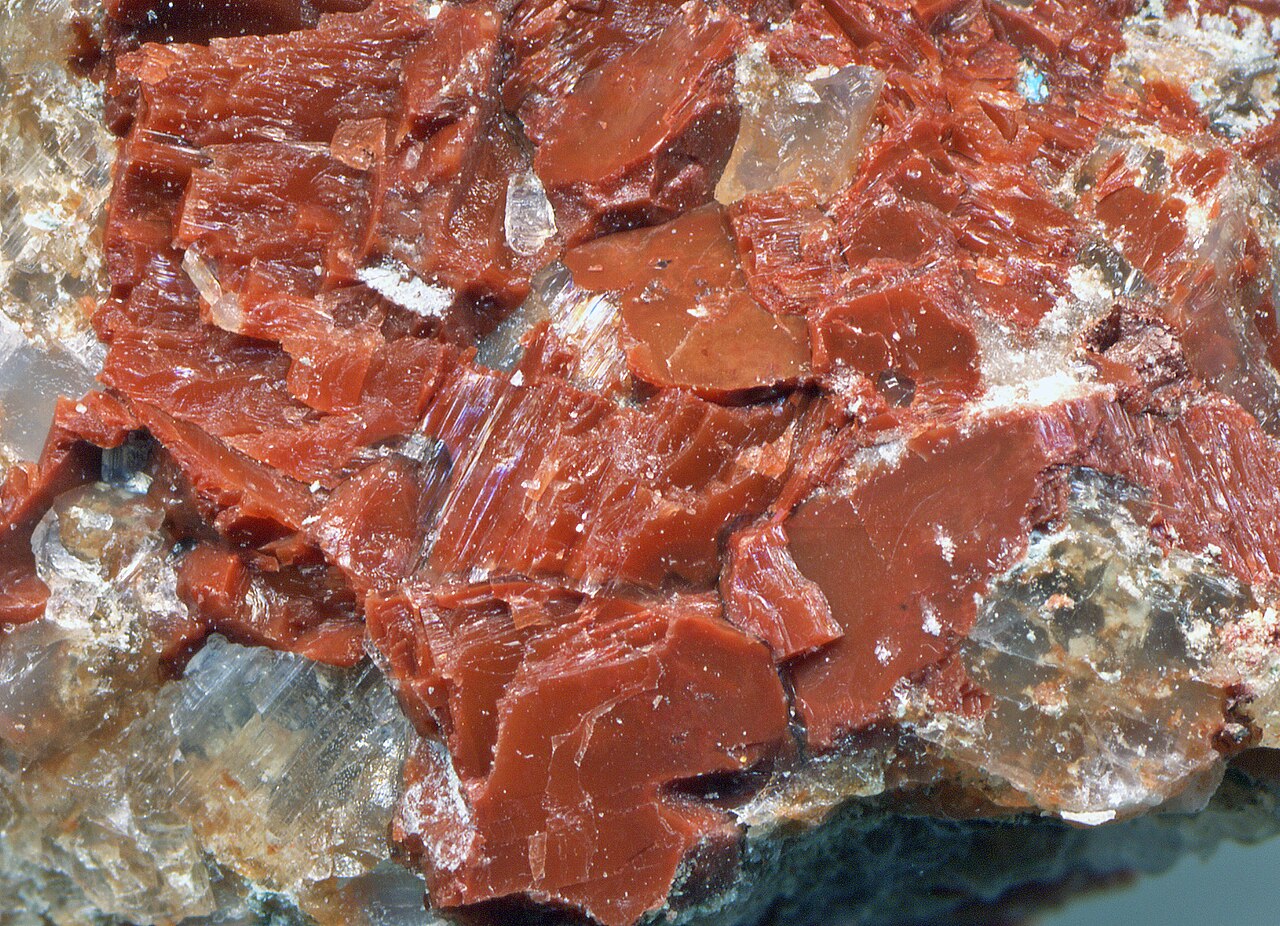
Potash is a group of potassium-bearing evaporite salts, mined chiefly as sylvite (potassium chloride) and used almost entirely as agricultural fertiliser.
Historical usage
The name comes from the old method of making potassium carbonate by leaching wood ash in pots, but the modern industry is built on mined mineral potash rather than ash. In Britain, potash is worked from a deep evaporite sequence beneath the North York Moors, developed at Boulby from the 1970s and still the country's only working potash mine.
How it worked
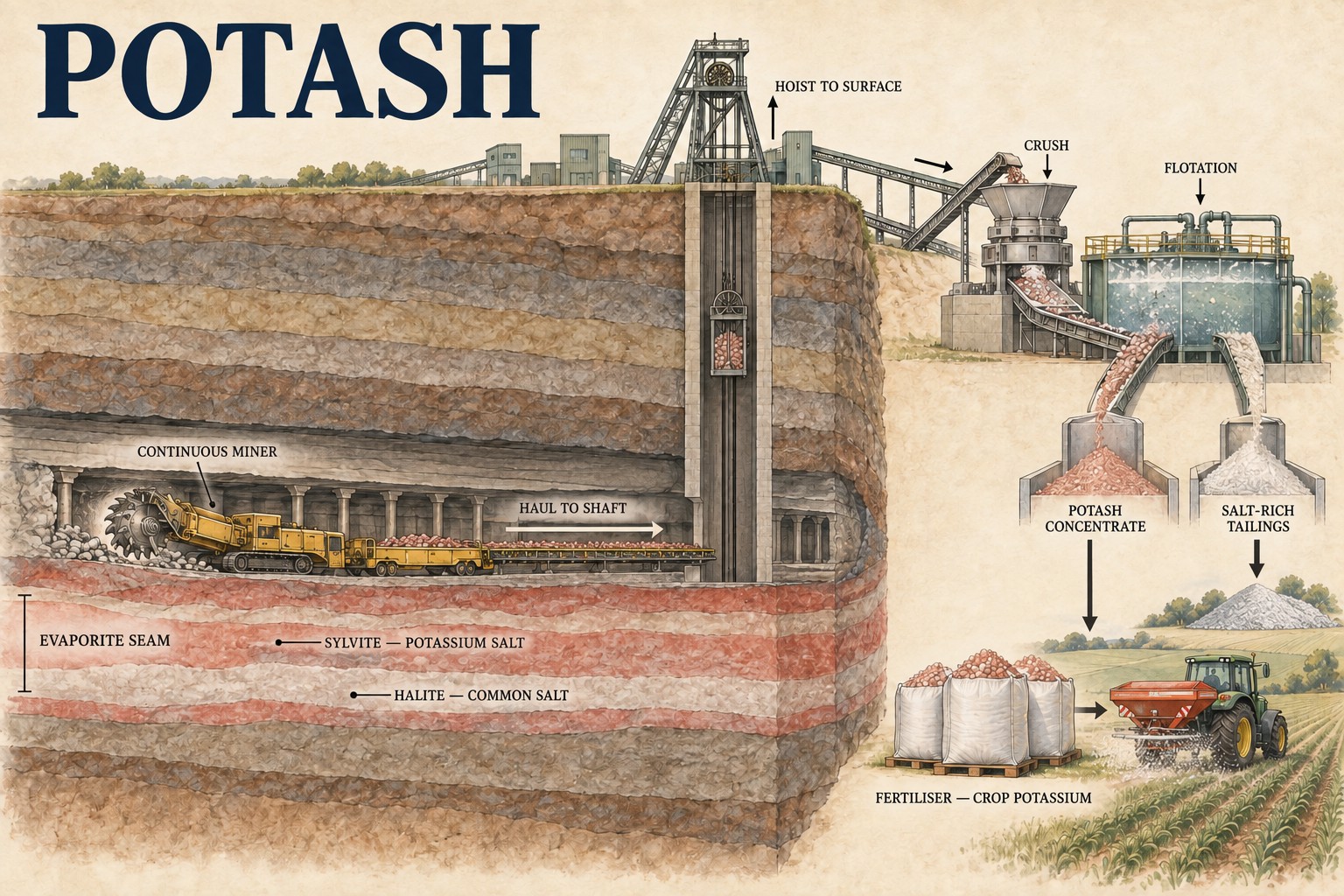
Potash is mined conventionally, by continuous mining machines or drill-and-blast cutting the ore from the seam at depth, then hoisted to the surface and processed — mainly by flotation — to separate the valuable potassium salt from the halite (common salt) it is typically found mixed with.
Why it was used
Almost all mined potash is used as fertiliser, since potassium is one of the three primary nutrients (with nitrogen and phosphorus) that crops need in bulk; a smaller share goes to industrial and chemical uses.
Value over time
Potash demand, and price, track global fertiliser demand closely. Years of under-investment through the 1990s left the market unable to keep pace with rapidly growing Asian demand in the 2000s, and prices climbed from under $200 a tonne in early 2008 to a peak of around $875-1,000 a tonne within a year — before collapsing back to around $350 as the global recession hit farm incomes. New Canadian production capacity then kept prices low through the 2010s, down to around $200 a tonne by 2016-17, before COVID-era supply-chain disruption and sanctions on Russian and Belarusian producers — together the world's second and third largest suppliers — drove another sharp spike to close to $600 a tonne in the early 2020s.
Hazards & challenges
Potash itself is not a significant toxicity hazard to miners, but the evaporite sequences it is found in commonly trap pockets of pressurised gas — principally methane, alongside other flammable and inert gases — in the surrounding shaly beds; disturbing these during cutting or blasting can trigger a sudden, high-pressure gas-and-salt blowout, one of the industry's most serious hazards, and blasting at Boulby is deliberately carried out only with the workforce withdrawn to the surface as a result. Boulby also works at considerable depth (1,200-1,500m), where rock temperature and pressure are themselves a physically demanding working environment.
Risks & limitations
Potash is a bulky, low-value bulk commodity whose economics depend heavily on scale and transport cost, and the market is dominated by a handful of very large producing countries (Canada, Russia and Belarus above all), which makes price highly sensitive to those countries' output decisions, trade sanctions and infrastructure.
Related terminology
Mines associated with this term
Included only where MineArchive's own research gives a reasonable evidential basis — not every mine where this might plausibly apply.
- Boulby Mine — North Yorkshire (well documented example)
Boulby is Britain's only working potash mine.
See every mine that worked potash →
Disasters associated with this term
Included only where MineArchive's own research gives a reasonable evidential basis, with the nature of the relationship stated — not every disaster where this term might plausibly apply.
- Boulby Mine gas blowout, 2016 (direct cause)
The 2016 blowout was caused by pressurised gas breaking out of the evaporite beds during mining, the same hazard mechanism this term describes. - Boulby Mine underground fire, 2016 (contextual relationship)
Named in this record’s summary: “…out 1,100m below the sea bed and around 8km from land at Boulby potash mine in the early hours of 13 April 2016; eleven workers were found…”
Sources
- (primary) Modeling and Mitigating Gas Hazards during Potash Mine Closure — Mining (MDPI journal)
- (secondary) Boulby Potash Mine — Mining Technology
- (secondary) Potash economics — SaltWork Consultants
Record created: 20 August 2026 · Last researched: 20 August 2026