 MineArchive
Polyhalite
| Category | Commodities |
|---|---|
| Commodity page | Polyhalite → |
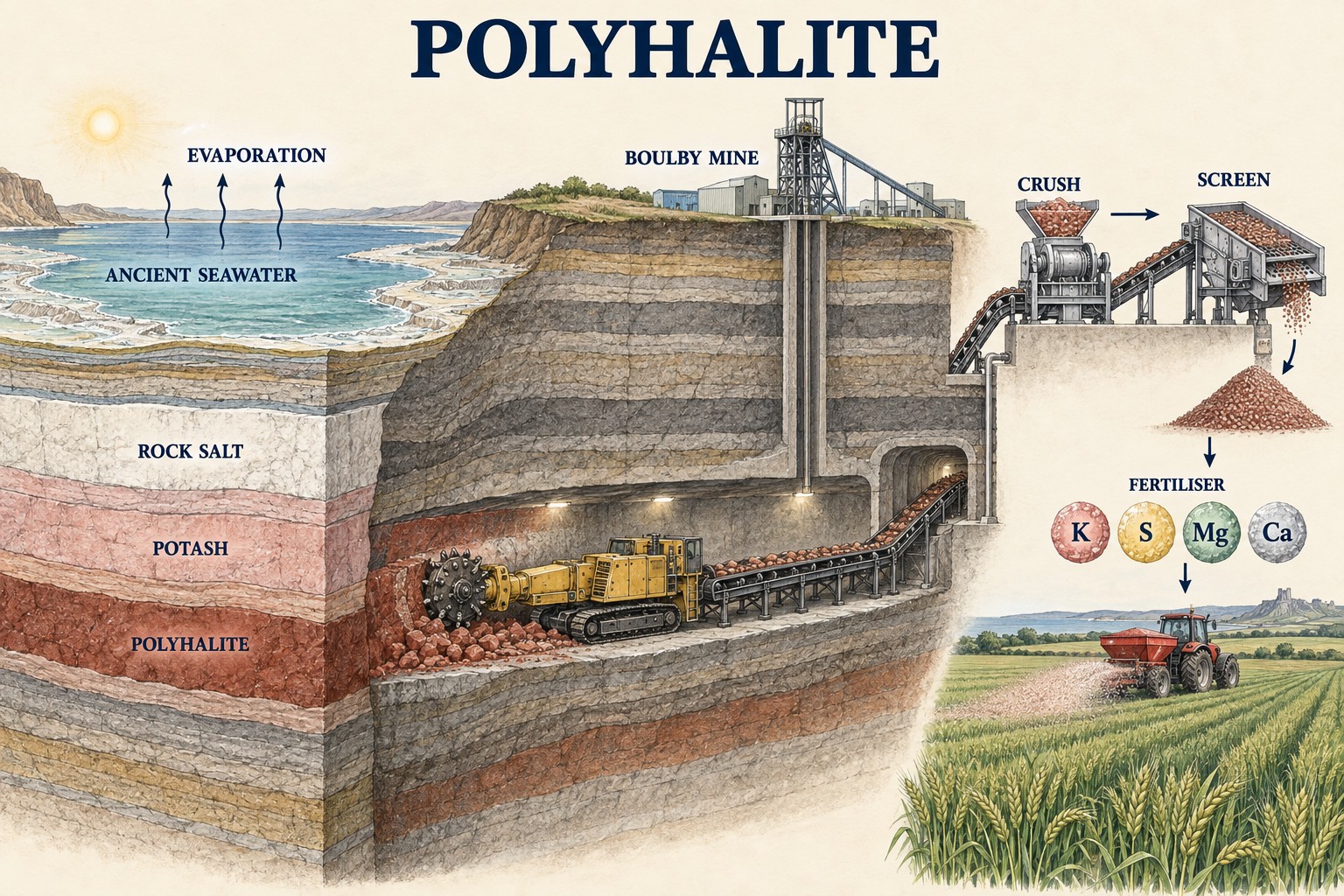
An evaporite mineral, a hydrated sulfate of potassium, calcium and magnesium (K₂Ca₂Mg(SO₄)₄·2H₂O), crystallised from ancient seawater as it evaporated, and mined today for use directly as a multi-nutrient fertiliser.
Historical usage
First described in 1818 from a deposit near Salzburg, Austria. The mineral was of little commercial interest for over a century; only in the 21st century, as Boulby Mine's owners recognised a use for it as an unrefined fertiliser, did it become an actively mined commodity in its own right rather than an incidental byproduct of potash working.
How it worked
Polyhalite is mined and simply crushed and screened to size — unlike potash, it needs no chemical processing before sale, since its mix of potassium, sulphur, magnesium and calcium is already in a form plants can use directly. At Boulby Mine it is worked alongside potash and rock salt from the same evaporite sequence; at the proposed Woodsmith Mine, ore would be carried underground via pipeline as a mineral slurry rather than hoisted and processed on the surface.
Why it was used
Its value lies in delivering four of the six major nutrients plants need — potassium, sulphur, magnesium and calcium — in a single, slow-release, unprocessed mineral, avoiding the energy-intensive refining potash and other fertiliser minerals typically require.
Value over time
Polyhalite had essentially no commercial value for most of the two centuries after its 1818 discovery — it was treated as a nuisance mineral found alongside more valuable potash and salt seams, not a resource in its own right. That changed only in the early 21st century, when Boulby Mine's operators recognised its potential as an unrefined, multi-nutrient fertiliser and began marketing it — first as Polysulphate, later also as POLY4 by Anglo American at the (still unbuilt, as of 2026) Woodsmith Mine — the deposit under North Yorkshire being the only one in the world currently worked for this purpose. Its value proposition rests on being usable straight from the ground, without the energy-intensive chemical processing that potash and most other mineral fertilisers require, and on supplying four major plant nutrients — potassium, sulphur, magnesium and calcium — in one slow-release mineral rather than several separate products.
Hazards & challenges
Polyhalite itself presents no special hazard distinct from other evaporite minerals worked at similar depths — the hazards at a mine like Boulby come from the general risks of deep, hot, salt-and-potash mining (heat stress at depth, the corrosive nature of some brines, and the same roof-fall and gas risks as any deep underground working) rather than from polyhalite's own chemistry, which is comparatively inert and non-toxic.
Risks & limitations
The mineral itself carries no special extraction risk beyond ordinary evaporite mining (see Extraction hazards) — the greater commercial risk has been market-related: polyhalite had no established fertiliser market before the 21st century, so its economic viability depends on building demand for a genuinely new product rather than an established one like potash.
Related terminology
Mines associated with this term
Included only where MineArchive's own research gives a reasonable evidential basis — not every mine where this might plausibly apply.
- Boulby Mine — North Yorkshire (well documented example)
Boulby Mine's own summary and history describe it as "the world's only polyhalite mine", extracting the mineral alongside its original potash and rock salt. - Woodsmith Mine — North Yorkshire (well documented example)
Named 3 times in this record, first in the summary: “…is being developed to work the world's largest known deposit of polyhalite through what will be the deepest shafts in Europe -- a project first…”
See every mine that worked polyhalite →
Sources
- (secondary) Polyhalite — Wikipedia — Wikipedia
- (secondary) The formation of polyhalite: a 250-million-year-old story — Anglo American
Record created: 2 September 2026 · Last researched: 2 September 2026