 MineArchive
Salt
| Category | Commodities |
|---|---|
| Commodity page | Salt → |
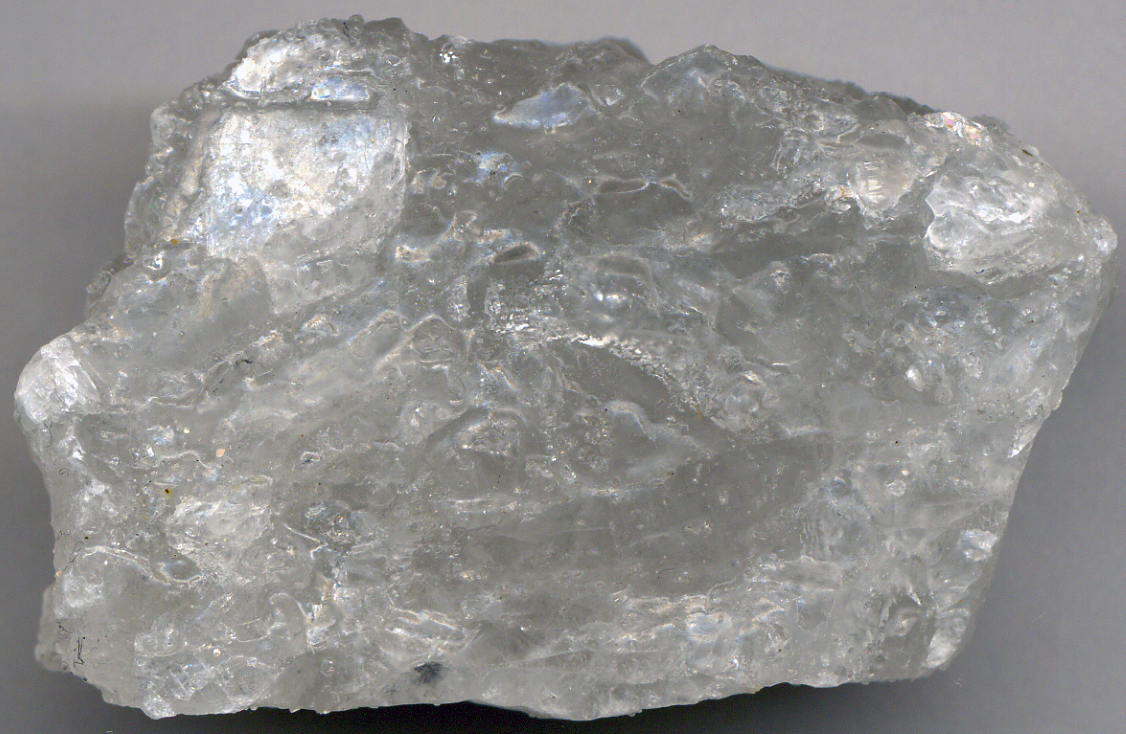
Salt is the mineral halite (sodium chloride), worked in Britain either by dry rock-salt mining or by pumping and evaporating brine, and used for winter road de-icing, food and chemical manufacture.
Historical usage
Salt has been made in Cheshire since Roman times, and the county's brine springs and later rock-salt deposits made it Britain's dominant salt-producing region for centuries; medieval Middlewich already treated salt as its principal taxable resource, shared between the Earl of Chester and the Crown. The 19th century saw the industry industrialise at scale under entrepreneurs such as John Corbett — self-styled the 'Salt King' — whose works were producing well over 100,000 tons a year by the 1870s.
How it worked
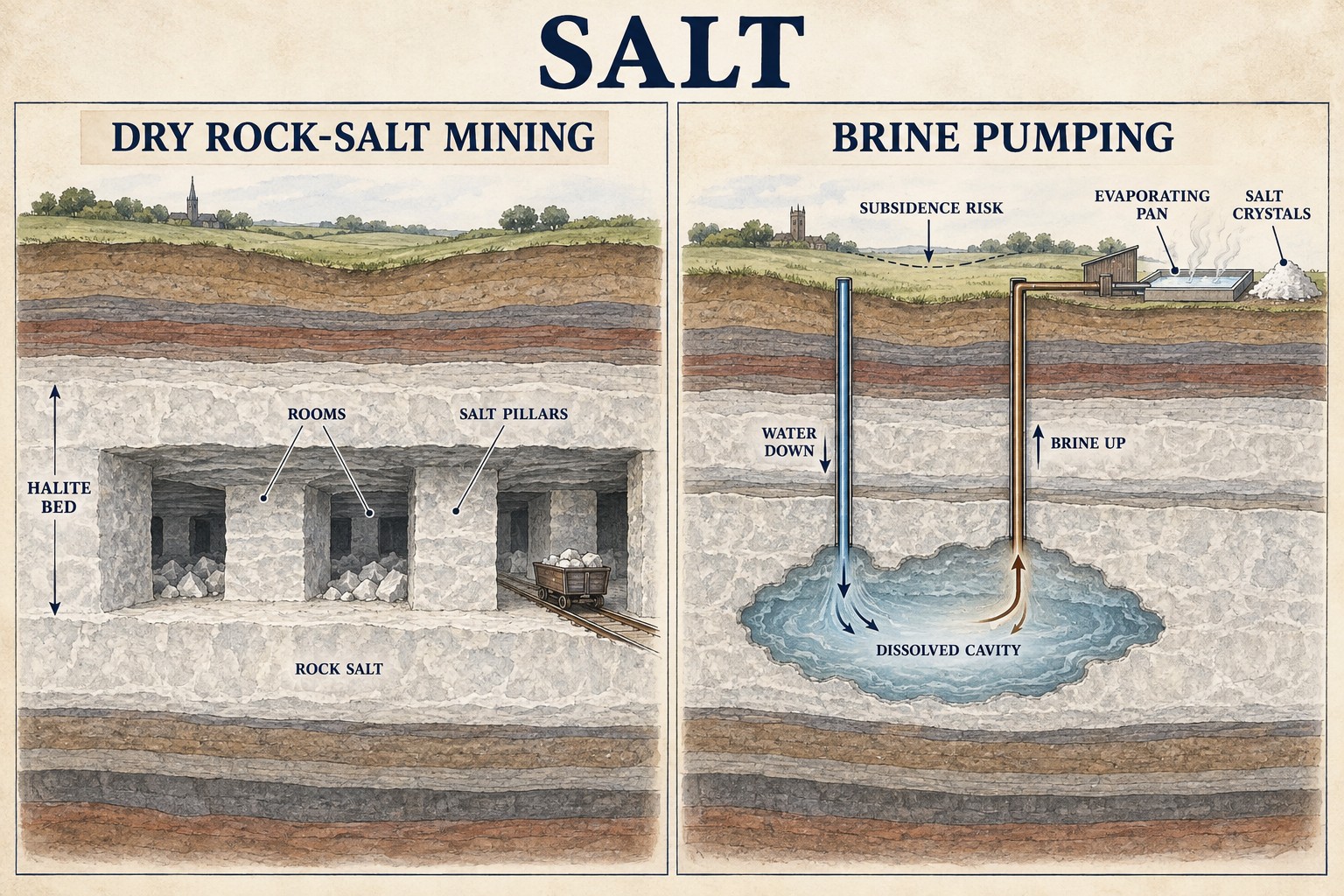
Two quite different methods have been used side by side in Cheshire: dry mining of solid rock salt beds by room-and-pillar working (as still practised at Winsford), and 'wild brining' — pumping naturally or artificially dissolved brine from underground and evaporating it in open pans on the surface. The second method proved far more damaging: uncontrolled brine pumping removed support from beneath the ground with no way of knowing how much salt had actually been dissolved away.
Why it was used
Salt's overriding modern use in Britain is de-icing winter roads, alongside long-standing roles in food preservation and seasoning and as a basic feedstock for the chemical industry (chlorine and sodium hydroxide manufacture).
Value over time
Salt was valuable and heavily taxed for most of its history — English salt taxes were not abolished until 1825 — but it has become a cheap, high-volume bulk commodity in the modern era; today's UK market is shaped less by scarcity than by seasonal demand for winter road grit, which can swing sharply with how severe a given winter turns out to be.
Hazards & challenges
Solid rock-salt mining itself carries no special chemical hazard to miners, but uncontrolled brine pumping proved disastrous to the surface above it: reckless 'wild brining' around Northwich caused severe, unpredictable ground subsidence through the second half of the 19th century, destroying buildings and culminating in the so-called Great Subsidence of 1880, which led directly to the Brine Subsidence Compensation Act 1891 and the creation of a dedicated compensation board that still exists today.
Risks & limitations
Rock salt is bulky and low-value per tonne, so British production has always depended on efficient bulk transport to market; demand for winter road salt is also inherently weather-dependent, making revenue less predictable than for most other mined commodities.
Related terminology
Mines associated with this term
5 examples chosen from 14 linked records — the term page is not an index.
- Marston Old Mine — Cheshire (well documented example)
Named 19 times in this record, first in the summary: “…1781 the first in the Northwich field to work the lower bed of rock salt. It was the celebrated show mine of the Cheshire salt district, lit…” - Adelaide Mine — Cheshire (well documented example)
Named 9 times in this record, first in the summary: “…rock-salt mine at Marston, near Northwich, worked from 1850 by the salt firm Joseph Verdin and Sons and known locally for the underground…” - Boulby Mine — North Yorkshire (well documented example)
Boulby works rock salt alongside potash. - Droitwich Salt Wells — Worcestershire (well documented example)
Salt has been made at Droitwich since at least the Bronze Age, on an industrial scale from around 300 BC, with brine collected in large storage pits. - Kilroot Salt Mine — County Antrim (well documented example)
The only rock salt mine on the island of Ireland, working a Triassic evaporite bed under Belfast Lough for about half a million tonnes of de-icing salt a year.
See every mine that worked salt →
Sources
- (secondary) Cheshire Brine and salt extraction: a history — Groundsure
- (secondary) Rock Salt Mining — Cheshire Brine Subsidence Compensation Board
Record created: 20 August 2026 · Last researched: 20 August 2026