 MineArchive
Subsidence
| Category | Ground Conditions & Hazards |
|---|
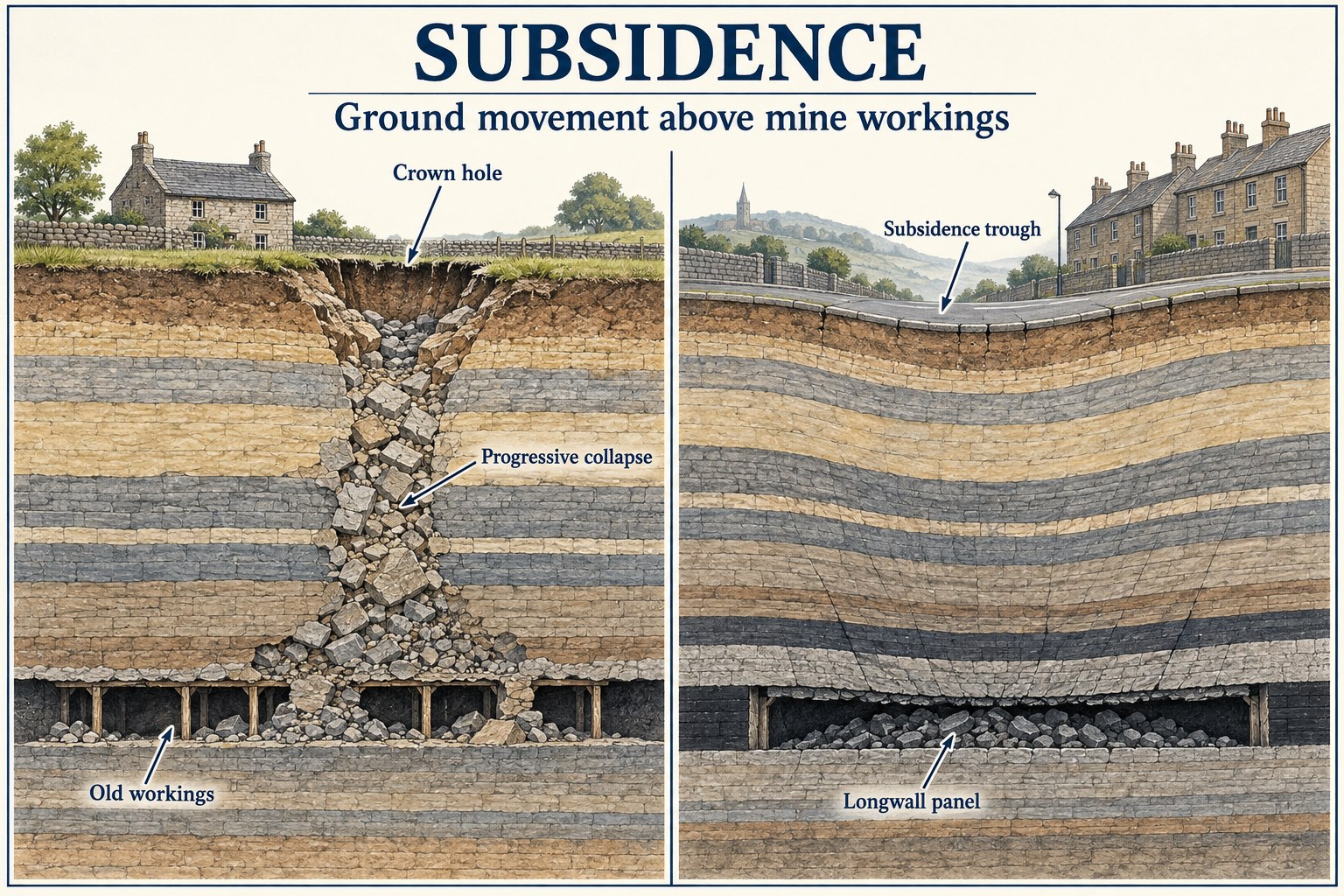
The sinking, cracking or sudden collapse of the ground surface caused by the failure or movement of underground workings beneath it — ranging from a slow, shallow sag spread across a wide area to a sudden, narrow 'crown hole' opening without warning.
Historical usage
A recognised hazard wherever shallow underground workings lay beneath land still in use — farmland, roads, railways, and, in later 20th-century Britain, whole streets of housing above old coalfields. Concern over unrecorded or poorly mapped historic workings has remained a live planning issue long after the mines themselves closed, since a void driven and abandoned a century or more ago can still collapse to the surface without warning.
How it worked
Where pillars or unsupported roof spans are left to carry the weight of the ground above indefinitely, they can weaken, crack or crush over time, especially once water reaches the void; the roof then fails and the collapse works its way upward through the overlying rock and soil until it finally reaches the surface — either as a sudden, steep-sided 'crown hole' directly above old shallow workings and roadway junctions, or as a broader, gradual subsidence trough where a wide area has been worked out, as beneath a longwall coal panel.
Risks & limitations
Because subsidence can lag mine abandonment by decades, it remains a genuine hazard long after a site itself is forgotten: a crown hole can open beneath a road, a garden or a railway line with no surface sign the ground beneath was ever worked, as it did without warning at Lindal Moor in 1892 and again in 1893.
Regional variation
Coalfield subsidence, spread across wide longwall-worked panels, tends to produce a broad, gradual trough; subsidence over shallower metal-mine or salt-mine workings, and over old shaft and roadway junctions generally, is more often the sudden, localised crown-hole type.
Related terminology
Bell Pit, Care and Maintenance, Powered Roof Supports, Roof Fall, Shaft Capping, Spoil Heap
Mines associated with this term
5 examples chosen from 50 linked records — the term page is not an index.
- Combe Down Stone Mines — Somerset (well documented example)
The mine's own recorded history explicitly describes roof falls causing subsidence above ground, confirmed by a 1994 survey. - Douglas Castle Colliery — South Lanarkshire (well documented example)
Named in this record’s history: “…to relieve local unemployment during the Depression. The resulting subsidence undermined the castle's own foundations so severely that it was…” - Eckington Mine — Derbyshire (well documented example)
Named in this record’s closure notes: “…railway line, the Coal Authority moved quickly to prevent future subsidence compromising the route, and because the mine contained underground…” - Gascoigne Wood Mine — North Yorkshire (well documented example)
Named in this record’s history: “…was diverted — the Selby Diversion — to protect rail services from subsidence. The workforce was planned from the outset to be transferred in…” - Upleatham Ironstone Mine — North Yorkshire (well documented example)
Named twice in this record, first in the history: “…and 1905 more than half the village, including the Hall, was lost to subsidence. The borough council's appraisal says nowhere else in Cleveland was…”
Disasters associated with this term
5 examples chosen from 6 linked records, most direct relationship first.
- Marston Hall Mine canal burst, 1907 (direct cause)
The ground over the flooded mine subsided, breaking the culvert under the canal. - Boosbeck subsidence, 1883 (contextual relationship)
Named 3 times in this record, first in the summary: “…the ironstone-mining village of Boosbeck caused widespread ground subsidence from mid-1883, damaging up to 200 houses across several streets; a…” - Flooding of the Adelaide Mine (contextual relationship)
Named twice in this record, first in the summary: “…1928, ending rock-salt mining at Northwich for good and creating the subsidence lake now known as Adelaide Flash.” - Home Farm Colliery inundation, 1877 (contextual relationship)
Named in this record’s narrative: “…acres and a hollow forty feet deep filled with water, The Times a subsidence of about a hundred feet over about a mile and 400,000 cubic yards of…” - Roachburn Colliery inrush, 1908 (contextual relationship)
Named in this record’s rescue and recovery: “…brought out except one on the Roachburn level. The inflow left a subsidence on the moor above covering some nine acres and 49 feet deep.”
Sources
- (secondary) A sinking feeling | Subsidence and old mine workings: underground dangers — isurv
- (secondary) Chapter 11: Coal mining subsidence in the UK — Geological Society, London, Engineering Geology Special Publications
Record created: 24 August 2026 · Last researched: 24 August 2026