 MineArchive
Bell Pit
| Also known as | Bell pits (Plural, as they are almost always found), Shaft mound (Survey and scheduling term for the surviving earthwork) |
|---|---|
| Category | Mine Workings & Access |
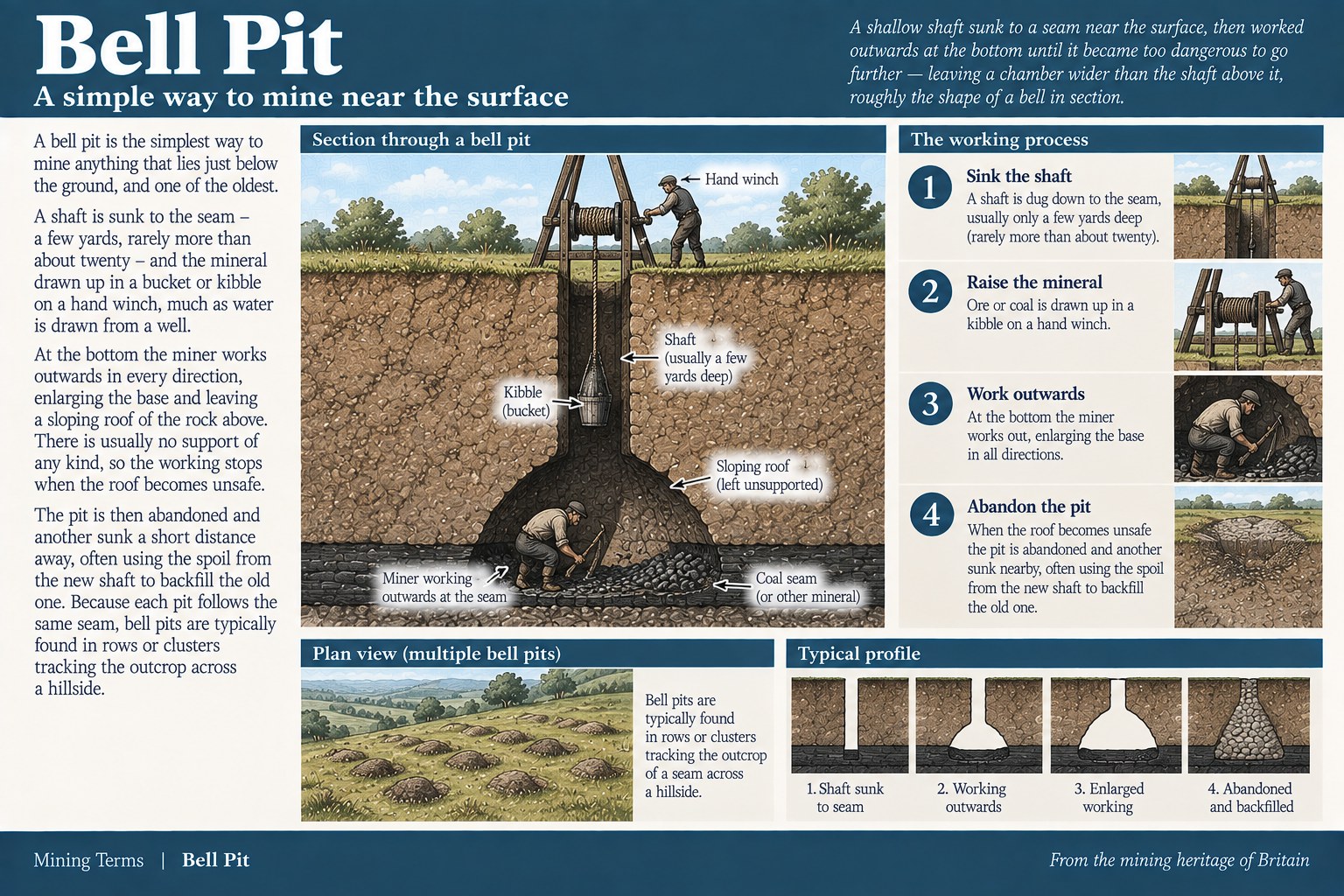
A shallow shaft sunk to a seam near the surface, then worked outwards at the bottom until it became too dangerous to go further — leaving a chamber wider than the shaft above it, roughly the shape of a bell in section. It is the simplest way to mine anything that lies just below the ground, and one of the oldest.
Historical usage
Bell pits were worked in Britain from prehistory to the twentieth century, for coal, ironstone, flint and lead. Grime's Graves in Norfolk is Neolithic; the ironstone pits around Bentley Grange in West Yorkshire are medieval; coal was still being got this way at Ford in Northumberland in the early 1900s. Brora's outcrop workings along the Sutherland links began as bell pits in the sixteenth century, and the Bronze Age copper workings on the Great Orme include shafts of the same basic kind.
How it worked
A shaft is sunk to the seam — a few yards, rarely more than about twenty — and the mineral drawn up in a bucket or kibble on a hand winch, much as water is drawn from a well. At the bottom the miner works outwards in every direction, enlarging the base and leaving a sloping roof of the rock above. There is usually no support of any kind, so the working stops when the roof becomes unsafe. The pit is then abandoned and another sunk a short distance away, often using the spoil from the new shaft to backfill the old one. Because each pit follows the same seam, the results line up: bell pits are typically found in rows or clusters tracking the outcrop across a hillside.
Why it was used
It needs no capital, no drainage, no ventilation and no timber — just a windlass, a rope and a man willing to go down. For a shallow seam it was for centuries the only economic method, and it remained so on small rural workings long after deep mining had industrialised.
Risks & limitations
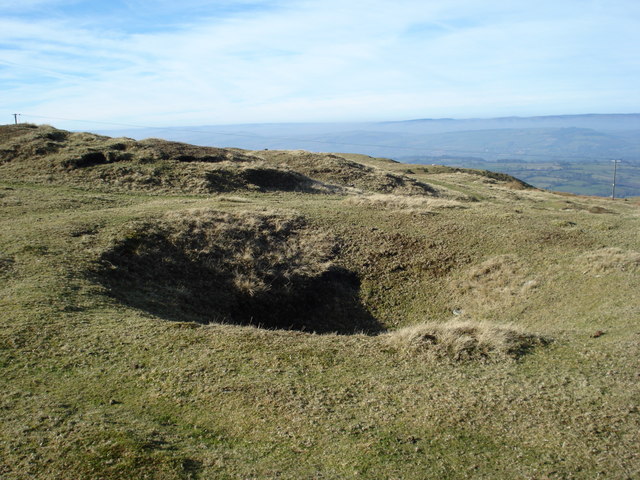
Everything that makes a bell pit cheap also makes it short-lived. Unsupported, it collapses; undrained, it floods; unventilated, it cannot be driven far from the shaft. It also wastes most of the seam, since a wide margin of coal or ore has to be left standing around each pit and between one pit and the next. That is why they occur in such numbers — the method only works by repetition. The abandoned shafts are a lasting hazard: a backfilled bell pit can settle centuries later into a crown hole, and the depressions left where they collapsed are the usual way the workings are recognised on the ground today.
Regional variation
The term is used across the English coalfields and the Yorkshire lead field. Very similar shallow shafts elsewhere carry local names — 'shaft mounds' in scheduling and survey language, describing the ring of upcast spoil rather than the pit inside it.
Related terminology
Coal, Kibble, Medieval, Opencast Working, Room and Pillar, Shaft, Subsidence
Mines associated with this term
5 examples chosen from 48 linked records — the term page is not an index.
- Faggergill Mine — North Yorkshire (well documented example)
Named in this record’s surface remains: “Multiple adit level entrances, shaft mounds and spoil heaps survive across the site, visible from the roads and…” - Lead Mines Clough — Lancashire (well documented example)
Named 3 times in this record, first in the workings: “…clough preserves evidence of successive phases of working: earlier bell pits survive on the higher ground above the main workings, while the main…” - Old Pit Radstock — Somerset (well documented example)
Named 3 times in this record, first in the history: “Coal had been dug from surface outcrops and shallow bell pits across north Somerset since at least the 15th century, and the…” - Strelley Colliery — Nottinghamshire (well documented example)
Named 3 times in this record, first in the history: “…them, influenced the coal industry nationally. Two further groups of bell pits are recorded elsewhere in the parish, one of thirty-three features…” - Allerton Bywater Colliery — West Yorkshire (well documented example)
Named in this record’s history: “…mining at Allerton Bywater goes back to the fifteenth century, and bell pits were worked in the south-east corner of Hollinhurst Wood in the…”
Sources
- (secondary) Bell pit — Wikipedia
- (secondary) Bell pits — Co-Curate — Newcastle University
Record created: 25 August 2026 · Last researched: 25 August 2026