 MineArchive
Medieval
| Also known as | Middle Ages |
|---|---|
| Category | Periods |
The Middle Ages, from the end of Roman rule in the early 5th century to about 1500, usually divided into the early medieval period before 1066 and the later medieval period after it. Mining was small in scale but widespread and closely regulated: tin in Cornwall and Devon under the stannaries, lead and silver in the Pennines, Mendip and Wales, iron in the Forest of Dean and the Weald, and coal where the seams came to the surface.
Historical usage
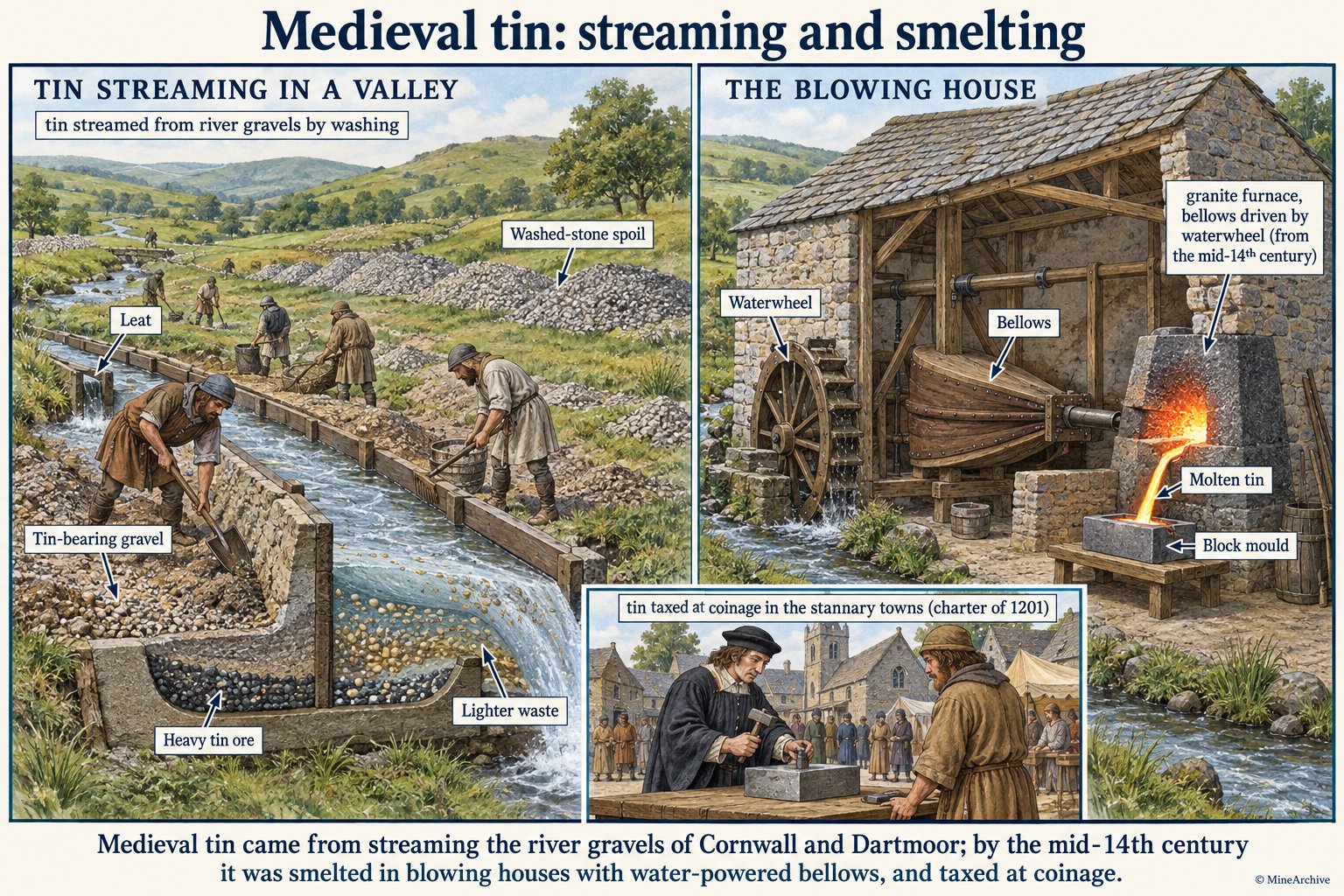
In the early medieval period Cornish tin was in demand for bronze and pewter and traded with the eastern Mediterranean and northern Europe. After 1066 the growth of population and the building of cathedrals and churches raised the demand for metals, and four were mined commercially: iron, tin, lead and silver, with coal from the 13th century. The discovery of silver near Carlisle in 1133 set off a boom in which mines across Cumberland, Durham and Northumberland produced three to four tonnes of silver a year, more than ten times the previous output of the whole of Europe. Lead was mostly a by-product of silver, mined in Yorkshire, Durham, the north and Devon, where in the late 13th century the Crown worked the silver-lead mines of the Bere Alston peninsula by shaft mining, the first documented true underground mining in the south-west. Tin came from the streams of Cornwall and Dartmoor, which supplied almost all of western Europe; King John's charter of 1201 gave the tinners privileges in return for a tax collected at coinage, and the Duchy of Cornwall, created in 1337, drew much of its revenue from it. Iron was mined in the Forest of Dean, Durham and the Weald. Monasteries and the Church were major owners: the monks of Durham Priory mined coal at around forty places in County Durham between the 1100s and the 1500s. The famine of 1315 and the Black Death of 1348 halted many mines and sent tin prices up, but mining recovered in the later 15th century: lead output almost doubled between 1300 and 1500, the Weald overtook the Forest of Dean as England's main iron district, England's first blast furnace was built at Newbridge in the Weald in 1496, and the dwindling tin gravels pushed Cornish tinners towards surface and bell-pit working of the lodes.
How it worked
Most working was shallow. Tin was streamed from the river gravels by washing; iron ore and coal near the surface were got from strip workings, trenches, tunnels and bell pits. Tin was smelted in granite furnaces with water-driven bellows: in 1198 the first Warden of the Stannaries described two smeltings, a rough one at the mine and a second at the stannary town for taxation, replaced by the mid-14th century by single-process blowing houses. Iron was smelted in bloomeries, and England's first water-powered iron forge was built at Chingley in the 14th century.
Why it was used
Silver underpinned the coinage and royal finances; lead roofed and plumbed the great churches and castles; tin was a valuable export, first to Germany and in the 14th century to the Low Countries; iron served every trade; and coal became worth digging in the 12th and 13th centuries as woodland shrank and charcoal grew dearer.
Risks & limitations
Medieval mining was economically fragile: lead mines often survived only because silver subsidised them, and the famine of 1315 and the Black Death of 1348 stopped work at many mines.
Regional variation
The south-west had tin, under its own stannary law with four stannaries in Devon and four in Cornwall; the northern Pennines, Mendip, Derbyshire and Wales had lead and silver; the Forest of Dean and the Weald had iron; and coal was dug wherever the measures reached the surface, as in Durham.
Related terminology
Barmote Court, Bell Pit, Roman, Stannary, Tin Streaming
Mines associated with this term
5 examples chosen from 48 linked records — the term page is not an index.
- Bere Alston Silver-Lead Mines — Devon (surviving physical example)
The Crown's royal silver mines, worked by shaft mining from 1292. - Caradon Hill Medieval and Post-Medieval Mines — Cornwall (surviving physical example)
A medieval streamwork already ancient by 1515. - Masson Hill Mine — Derbyshire (surviving physical example)
Caves enlarged by medieval miners, their pick-marks documented from 1470. - Ramsley Moor Lead Smelting Site — Derbyshire (surviving physical example)
An intact late medieval lead-slag resmelting site. - Silver Gill Mine — Cumbria (surviving physical example)
Earliest workings archaeologically dated to 1020-1200.
Sources
- (secondary) Cornish Mining World Heritage Site: History overview (Theme 2) — Cornwall and West Devon Mining Landscape World Heritage Site
- (secondary) Economics of English mining in the Middle Ages — Wikipedia
- (secondary) Mining archaeology in the British Isles — Wikipedia
- (secondary) The Miners' Banner — Durham Cathedral
Record created: 18 September 2026 · Last researched: 18 September 2026