 MineArchive
Roman
| Also known as | Romano-British |
|---|---|
| Category | Periods |
The period of Roman rule in Britain, from the conquest of AD 43 to the early 5th century, when mining was organised on a scale not matched again until the Middle Ages. Lead, silver, gold, iron, copper, tin, coal, salt and building stone were all worked, and Britain's mineral wealth is often counted among the reasons for the conquest.
Historical usage
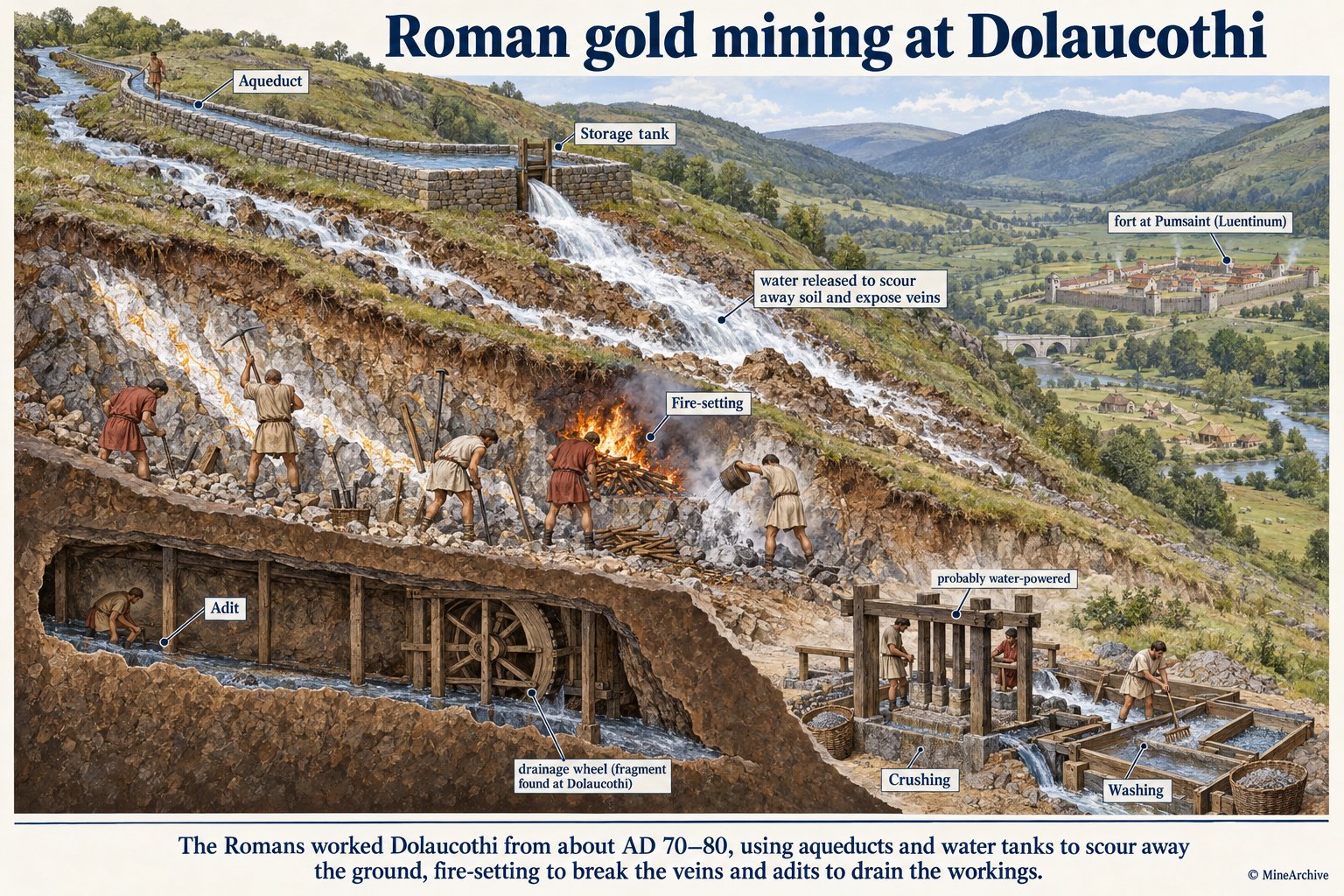
By AD 49, six years after the invasion, the Romans had lead mines running on Mendip and in Derbyshire, Shropshire, Yorkshire and Wales, and by AD 70 Britain had overtaken Spain as the empire's leading lead producer; after Spanish complaints Vespasian limited British output, but it went on rising, and lead ingots, or pigs, have been found dating from the late 2nd and early 3rd centuries. Mendip, and especially Charterhouse, was the largest source, and Mendip lead still lines the Great Bath at Bath. Lead was mined partly for its silver, which the Romans called 'British silver'. Gold came from Dolaucothi in Carmarthenshire, the only known Roman gold mine in Britain, first worked extensively between AD 70 and 80. Iron was the most widely mined metal: the Ordnance Survey map of Roman Britain lists 33 iron mines, two-thirds of them in the Weald and 15 per cent in the Forest of Dean, and Henry Cleere's study of the Roman iron industry traced the Weald's connections with the Classis Britannica, the Roman fleet in Britain. Coal was dug from outcrops and from shafts and galleries for forges, hypocausts and kilns, from Bath to Hadrian's Wall, and salt was made in lead pans at Middlewich, Nantwich and Northwich. As the Romano-British economy declined in the late 4th century, smelted metal grew scarce and people turned to scavenging scrap.
How it worked
The Romans brought large-scale water engineering. At Dolaucothi, aqueducts and tanks stored water that was released to scour away the soil and expose the veins; the veins were then broken by fire-setting and washed clear, leaving opencasts still visible today, and long drainage adits followed once opencasting no longer paid. Ore was crushed, probably by water-powered hammers, and washed; a fragment of a drainage wheel found at Dolaucothi shows water-wheels were used to lift water from the workings, as at Rio Tinto in Spain. Silver was separated from lead by cupellation, heating the metal with bellows until the lead oxidised away. Iron ore was crushed, washed and smelted in bloomeries, which left slag heaps large enough to be used later as road metal.
Why it was used
Lead was essential to the empire, for water pipes, cisterns, baths, pewter and coffins, and as the source of silver for the coinage; iron served for weapons, tools and building; gold went into ingots for minting. The army's demand for iron in particular made Britain, with its ores and its woods for charcoal, a valuable province.
Risks & limitations
Working conditions were poor, especially where fire-setting was used underground. Some miners may have been slaves, but skilled men were needed to build the aqueducts and the machinery for draining and crushing. Later mining has destroyed most Roman workings, so much of the evidence rests on finds such as stamped lead pigs and coins rather than on the mines themselves.
Regional variation
Lead came from Mendip, Derbyshire, Shropshire, Flintshire, Yorkshire and the northern Pennines; gold from Dolaucothi; iron from the Weald and the Forest of Dean; salt from the Cheshire wiches; and building stone from quarries across lowland Britain.
Related terminology
Fire-setting, Hushing, Iron Age, Medieval
Mines associated with this term
5 examples chosen from 32 linked records — the term page is not an index.
- Beauport Park Roman Iron Mine — East Sussex (surviving physical example)
A Romano-British bloomery ironworks of the 1st-3rd centuries AD, linked to the Classis Britannica. - Kimmeridge Oil Shale Workings — Dorset (surviving physical example)
Romano-British workshops turned the shale into armlets. - Charterhouse Roman Mines — Somerset (surviving physical example)
Lead and silver mined by AD 49, attested by stamped lead pigs. - Dolaucothi Gold Mines — Carmarthenshire (surviving physical example)
The only known Roman gold mine in Britain, worked extensively from about AD 70. - Alderley Edge Mines — Cheshire (well documented example)
Roman-era working between the Bronze Age and industrial phases.
Sources
- (secondary) History of Dolaucothi — National Trust
- (secondary) Mining archaeology in the British Isles — Wikipedia
- (secondary) Mining in Roman Britain — Wikipedia
- (secondary) Research Framework for the Archaeology of the Extractive Industries in England: the Prehistoric and Roman Periods (assessment, 2013) — National Association of Mining History Organisations
- (secondary) The iron industry of Roman Britain (Henry F. Cleere, PhD thesis, 1981) — Wealden Iron Research Group
Record created: 18 September 2026 · Last researched: 18 September 2026