 MineArchive
Roadstone
| Also known as | Road Metal, Road Stone, Roadstone Aggregate |
|---|---|
| Category | Commodities |
Crushed rock quarried for road building — the single largest use of crushed rock in Britain. It is sold either coated with bitumen for asphalt or uncoated for the unbound layers beneath, and in 2014 the two together accounted for just under 40 million tonnes, about a quarter of all primary aggregate sold in Great Britain.
Historical usage
Roadstone is what most British hard-rock quarrying became. Through the nineteenth century a hard-rock quarry’s premium product was dressed stone — building blocks, kerbs and paving setts cut by hand. Tarmacadam ended that trade between the wars and replaced it with a bulk one: the same rock, blasted, crushed, graded and sold by the tonne. The scale followed the roads. Somerset’s output stood generally below half a million tonnes a year until 1919, almost tripled by 1931 on interwar road building and construction, rose from two or three million tonnes in the 1950s to 12.6 million in 1973 largely on sales into south-east England, and peaked at 18.8 million tonnes in 1990 after the late-1980s construction boom. Many quarry operators now run their own tar coating plants on site.
How it worked
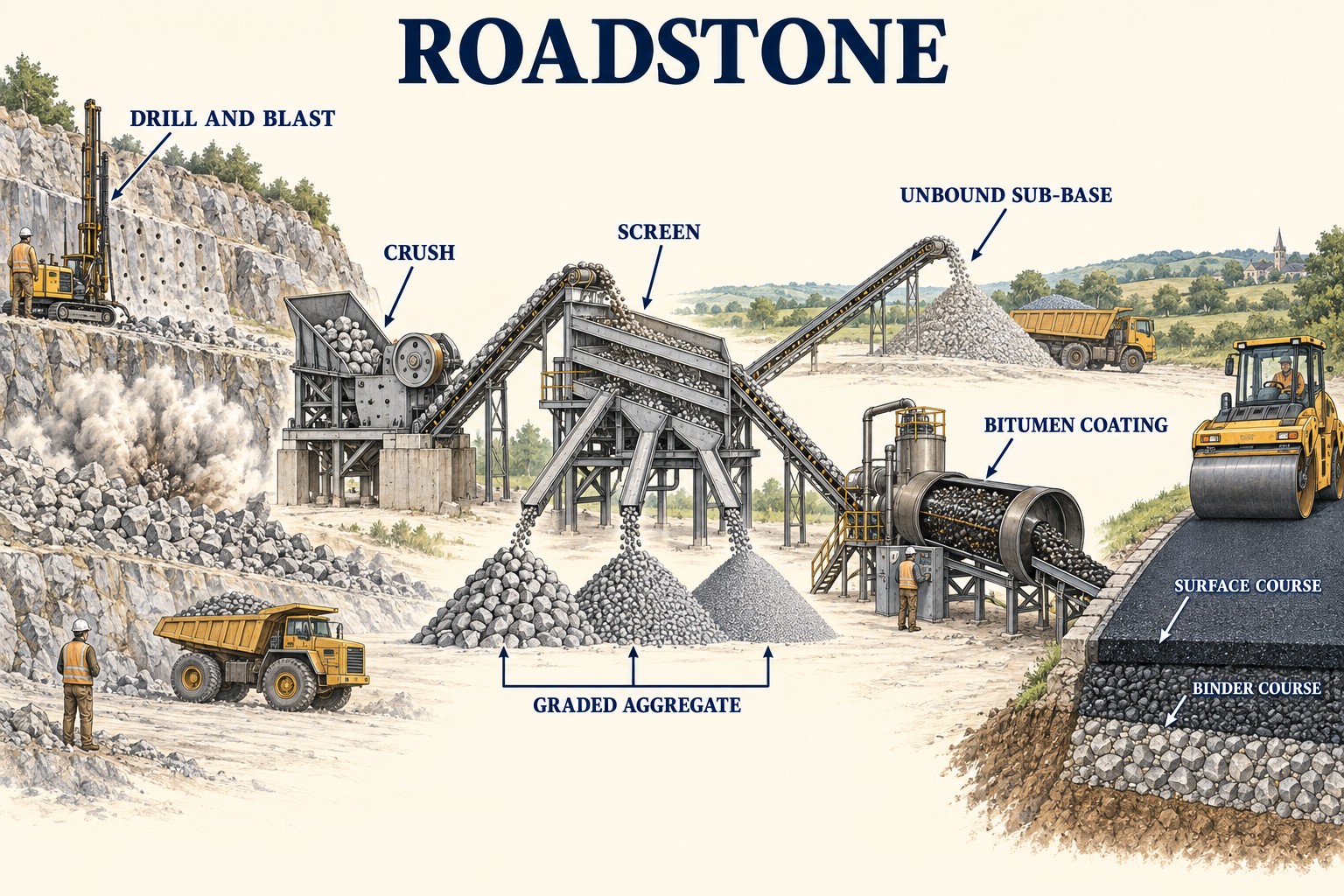
The rock is drilled and blasted from the face, then crushed and screened into graded fractions. A modern flexible road pavement is built in layers, each wanting something different: the sub-base provides a solid platform and may be unbound; the binder course carries the load; and the surface course keeps the weather out and provides an even, skid-resistant running surface. Over 95 per cent of Britain’s roads are asphalt, so most surfacing stone is coated with bitumen before it leaves the quarry.
Why it was used
Surfacing stone has to be hard-wearing and, above all, resistant to polishing — a stone that takes a shine underneath traffic stops gripping. Performance is measured as Polished Stone Value, alongside abrasion and crushing values, and the aggregate must also hold its bond with the bitumen rather than stripping out of it. Igneous rock and certain sandstones meet this best, and are the premium products of the crushed-rock industry: the Pennant Sandstone of the South Wales Coalfield is one of the best natural road-surfacing materials in Britain, the Precambrian Longmyndian rocks around Shrewsbury yield high-specification surfacing stone, and so do the folded Lower Palaeozoic greywackes of the Settle and Ingleton inliers in western North Yorkshire. Limestone, strong and durable but prone to polishing, generally goes into the sub-base and lower courses instead.
Risks & limitations
The resource is where the geology put it, and that is rarely where the demand is. There is no significant hard rock at outcrop south-east of a line from Portland Bill to Flamborough Head, which is also the most densely populated and fastest-growing part of the country, so roadstone travels — Somerset’s Mendip output rose on "exports" to the south-east, and high-specification stone from North Yorkshire is distributed throughout England. High-PSV stone is scarcer still, restricted to particular formations and, at surface, degraded by weathering along joints. Working the rock also generates waste: sandstone deposits carry beds of clay, mudstone and siltstone that must be disposed of on site, and crushing hard sandstone throws large quantities of fines into tips and settlement lagoons.
Related terminology
Mines associated with this term
5 examples chosen from 35 linked records — the term page is not an index.
- Penlee Quarry — Cornwall (well documented example)
Named twice in this record, first in the summary: “A large greenstone quarry above Newlyn, worked for roadstone for most of a century and served by Cornwall's most westerly railway…” - Prestonhill Quarry — Fife (well documented example)
Named in this record’s geology: “…in the Scottish and northern English quarrying trade, valued for roadstone because of its strength. It sits among the igneous rocks of the…” - Tonfanau Quarry — Gwynedd (well documented example)
Named in this record’s geology: “…as among the hardest granite in Europe, which is what suited it to roadstone and to the hard-wearing building work it went into at Tywyn.” - Ailsa Craig — South Ayrshire (well documented example)
Named 6 times in this record, first in the summary: “…stones since the 1850s, and a short-lived, heavily capitalised roadstone operation from 1907 that never turned a profit.” - Arcow Quarry — North Yorkshire (well documented example)
Named 4 times in this record, first in the summary: “…rapidly into the single Arcow Quarry, switching to crushing rock for roadstone, ballast and aggregate. A rail link opened in 2016 now takes two…”
Sources
- (primary) Construction Aggregates: Mineral Planning Factsheet (2019) — British Geological Survey
- (secondary) Aggregate resources — Foundations of the Mendips — Foundations of the Mendips (hosted by the British Geological Survey)
- (secondary) Quarrying for aggregate — Foundations of the Mendips — Foundations of the Mendips (hosted by the British Geological Survey)
Record created: 8 September 2026 · Last researched: 8 September 2026