 MineArchive
Penlee Quarry
| Also known as | Gwavas Quarry |
|---|---|
| Location | Above Newlyn, south of Penzance, Cornwall — 50.0959, -5.5423 (exact) |
| Commodities | Whinstone, Copper, Zinc |
| Type | Quarry |
| Worked | 1879–1991 |
| Maximum depth | Surface quarrying in benches; no depth figure applies. |
| Operators | James Runnalls (1879–?) |
Overview
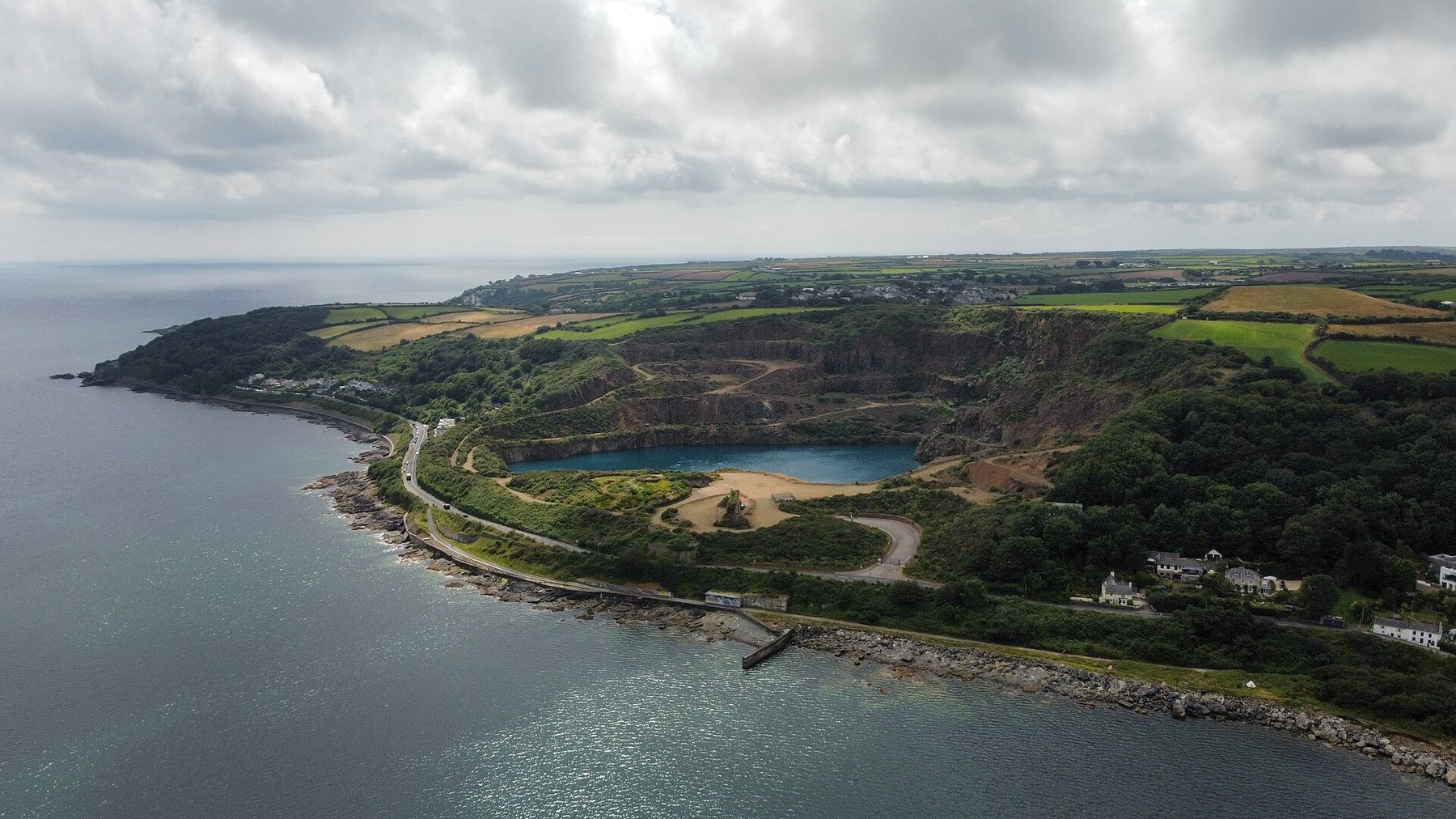
A large greenstone quarry above Newlyn, worked for roadstone for most of a century and served by Cornwall's most westerly railway — a 2 ft gauge line running half a mile down to Newlyn harbour, and among the last industrial narrow-gauge lines working in Britain. The rock is an altered dolerite of unusually high crushing strength, and the quarry faces carry a mineral assemblage, molybdenite included, that is rare in the South West.
History
Mineral extraction at Penlee goes back to the early nineteenth century, when copper, zinc and rarer minerals were worked here. Stone quarrying proper was begun in 1879 by James Runnalls of Penzance at a quarry near the Old Battery, and the operation moved to the present site at the turn of the twentieth century, where it became known as Gwavas Quarry.
As production grew, a 2 ft gauge railway was opened around 1900 to carry stone half a mile east to the south pier of Newlyn harbour, from where it went out by ship. A steam locomotive named Koppel was bought to work the line; internal combustion locomotives took over from 1930. The line was Cornwall's most westerly railway and one of the last industrial narrow-gauge railways operating in the United Kingdom, closing in the early 1970s.
Crushed roadstone output was given as 120,000 tons in 1982, and the quarry is reported to have produced over 300,000 tons a year at its peak. Work ceased in 1991. Some levels have since been restructured, opening fresh faces, but there appear to be no plans to work it again.
Geology
Penlee exposes country rock — the Devonian Mylor Slate Formation, the Cornish 'killas' — together with the greenstone that was the object of the quarrying: a large dolerite intrusion, the Gwavas sill, emplaced in Devonian times. The later intrusion of the Land's End Granite, 290 to 300 million years ago, metamorphosed the greenstone, growing copious green acicular actinolite that overprints the original ophitic texture. That alteration gave the rock its high crushing strength — though a low polished stone value kept it off most British road surfaces.
The quarry is a Geological Conservation Review site for its mineralisation, which is of several types: early pegmatitic, and pyrometasomatic in the greenstones. A north–south lode dipping 65 degrees west carries an assemblage unusual for Cornwall — chalcopyrite, arsenopyrite, löllingite, molybdenite, pyrite, pyrrhotite, quartz and chalcedony — of which molybdenite and löllingite are both rare in south-west England. An east–west tin-copper lode is recorded crossing the quarry but is now largely obscured, and an amethystine-chalcedonic vein has been revealed in the northern faces.
Workings
A large open quarry, close to 800 m across in both the north–south and east–west directions, worked in benches. Stone was originally shipped straight from the quarry; from about 1900 a 2 ft gauge railway carried it half a mile to the south pier at Newlyn, worked first by the steam locomotive Koppel and from 1930 by internal combustion locomotives. Some faces are old and unstable, and the lode mineralisation is often best examined in large loose blocks within the quarry rather than in the faces themselves.
Closure
Quarrying ceased in 1991. The narrow-gauge railway to Newlyn harbour had closed in the early 1970s. Some areas of the quarry have since seen levels restructured, producing fresh exposures, but there appear to be no plans for further working.
What remains
Disused. Some levels have been restructured since closure, which has opened fresh faces; others are old and unstable. The site remains a Geological Conservation Review locality, its mineralisation studied largely from loose blocks within the quarry because of the state of the older faces.
The quarry faces and benches, and the course of the narrow-gauge line down to the south pier at Newlyn.
Nearby mines
- Wherry Mine — 1.1 miles (1.8 km) N
- Ding Dong Mine — 4.4 miles (7.1 km) NW
- Tregurtha Downs Mine — 4.8 miles (7.7 km) NE
- Balleswidden Mine — 5.2 miles (8.4 km) W
- Carn Galver Mine — 6.1 miles (9.8 km) NW
Straight-line distance, within 9 miles (15 km). Show on the map.
Recorded claims
Individual factual claims, each attached to the source(s) that support it below. Where sources disagree, both are kept.
- Mineral extraction at Penlee dates back to the early nineteenth century, when copper, zinc and rarer minerals were mined here. 1
- Stone quarrying was started in 1879 by James Runnalls of Penzance at a quarry near the Old Battery; operations moved to the present site at the turn of the twentieth century, becoming known as Gwavas Quarry. 2,1
- A 2 ft gauge railway opened around 1900 connected the quarry with the south pier of Newlyn harbour about half a mile east; it was Cornwall's most westerly railway and one of the last operating industrial narrow-gauge railways in the UK, closing in the early 1970s. 1
- A steam locomotive named Koppel was bought to work the line, with internal combustion locomotives replacing steam from 1930 onwards. 1
- The altered dolerite 'greenstone' from Penlee was noted for its high crushing strength, but a low polished stone value precluded its use for most road surfaces in the UK. 2
- Crushed roadstone production was given as 120,000 tons in 1982, and at its peak the quarry is reported to have produced over 300,000 tons of roadstone annually. 2
- A north–south vein in the quarry carries an assemblage unusual for Cornwall — chalcopyrite, arsenopyrite, löllingite, molybdenite, pyrite, pyrrhotite, quartz and chalcedony — of which both molybdenite and löllingite are rare in south-west England. 2
- The quarried greenstone is a Devonian dolerite intrusion, the Gwavas sill, emplaced in the Mylor Slate Formation and metamorphosed by the later intrusion of the Land's End Granite 290 to 300 million years ago. 2
- Work ceased in 1991; some areas of the quarry have since had levels restructured, giving fresh exposures, but there appear to be no plans for further development as a working quarry. 2
Photographs & further reading
The GCR chapter on the quarry's mineralisation, describing the lodes and their unusual assemblage, the relationship of the Gwavas sill to the Land's End Granite, and the present state of the faces.
View sourceThe history of the 2 ft gauge line from quarry to Newlyn pier, its locomotives and its closure — Cornwall's most westerly railway.
View sourceA walker's account of the quarry and the route of its tramway as they are now.
View sourceSources
- (secondary) Penlee Quarry railway — Wikipedia
- (primary) Bevins, Young, Mason, Manning & Symes, 'Penlee Quarry', Mineralization of England and Wales (Geological Conservation Review Series No. 36) — Joint Nature Conservation Committee
- (observational) Penlee Quarry — iWalk Cornwall
Record created: 3 September 2026 · Last researched: 3 September 2026