 MineArchive
Carn Galver Mine
| Location | Morvah and Zennor, Penwith, Cornwall — 50.1709, -5.6138 (exact) |
|---|---|
| Commodity | Tin |
| Type | Metal |
| Worked | Early 19th century–1875 |
| Maximum depth | 130 fathoms |
| Operators | Morvah and Zennor Tin Mines (1835–?) |
Overview
Carn Galver, on the west slope of its namesake tor between Zennor and Morvah, was an ancient tin-working site that Victorian investors tried, three separate times, to turn into a modern mine — never quite managing more than a modest 150 tons of black tin for their trouble.
History
Carn Galver Mine, also known as Wheal Rose, worked tin on the west slope of Carn Galver across three distinct periods: an early 19th-century phase to 1840, a second spell from 1851 to 1869, and a final attempt from 1871 to 1875. The wider Morvah and Zennor Tin Mines company, formed in 1835, covered a larger area than Carn Galver alone. Recorded output was modest — only 150 tons of black tin across 1860 and 1871-6 — but the mine was worked seriously: by 1871 it employed seventy miners, with an adit driven 70 fathoms below surface and a shaft sunk to 130 fathoms. Two engine houses were built in 1871, housing a 30-inch Cornish engine and a 22-inch whim engine, standing close to the mine's count house. The mine closed for good in 1875.
Geology
The mine worked a tin lode on the west slope of Carn Galver within the Penwith orefield, part of the same hydrothermal, granite-related Cornubian mineralisation worked across west Cornwall.
Geological setting: Hydrothermal Deposits (well documented example), Veins and Lodes (well documented example)
Workings
An adit was driven 70 fathoms below surface, with a shaft sunk to 130 fathoms; two engine houses built in 1871 housed a 30-inch Cornish engine and a 22-inch whim engine, standing close to the mine's count house.
Closure
The mine closed in 1875 after its third and final working period, having never produced more than a modest tonnage of tin.
What remains
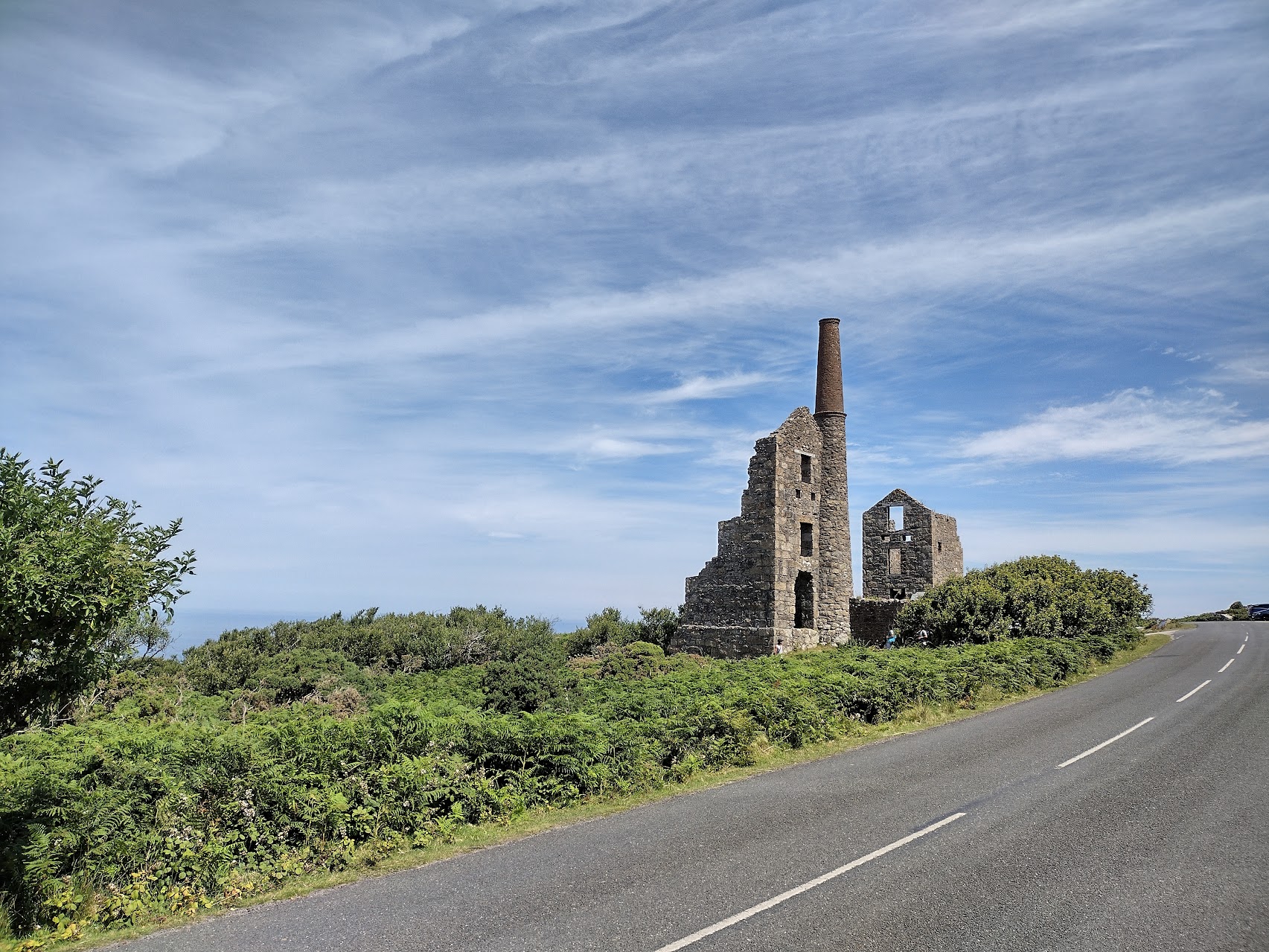
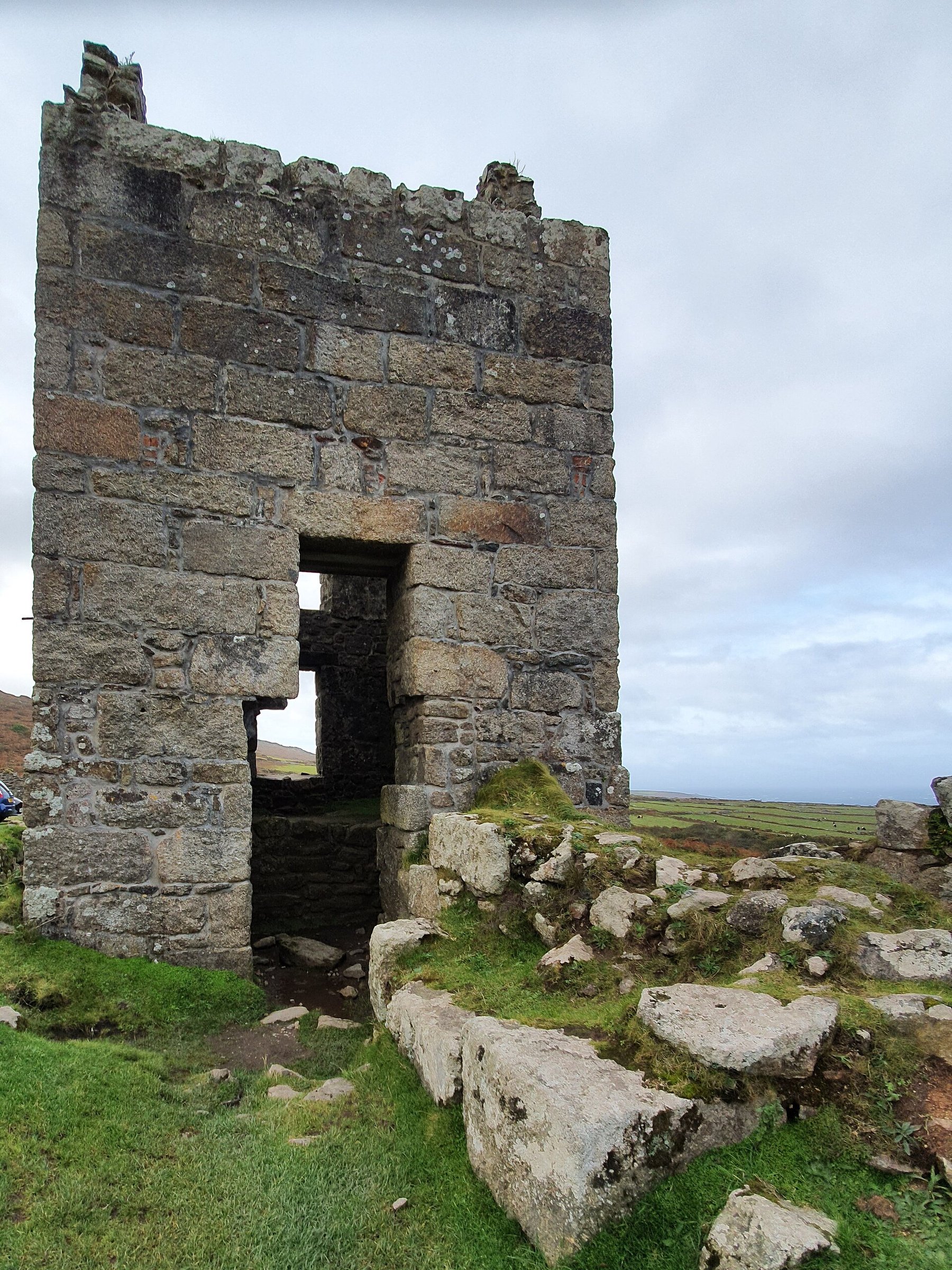
Two ruined engine houses survive west of the B3306, the westernmost retaining its chimney; further shaft remains and the site of the count house lie nearby.
Nearby mines
- Ding Dong Mine — 1.7 miles (2.8 km) SE
- East Boscaswell Mine — 2.2 miles (3.6 km) SW
- Parkenoweth Mine — 2.5 miles (4.1 km) SW
- Pendeen Consols — 2.6 miles (4.2 km) W
- Geevor Tin Mine — 3.0 miles (4.9 km) SW
Straight-line distance, within 9 miles (15 km). Show on the map.
Recorded claims
Individual factual claims, each attached to the source(s) that support it below. Where sources disagree, both are kept.
- By 1871 the mine employed seventy miners, with an adit 70 fathoms below surface and a shaft sunk to 130 fathoms; total recorded output across the mine's working life came to only 150 tons of black tin. 1,2
- Two engine houses built in 1871 housed a 30-inch Cornish engine and a 22-inch whim engine. 1
- A tracing of the long sections and plan of Carn Galver Mine, Zennor, and the Garden Mine is held by the British Geological Survey (MP24756), given by Pendeen Community Heritage at Geevor. 3
Photographs & further reading
The Cornwall Calling account of the mine's three working periods, its engines and its output.
View sourceSources
- (secondary) Carn Galver Mine (Wheal Rose), Morvah and Zennor United Mines, Morvah, Cornwall, England, UK — Mindat
- (secondary) Carn Galver Mine, Cornwall — Cornwall Calling
- (primary) CARN GALVER MINE ZENNOR AND THE GARDEN MINE (Mine plan MP24756, BGS mine plans catalogue) — British Geological Survey / Mining Remediation Authority
- (primary) Carn Galver Mine Zennor and the Garden Mine (BGS Mine Plans Catalogue) — British Geological Survey / Pendeen Community Heritage
Record created: 23 August 2026 · Last researched: 24 September 2026