 MineArchive
Count House
| Also known as | Counting house |
|---|---|
| Dialect | Cornish |
| Category | Structures & Machinery |
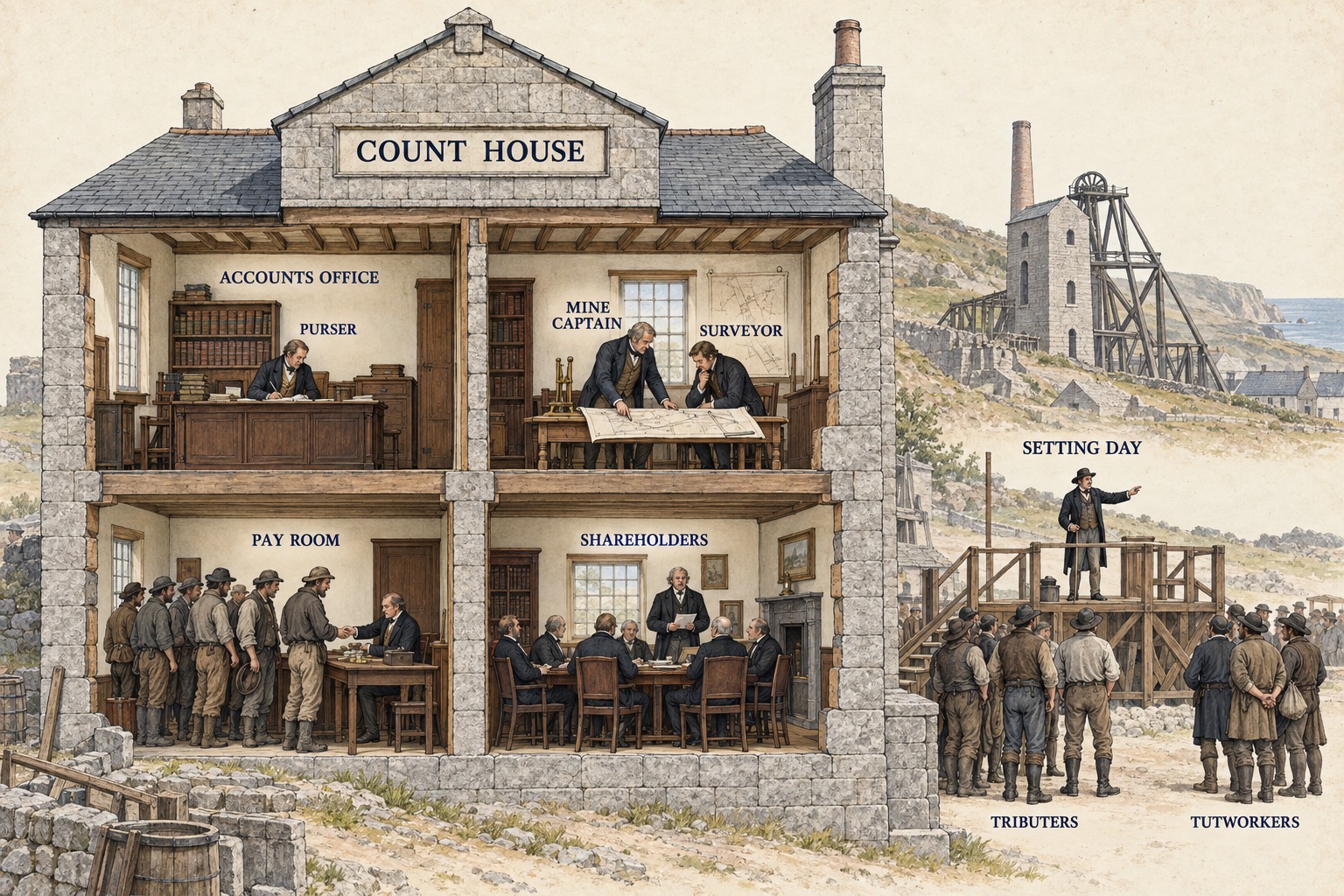
The mine's administrative building — a shortened form of "account house" — where the purser and mine captain worked, miners were paid, and the rights to work sections of ground were auctioned on setting days.
Historical usage
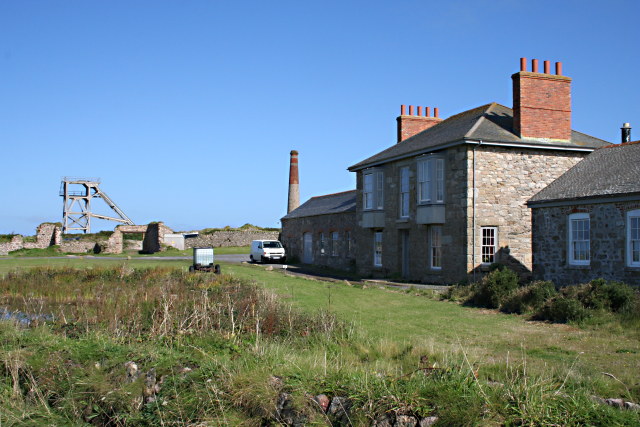
Count houses were a standard feature of Cornish and Devon mines, housing the purser (accountant), mine captain (manager) and surveyors, and were deliberately built to a grander standard than most surrounding buildings to project financial solidity and reassure shareholders — Botallack's granite Count House, completed in 1861, is a well-preserved example.
How it worked
Roughly every two months, on setting day, unworked ground was divided into pitches and auctioned in the open air outside the count house, often from a raised stage where the mine captains stood; pares of tributers and tutworkers bid for pitches, and this was also where their pay was settled once the setting period ended. Shareholders ("adventurers") gathering to review the mine's accounts were sometimes entertained there too.
Why it was used
Centralising a mine's accounts, management and pay in one purpose-built building gave a mine a stable administrative base and a public face — its architecture and setting were part of how a mining company presented itself as sound and well run to the investors whose money it depended on.
Risks & limitations
As a purely administrative building the count house carried none of the physical hazards of the workings themselves; its practical limitation was simply cost — a building deliberately built beyond bare necessity to look prosperous was itself an ongoing expense for a mine to carry.
Regional variation
The count house, and the setting-day/tribute-and-tutwork system it administered, is specifically a Cornish and Devon institution, tied to the Stannary system of mining law in those counties.
Related terminology
Adventurer, Cost Book System, Miners' Barracks
Mines associated with this term
5 examples chosen from 11 linked records — the term page is not an index.
- Botallack Mine — Cornwall (surviving physical example)
Botallack's granite Count House, completed in 1861, survives and is where the mine's tutwork and tribute pay was settled. - Carn Galver Mine — Cornwall (well documented example)
The mine's own recorded workings explicitly describe the engine houses standing close to the mine's count house. - Eaglesbush Colliery — Neath Port Talbot (well documented example)
Named in this record’s history: “…Eaglesbush Cottage, for fifty years from Lady Day 1835, a house, a counting house, the land on which Penrose had sunk a new coal pit, a farm, and the…” - Hudgill Burn Mine — Cumbria (well documented example)
Named 4 times in this record, first in the history: “…Hospital put up a set of six stone storage bays, a walled yard and a count house beside the Nent road about 1817, mainly to hold the duty ore coming…” - Logaulas Mine — Ceredigion (well documented example)
Named in this record’s history: “…farms into genuine mining communities, complete with chapels, a counting house and workers' housing built to serve the industry. The mines took…”
Sources
- (secondary) The history of Botallack — National Trust
- (secondary) What is a count house? — National Trust
Record created: 20 August 2026 · Last researched: 20 August 2026