 MineArchive
Tribute and Tutwork
| Also known as | Tributers, Tutworkers, Pare |
|---|---|
| Dialect | Cornish |
| Category | Labour & Roles |
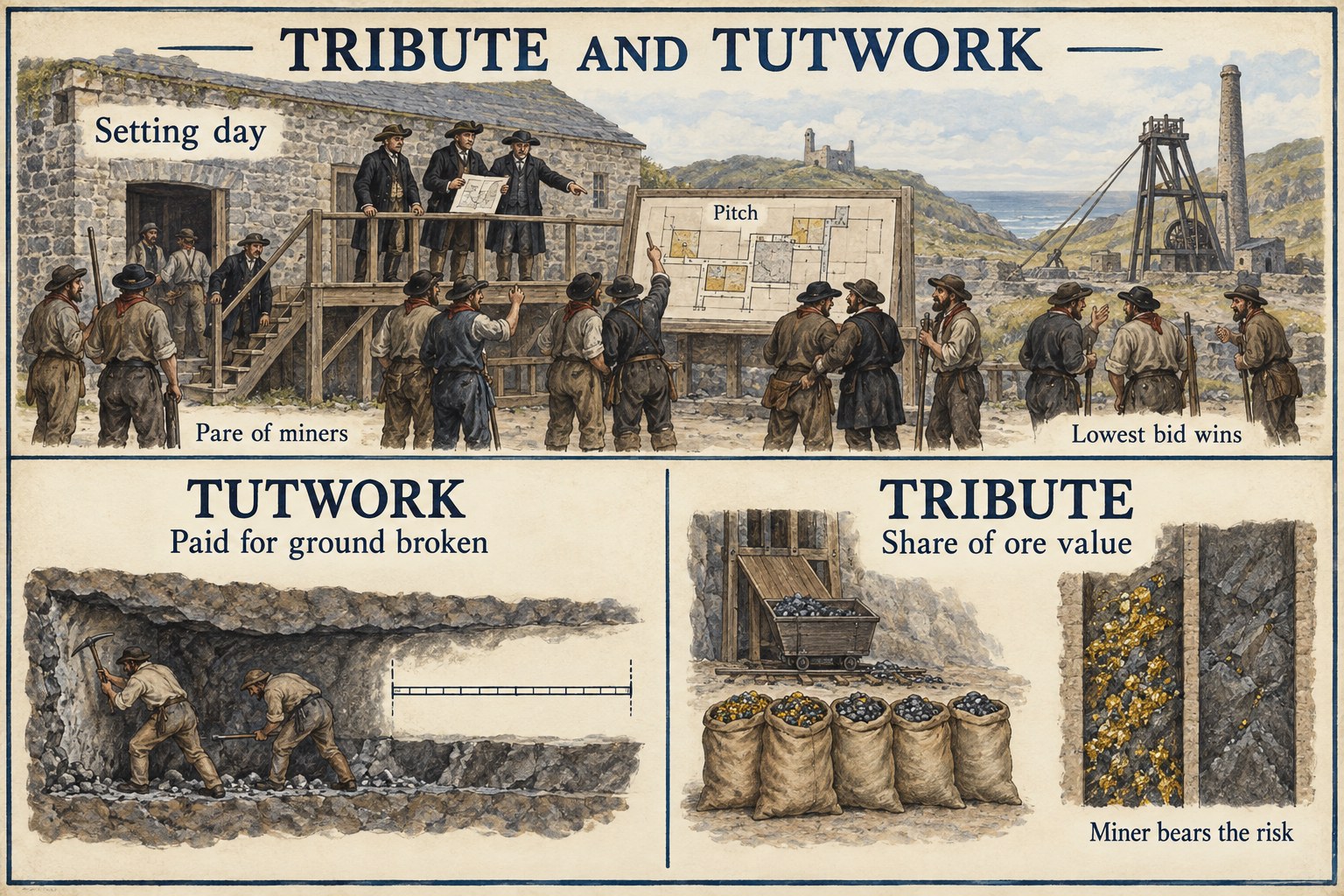
The two-part contract system used to pay most underground miners in Cornwall and Devon: tutwork paid a rate per fathom of ground broken (driving levels, sinking shafts), while tribute paid a share of the value of the ore raised and dressed.
Historical usage
The system grew out of Cornwall and Devon's Stannary mining law and was the dominant way underground miners were paid across the Cornish and Devon orefields through the 18th and 19th centuries. Cornish emigration carried it to mining districts abroad, including hard-rock gold mining in Australia and even the Alten copper mines in Arctic Norway.
How it worked
Roughly every two months, on "setting day," a mine's unworked ground was divided into pitches and auctioned off in the open air in front of the count house, usually from a raised stage where the mine captains stood. A pare — a small group of between two and eight miners — bid for a pitch by naming the lowest share of ore value (for tribute) or the lowest rate per fathom (for tutwork) they were willing to work it for; the lowest bid won the pitch for the coming period.
Why it was used
Tribute and tutwork let mine owners pay for output rather than time, shifting much of the risk and reward of an uncertain, variable ore body onto the miners themselves — who, on a good pitch, could earn considerably more than a fixed wage. That shift of risk, more than anything else, was the system's real appeal to owners.
Risks & limitations
The flip side of that appeal was real financial risk for the miners: because pay depended on the actual value or quantity of ground won, a pare could end a two-month setting in debt if a pitch of ore turned out poorer than expected, or if their own costs — candles, gunpowder, tools — ate into a thin tribute share. Miners also worked long hours in cramped, poorly ventilated underground conditions that encouraged the spread of tuberculosis alongside silicosis from rock dust, a combination that left mining communities with markedly shorter life expectancy and comparatively little formal compensation available if a miner was permanently disabled.
Regional variation
While most strongly associated with Cornwall and Devon, tribute and tutwork spread wherever Cornish miners emigrated to work hard-rock mines — notably Australia, where it became especially common in gold mining and was formally recognised in warden's courts during the gold-rush era.
Related terminology
Mines associated with this term
5 examples chosen from 6 linked records — the term page is not an index.
- Botallack Mine — Cornwall (well documented example)
Botallack's own Count House, built 1861, is specifically documented as where both tutwork and tribute pay were settled. - Wheal Mary Ann — Cornwall (well documented example)
Named in this record’s history: “…usual to Cornish mining, with miners working underground pitches on tribute and tutwork. An 1863 inspection for Lord Kinnaird's Royal Commission on the…” - Creggan Silver-Lead Mines — County Armagh (well documented example)
Named in this record’s workings: “…at roughly 15-fathom intervals — worked on the Cornish system of tribute and tutwork by miners under Captain Samuel Bailey. Ore was dressed at the…” - Greenlaws Mine — County Durham (well documented example)
Named in this record’s history: “…low silica content notwithstanding. After official mining ended, tributers continued to extract material by hand, and specimens recovered in…” - Fowey Consols — Cornwall (well documented example)
Named in this record’s history: “…a canal in the late 1820s. In 1831 miners at the setting day, when tribute and tutwork pitches went to the lowest bidder, tried to hold the prices up; when…”
Sources
- (secondary) Cornish Miners Earnings and Health the Tribute and Tut Systems — RootsWeb (Triplett family history pages)
- (secondary) Tribute mining — Wikipedia
Record created: 20 August 2026 · Last researched: 20 August 2026