 MineArchive
Stannary
| Dialect | Cornish and Devon |
|---|---|
| Category | Law & Custom |
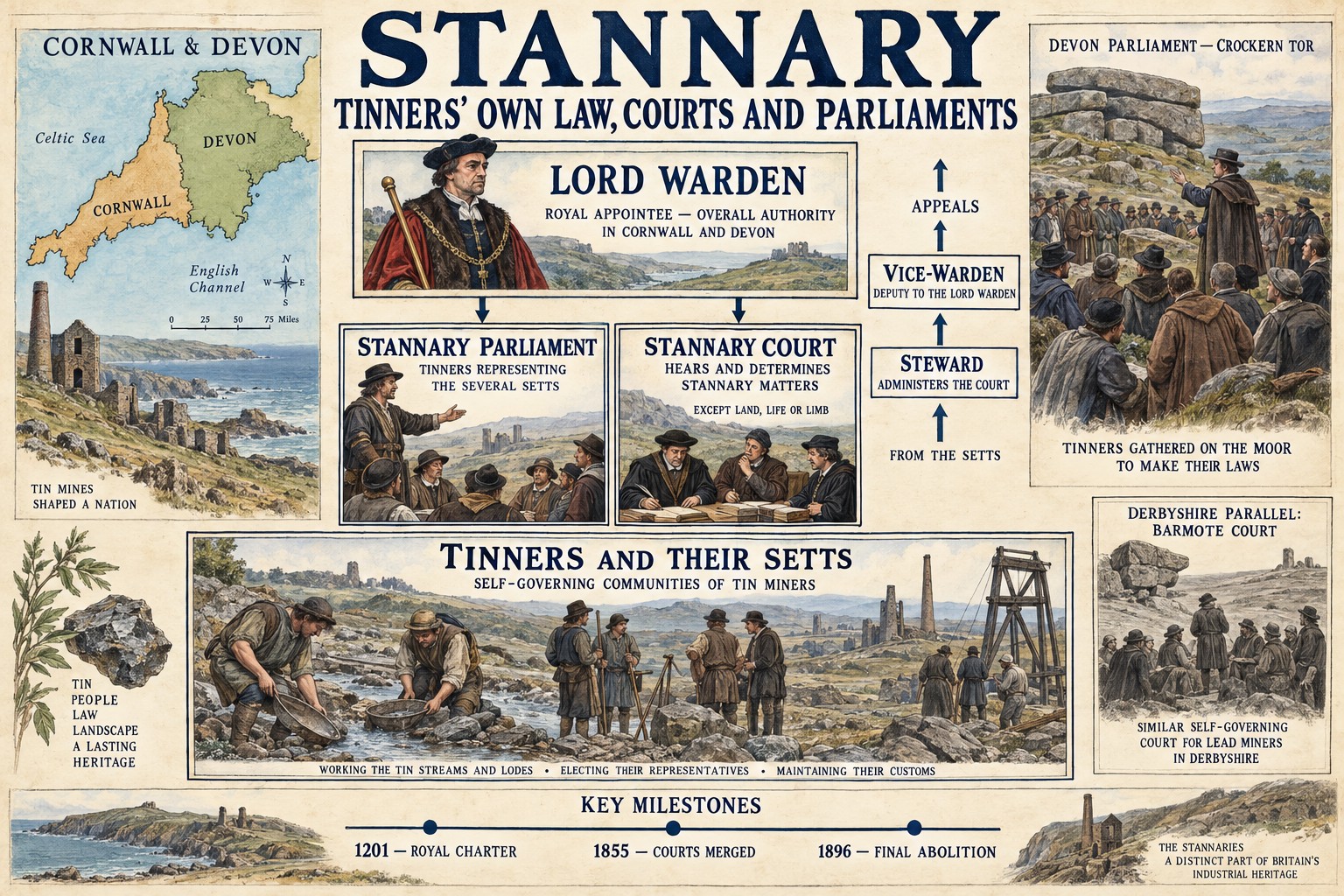
The distinct body of law, courts and self-governing institutions that regulated tin mining in Cornwall and Devon from the medieval period until the late 19th century — the Cornish and Devon counterpart to Derbyshire's Barmote Court system.
Historical usage
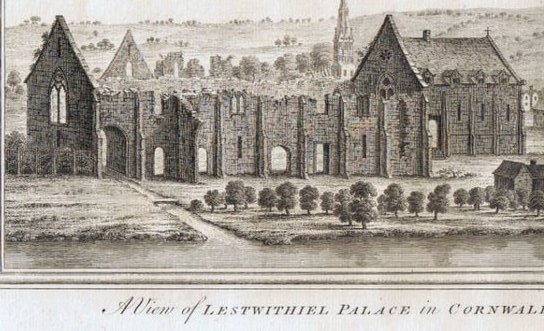
Stannary law is among the oldest bodies of law absorbed into the English legal system, with roots in the 12th century and formal royal charters from King John (1201) and Edward I, whose 1305 charter formalised Devon's stannaries at Tavistock, Ashburton, Chagford and (from 1307) Plympton. In exchange for exemption from ordinary taxation, tinners paid their own stannary taxes and had the right to trial in their own specialist courts rather than the ordinary county courts. Cornwall and Devon each had their own Stannary Parliament — Devon's meeting at Crockern Tor with 96 jurates, Cornwall's drawing on elected stannators from its four stannaries — with Cornwall's Parliament last meeting in 1753 and Devon's in 1786. The system was gradually wound down: the stannary courts merged in 1855, and the Stannaries Court (Abolition) Act 1896 finally transferred their remaining powers to the ordinary county authorities, though Devon kept appointing honorary stannators into the 1980s.
How it worked
The Lord Warden of the Stannaries held sole magisterial authority over tinners, trying all cases except those involving land, life or limb, with stewards conducting regular trials and appeals going to a vice-warden. Working ground itself was licensed through the sett system (see that term) rather than through ordinary land law.
Why it was used
Tin mining generated its own distinct set of legal problems — working rights, boundary disputes, taxation on a valuable royal commodity — that ordinary English land and county law was not well suited to handle, so a specialist, self-governing system grew up around it instead, much as Derbyshire's lead field developed the separate Barmote court system to solve the same kind of problem.
Risks & limitations
A system this old and self-contained inevitably grew unwieldy: by the 19th century its separate courts and privileges increasingly duplicated, and sometimes conflicted with, ordinary English law, which is ultimately why Parliament wound it down through the 1855 merger of the stannary courts and their final abolition in 1896.
Regional variation
Stannary law was specific to Devon and Cornwall's tin industry; the nearest parallel elsewhere in Britain is Derbyshire's Barmote court system, which regulated lead mining on broadly similar free-mining principles but under an entirely separate legal tradition.
Related terminology
Barmote Court, Medieval, Mineral Royalty, Sett (Mining Lease)
Mines associated with this term
Included only where MineArchive's own research gives a reasonable evidential basis — not every mine where this might plausibly apply.
- Whiteworks Mine — Devon (well documented example)
Named in this record’s history: “Tin working at Whiteworks is recorded in stannary rolls as early as 1180, but the workings expanded substantially…”
Sources
- (secondary) Cornish Stannary Parliament — Wikipedia
- (secondary) Stannary law — Wikipedia
Record created: 22 August 2026 · Last researched: 22 August 2026