 MineArchive
Mineral Royalty
| Also known as | Royalty (The bare form used in most mining leases.), Dues (Cornwall and Devon), Lordship, Mineral Dues |
|---|---|
| Category | Law & Custom |
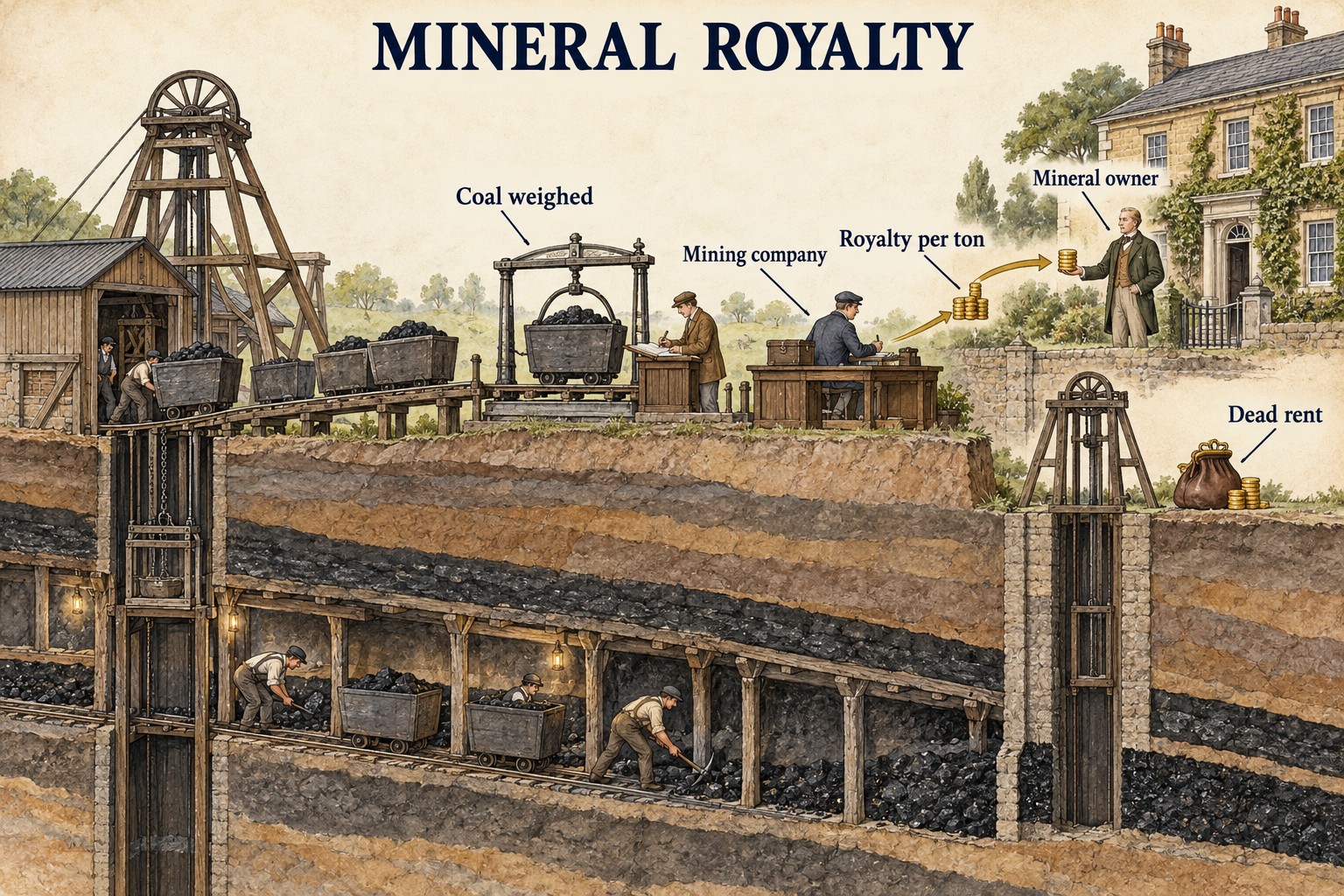
A payment made to the owner of the minerals for every ton raised — not rent for the land, but a share of the substance itself. In Britain the minerals under a field commonly belonged to someone other than the person mining them, and the royalty is the mechanism by which that ownership was turned into income.
Historical usage
Unlike most countries, Britain separated the ownership of a mine from the ownership of what it produced: the mine owner did not own the coal he raised, the landowner did, and was paid a royalty according to how much came out. The arrangement is very old. At Nantymwyn a documentary reference records a mining royalty of one-eleventh of the ore produced. In Devon the Dukes of Bedford took £182,036 in dues from the George and Charlotte mine, mostly as an eight per cent royalty on the company's ore. At Rosevale the tenancy shifted from a flat £36 a year to a royalty based on minerals sold, and at the Felixstowe and Trimley coprolite diggings the tenant paid the landlord a royalty per ton.
By the twentieth century the separation was widely regarded as a brake on the coal industry, since it complicated the amalgamation of takes and the planning of workings across boundaries. The Coal Act 1938 vested the fee simple in all coal and mines of coal in the Coal Commission, which acquired the freehold of the coal and the shafts from 1 January 1939; ten Regional Valuation Boards then sat through the early 1940s to value the royalty owners' claims for compensation. Mining and selling coal stayed in private hands until nationalisation of the industry itself on 1 January 1947.
How it worked
A mining lease set the royalty as a rate per ton raised or as a fraction of the ore or its value — an eighth, a tenth, an eleventh — usually alongside a 'dead rent' or minimum payable whether or not anything was got, so that the mineral owner was not left with nothing if the take lay idle. Weighing and accounting for the royalty was therefore a standing point of contact, and sometimes of dispute, between owner and lessee. Local systems had their own names and their own officers: in the Forest of Dean the gaveller granted gales and took the Crown's dues, and elsewhere the payment is called dues or lordship rather than royalty.
Why it was used
It let a landowner draw an income from minerals without any of the risk or capital of mining them, and let a mining company work ground it could not afford to buy outright. For the landowner the attraction is obvious — the Dukes of Bedford's £182,036 from a single Devon mine was earned without sinking a shaft. For the mining company it converted an impossible purchase price into a cost per ton payable out of production.
Risks & limitations
The royalty is a fixed charge on every ton whatever the market is doing, so in a bad year it falls hardest; dead rent has to be paid even when nothing is raised at all. More broadly, the split ownership it rested on was blamed for holding the industry back between the wars, because working across a boundary meant negotiating with another mineral owner, and takes could not easily be amalgamated into efficient units. That criticism is what the Coal Act 1938 was answering.
Regional variation
The payment goes by different names in different districts. In Cornwall and Devon it is commonly dues; in the Forest of Dean the Crown's rights are administered by the gaveller and the take itself is a gale; elsewhere it may be lordship. The rate varies as widely as the name — a one-eleventh share at Nantymwyn, eight per cent at the George and Charlotte, a per-ton rate in the Suffolk coprolite diggings.
Related terminology
Barmote Court, Gale and Gaveller, Stannary, Truck System
Mines associated with this term
5 examples chosen from 76 linked records — the term page is not an index.
- Nantymwyn Mine — Carmarthenshire (well documented example)
Named in this record’s history: “…date back to Roman times, with a documentary reference to a mining ‘royalty’ of one-eleventh of ore produced at Rhandirmwyn as early as 1304.…” - Sheriff Hill Colliery — Tyne and Wear (well documented example)
Named in this record’s summary: “…as Ellison Main after the Ellisons of Hebburn Hall who owned the royalty and as Sheriff Hill after the village that grew around it. Sunk in…” - Addison Colliery — Tyne and Wear (well documented example)
Named 3 times in this record, first in the summary: “…east of Ryton, sunk from January 1864 in the ancient Grand Lease royalty; it had 180 beehive coke ovens, a village built for its workforce,…” - Bearpark Colliery — County Durham (well documented example)
Named in this record’s history: “…shaft named in the records. Borings had been made in the Bearpark royalty, on the Brancepeth estate near Witton Gilbert, in 1854; the colliery…” - Belmont Mine — North Yorkshire (well documented example)
Named twice in this record, first in the summary: “An ironstone mine in the Belmont royalty above Guisborough, leased from the Chaloner family in 1853 and…”
Disasters associated with this term
Included only where MineArchive's own research gives a reasonable evidential basis, with the nature of the relationship stated — not every disaster where this term might plausibly apply.
- Newbottle Colliery boiler explosion, 1832 (contextual relationship)
Named in this record’s narrative: “…of Durham's Newbottle Colliery, the boiler of a steam engine on his lordship's railway exploded while workmen were repairing it. The boiler and…” - Wheatley Hill Colliery inrush, 1871 (contextual relationship)
Named in this record’s narrative: “The Original Hartlepool Collieries Company had reached the dip of its royalty at Wheatley Hill; its Thornley collieries lay to the rise, and a…”
Sources
- (primary) Mines and mining (research guide) — The National Archives
- (primary) Nationalisation of Mines and Minerals Bill, House of Commons debate, 4 February 1938 — Hansard
- (secondary) Coal Act 1938 — Wikipedia
Record created: 3 September 2026 · Last researched: 3 September 2026