 MineArchive
Bearpark Colliery
| Location | Bearpark, near Durham, County Durham — 54.7847, -1.6222 (approximate) |
|---|---|
| Commodities | Coal, Fireclay |
| Type | Coal |
| Worked | 1872–1984 |
| Maximum depth | About 427 ft (130 m), 16 Feet Pit; the Busty at 66 fathoms (1894) |
| Operators | Bearpark Coal Company (1872–1880), Bearpark Coal & Coke Co. Ltd (1890–1947), National Coal Board (1947–1984) |
Overview
A County Durham colliery two miles west of Durham City, opened in 1872 and worked for over a century until April 1984. It was a coking-coal pit almost throughout, raising fireclay alongside the coal into the 1920s, and reached 350,000 tons in the year of nationalisation. Unusually for a Durham colliery of its size, no disaster of five or more deaths is recorded there.
History
The colliery opened in 1872 under the Bearpark Coal Company, and its 16 Feet Pit is the shaft named in the records. Borings had been made in the Bearpark royalty, on the Brancepeth estate near Witton Gilbert, in 1854; the colliery was sunk in 1872 and drew coal the same year. The Bearpark Coal and Coke Company was directed by Theodore Fry, a Quaker ironmaster from Darlington. By 1894 three shafts worked the Busty, 66 fathoms deep, and the Hutton about nine fathoms above it, with about 1,000 men and boys. Beehive coke ovens opened in 1873; fifty of the ovens were of the Simon Carves type, recovering benzol, ammonia and coal tar, and new by-product ovens replaced the beehives in 1917. Employment peaked at 1,367 in 1925, 1,049 of them below ground. Ownership passed to the Bearpark-Brancepeth Coal & Coke Company in the 1880s and to the Bearpark Coal & Coke Company in the 1890s — the successive names tracking what the colliery was actually for. Its returns from 1894 onward are almost monotonously consistent: coking and manufacturing coal, with fireclay, year after year to 1921, and coking coal alone through the 1920s and 1930s.
The National Coal Board took the colliery over in 1947, when it raised 350,000 tons of bunker, coking, manufacturing and steam coal. It reverted to coking coal for most of the Coal Board years, with household and steam coal added between 1965 and 1975, and was still returning coking coal in 1985. The Hutton was abandoned on 21 December 1929 and the Busty in 1948. It closed on 6 April 1984.
Geology
The colliery worked the Coal Measures of the west Durham coalfield, where the coals are of coking quality — the reason the colliery's owners twice renamed themselves for coke and why the pit fed the coke and iron trades rather than the household market. Seatearth fireclay beneath the coals was raised as a saleable product until the 1920s.
Workings
The 16 Feet Pit is the shaft named in the colliery records. The output returns are unusually consistent — coking and manufacturing coal with fireclay from 1894 to 1921, coking coal alone through the 1920s and 1930s, and coking coal again for most of the National Coal Board years, with household and steam coal added between 1965 and 1975.
Closure
Closed on 6 April 1984, having worked for 112 years.
What remains
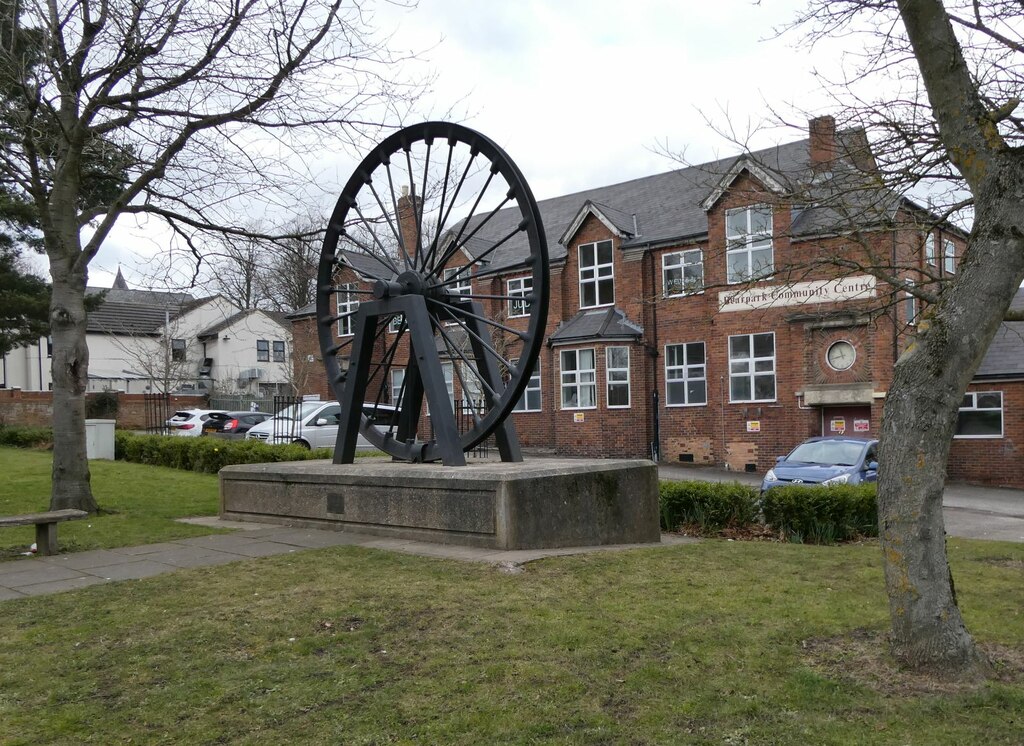
The colliery has been cleared, but the village keeps its memory. Bearpark Community Centre — a red brick building put up in 1921 as the miners' welfare hall — is at the hub of the village, and an old pit wheel stands in front of it as a memorial to Bearpark's mining history. Bearpark Colliery Road still carries the pit's name.
The former miners' welfare hall of 1921, now the community centre, with a pit wheel in front of it.
Related mines
- East Hedley Hope Colliery — Both Bearpark Coal & Coke Co. collieries in the Deerness valley, East Hedley Hope from June 1936 to nationalisation.
- Hedleyhope Colliery — Both were held by the Bearpark Coal and Coke Company.
- Littleburn Colliery — Both were held by the Bearpark Coal and Coke Company.
Nearby mines
- Ushaw Moor Colliery — 1.0 miles (1.7 km) SW
- Broom Park Colliery — 1.2 miles (1.9 km) S
- New Brancepeth Colliery — 1.5 miles (2.5 km) SW
- Aykley Heads Colliery — 1.8 miles (2.8 km) E
- Witton Colliery — 1.8 miles (2.8 km) N
Straight-line distance, within 9 miles (15 km). Show on the map.
Disasters & major incidents
-
Bearpark Colliery fall of stone, 1902
20 June 1902 · Collapse / Roof Fall · 2 fatalities
On 20 June 1902 a chock drawer and a young timber leader were killed by a large fall of stone while repairing an old roadway at Bearpark Colliery, near Durham.
What's uncertain
Points where sources disagree or the record could not be settled; both accounts are kept. All open questions in the archive.
- Bearpark Community Centre, a red brick building originally put up in 1921 as a miners' welfare hall, stands at the hub of the village with an old pit wheel in front of it as a memorial to Bearpark's mining history. (uncertain) 2
Recorded claims
Individual factual claims, each attached to the source(s) that support it below. Where sources disagree, both are kept.
- The colliery opened in 1872 and closed on 6 April 1984. 1
- It was held by the Bearpark Coal Company from 1872, the Bearpark-Brancepeth Coal & Coke Company in the 1880s, the Bearpark Coal & Coke Company from the 1890s, and the National Coal Board from 1947. 1
- The returns record coking and manufacturing coal with fireclay from 1894 to 1921 and coking coal alone through the 1920s and 1930s; in 1947 the colliery raised 350,000 tons of bunker, coking, manufacturing and steam coal. 1
- The Durham Mining Museum records no disaster of five or more killed at Bearpark, though it lists 90 named fatalities across the colliery's working life. 1
- Theodore Fry was involved in founding the Bearpark Coal and Coke Company in 1872, which established the coal mine at Bearpark. 2
- Bearpark Community Centre, a red brick building originally put up in 1921 as a miners' welfare hall, stands at the hub of the village with an old pit wheel in front of it as a memorial to Bearpark's mining history. (uncertain) 2
- In 1894 the colliery had three shafts working the Busty, 66 fathoms deep, and the Hutton about nine fathoms above it, with about 1,000 men and boys; fifty of its coke ovens were Simon Carves ovens recovering benzol, ammonia and coal tar. 1,3
- The Bearpark Coal and Coke Company was directed by Theodore Fry, a Quaker ironmaster from Darlington. 3
- Employment peaked in 1925 at 1,367, 1,049 below ground and 318 above. 3
- Bearpark's coke ovens opened as beehive ovens in 1873 and were replaced by by-product ovens in 1917. 1
- The Hutton was abandoned on 21 December 1929 and the Busty in 1948. 1
- The 16 Feet Pit section runs to about 427 feet. 4
Photographs & further reading
The colliery's opening and closing dates, its shaft, the succession of coal and coke companies that owned it, and the annual output returns from 1873 to 1985.
View sourceWhellan's 1894 description of the colliery, its coke ovens and village, with the 1925 employment peak.
View sourceSources
- (primary) Durham Mining Museum: Bearpark Colliery — Durham Mining Museum
- (secondary) Bearpark — Wikipedia
- (secondary) Bearpark Colliery (1872 - 1984) — Co-Curate (Newcastle University)
- (primary) Bearpark Colliery: strata sunk in the 16 Feet Pit — Durham Mining Museum
Record created: 3 September 2026 · Last researched: 5 October 2026