 MineArchive
Broom Park Colliery
| Also known as | Broompark Colliery |
|---|---|
| Location | Broompark, Deerness valley, near Durham, County Durham — 54.7683, -1.6137 (approximate) |
| Commodity | Coal |
| Type | Coal |
| Worked | 1870 (sinking)–1905 |
| Maximum depth | 625 feet (shaft to the Victoria seam, 1870) |
| Operators | North Brancepeth Coal Company Ltd (1870–?) |
Overview
The North Brancepeth Coal Company's colliery at Broompark, west of Durham, sunk in 1870 to the Victoria seam; it employed over 600 in 1894, lost its buildings to fire in 1904, and was worked on from Littleburn until 1935.
History
Broom Park Colliery lay at Broompark, in the Deerness valley about three miles west of Durham, and was worked by the North Brancepeth Coal Company. Its shaft was sunk in 1870 from a surface about 300 feet above sea level, passing the Low Main, Brass Thill, Hutton, Harvey, Busty, B and Brockwell seams to the Victoria at 625 feet. A few colliery houses were built near the old village of Broom.
The colliery was standing through the 1880s, with J. A. Ramsay and then M. F. Holliday as agent. By 1894 it employed 638 people, 450 of them underground; its Hutton was then a prize gas coal at about 30 fathoms, and the deeper Harvey, Busty and Brockwell gave coking coal. Numbers fell to 240 by 1900, under the manager William C. Daglish.
The Hutton was abandoned as exhausted on 4 August 1905. The historic environment record says that a fire on 8 August 1904 destroyed many of the buildings and that, rather than rebuild, the coal was worked from nearby Littleburn Colliery; it also says the colliery never began production, which the mining returns of the 1890s contradict. From 1905 Broom Park was returned together with Littleburn, with 870 people in 1910, and its Low Main, Hutton and Busty workings were abandoned with Littleburn's on 9 July 1935. The site is now the County Council's Broompark picnic site.
Geology
The 1870 shaft passed the Low Main, Brass Thill, Hutton (3 feet at 174 feet), Harvey, Busty (4 feet 6 inches at about 449 feet), B, Brockwell and Victoria seams. The Hutton gave gas coal; the Harvey, Busty and Brockwell coking coal.
Workings
A shaft sunk in 1870 to the Victoria seam; the Hutton was the main seam worked, and from 1905 the workings were run with Littleburn Colliery's.
Closure
The Hutton was abandoned as exhausted on 4 August 1905, after a fire in August 1904; the remaining workings were abandoned with Littleburn on 9 July 1935.
What remains
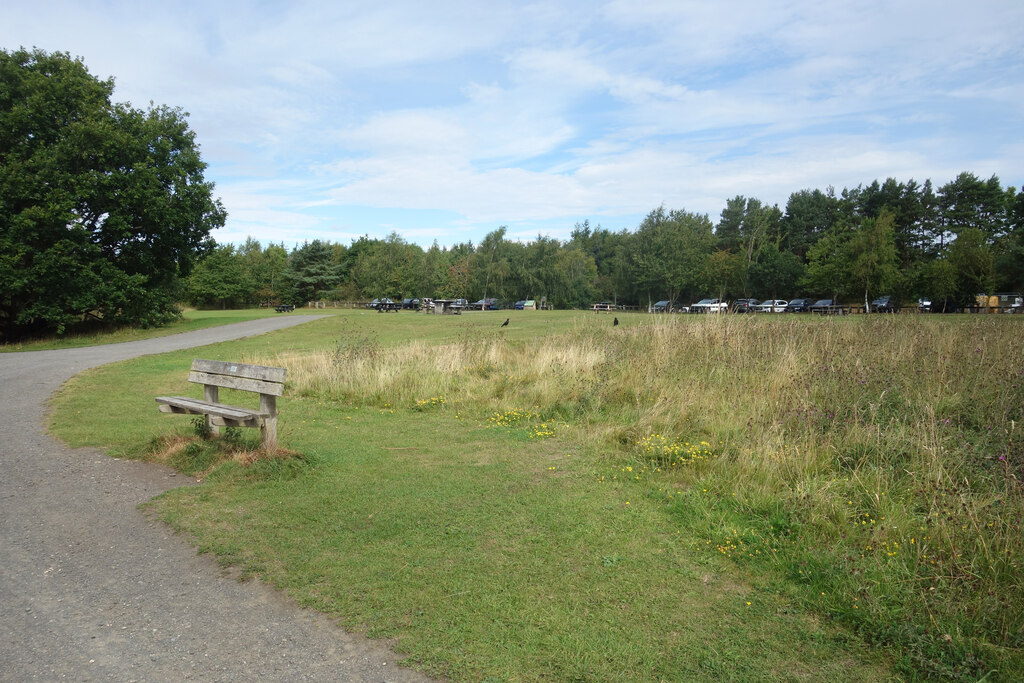
The site is occupied by Durham County Council's Broompark picnic site.
Redevelopment
Broompark picnic site, with paths on the old railway lines.
Related mines
- Littleburn Colliery — Broom Park's coal was worked from Littleburn after 1904, and their workings were abandoned together in 1935.
Nearby mines
- Brandon Colliery — 1.0 miles (1.6 km) S
- Bearpark Colliery — 1.2 miles (1.9 km) N
- Littleburn Colliery — 1.3 miles (2.0 km) S
- Ushaw Moor Colliery — 1.4 miles (2.3 km) NW
- Browney Colliery — 1.6 miles (2.5 km) S
Straight-line distance, within 9 miles (15 km). Show on the map.
What's uncertain
Points where sources disagree or the record could not be settled; both accounts are kept. All open questions in the archive.
- The colliery never began production of coal. (disputed) 4
Recorded claims
Individual factual claims, each attached to the source(s) that support it below. Where sources disagree, both are kept.
- Sunk in 1870 to the Victoria seam at 625 feet. 1,2
- Employed 638 people in 1894, 450 of them underground. 1
- Operated by the North Brancepeth Coal Company. 1,3
- A fire on 8 August 1904 destroyed many of the colliery buildings, and the coal was afterwards worked from Littleburn Colliery. 4
- The colliery never began production of coal. (disputed) 4
- The Hutton seam was abandoned as exhausted on 4 August 1905. 5,6
- W. C. Daglish was manager from 1900 to 1910. 7
- The site is now the County Council's Broompark picnic site. 4
Photographs & further reading
The Durham historic environment record for the colliery site.
View sourceSources
- (primary) Broom Park Colliery — Durham Mining Museum
- (primary) Account of Strata sunk through from surface to the Victoria Seam, at Broompark Colliery, near Durham, 1870 (An Account of the strata of Northumberland & Durham as proved by Borings & Sinkings, Vol. A-B, 1878) — North of England Institute of Mining & Mechanical Engineers, via the Durham Mining Museum
- (secondary) Broompark — Wikipedia
- (secondary) Broompark Colliery (HER D3969) — Keys to the Past (Durham and Northumberland HER)
- (primary) Catalogue of Plans of Abandoned Mines: Broom Park Colliery — Durham Mining Museum
- (primary) Broom Park Mine Plans (Mining Remediation Authority abandonment plan 4864, Hutton, 1905) — British Geological Survey / Mining Remediation Authority
- (primary) Broom Park Colliery: Colliery Management (prior to 1970) — Durham Mining Museum
Record created: 9 October 2026 · Last researched: 9 October 2026