 MineArchive
Fathom
| Category | Prospecting & Exploration |
|---|
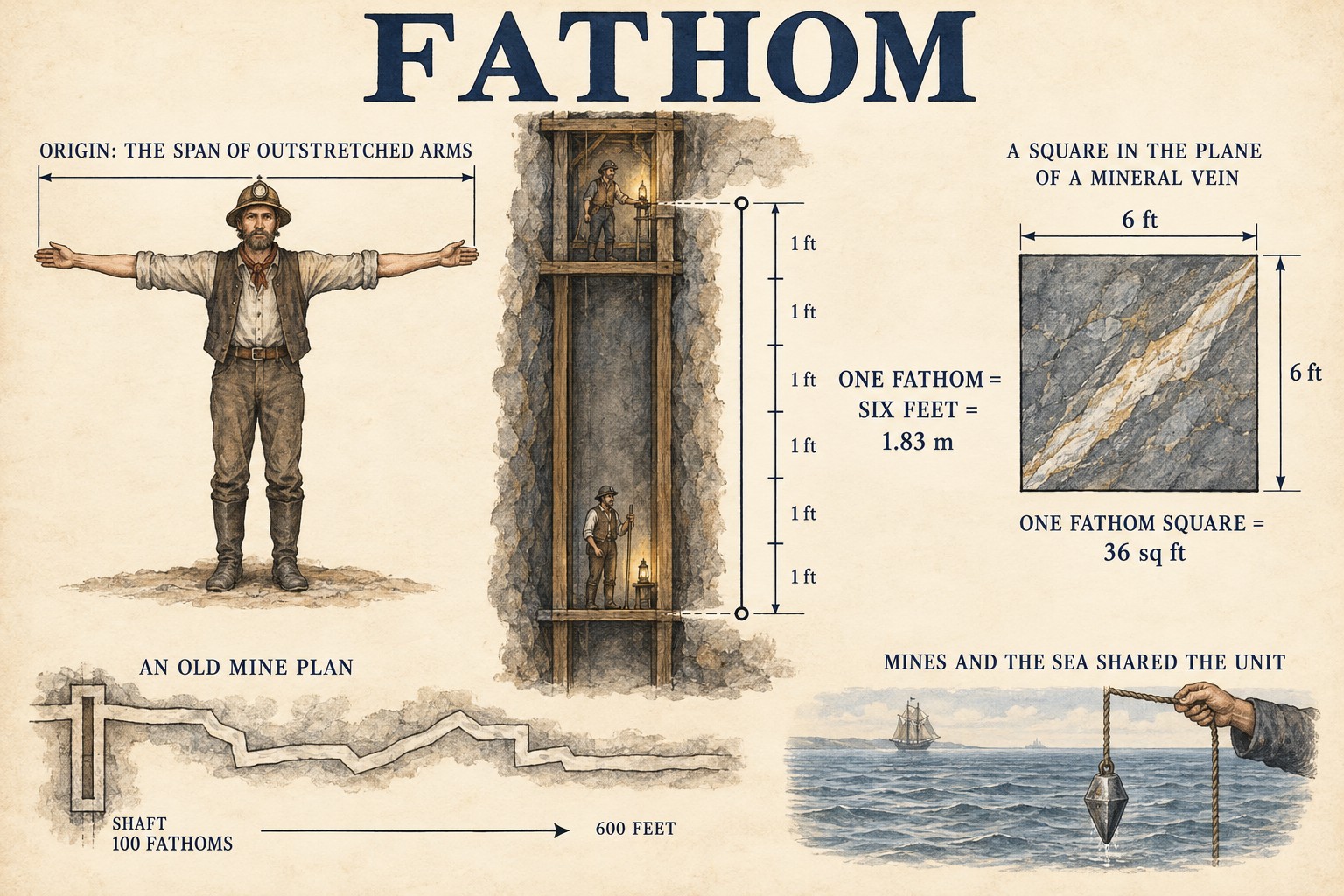
A traditional unit of length equal to six feet (1.83m), used until the early 20th century as the standard British unit for measuring the depth of a mine.
Historical usage
The fathom's origin lies in seafaring rather than mining — from the Old English 'fæthm', the span of a person's outstretched arms — and it remained the standard nautical unit of depth long before and after its adoption underground. British mines used the fathom as their normal unit for shaft depth and level spacing right up until the early 20th century, when it gave way to feet and, eventually, metres.
How it worked
A fathom measured six feet vertically; miners also used it as a unit of area, one fathom square (six feet by six feet, or 36 square feet) in the plane of a vein, for measuring the extent of ground worked or allocated.
Why it was used
As a unit already familiar from everyday seafaring and rough measurement, the fathom gave miners and mine managers a simple, shared way to record and compare shaft depths and level spacing without needing more specialised units.
Regional variation
The fathom was used across the British mining industry generally, not tied to any one region or commodity, though depth figures recorded in fathoms are especially common in older Cornish and Derbyshire mine records.
Related terminology
Mines associated with this term
5 examples chosen from 163 linked records — the term page is not an index.
- Bowhill Colliery — Fife (well documented example)
Named twice in this record, first in the history: “…as 'the Josephine' ever after. The sinking met payable coal from 81 fathoms (the Bower Bank seam) down to 219 fathoms (the Two Feet, or…” - Lassodie Colliery — Fife (well documented example)
Named 3 times in this record, first in the history: “…10 and 11 were sunk at the east side of the estate, to 60 and 124 fathoms. The work was labour-intensive and drew miners and families in…” - Sheriff Hill Colliery — Tyne and Wear (well documented example)
Named 6 times in this record, first in the history: “…was sunk about 1785-95 to the Hutton seam, five feet thick at 125 fathoms, passing fifteen seams on the way, with the High Main at about 60…” - Stargate Colliery — Tyne and Wear (well documented example)
Named 3 times in this record, first in the summary: “A Ryton colliery sunk from 1800 to the Brockwell seam at 83 fathoms, scene of the explosion of 30 May 1826 that killed 38 men and boys;…” - Wheal Vor — Cornwall (well documented example)
Linked on an exact-phrase match in this record's own text.
Disasters associated with this term
5 examples chosen from 45 linked records, most direct relationship first.
- Auckland Park Colliery Shaft Accident, 1863 (contextual relationship)
Named twice in this record, first in the summary: “…pipe, their weight tipped the cradle, and four of them fell about 51 fathoms into five feet of water at the bottom of the shaft. The cradle swung…” - Backworth Colliery shaft accident, 1857 (contextual relationship)
Named in this record’s narrative: “…which they were being wound up fell away from the hook. The pit, 85 fathoms deep, had lately been sunk, so the old basket was still in use while…” - Bigge Pit explosion, 1841 (contextual relationship)
Named in this record’s narrative: “…small: headways of 220 and 280 yards east and west from a shaft 140 fathoms deep, through the High Main to the Bensham seam. The men worked with…” - Boosbeck subsidence, 1883 (contextual relationship)
Named in this record’s cause: “…at fault in 1884 court proceedings. A bed of quicksand about 13 fathoms (78 feet) thick lying above the ironstone, and containing much…” - Botallack Mine shaft accident (contextual relationship)
Named in this record’s narrative: “…a shaft driven at an angle of about 32.5 degrees, extending some 400 fathoms out beneath the seabed — when the chain drawing their carriage broke…”
Sources
- (secondary) Fathom — Encyclopaedia Britannica
- (secondary) Fathom: Unit of Depth Equal to Six Feet — UK Sailmakers
Record created: 22 August 2026 · Last researched: 22 August 2026