 MineArchive
Wheal Vor
| Location | Breage, Cornwall — 50.1179, -5.3266 (exact) |
|---|---|
| Commodities | Tin, Copper |
| Type | Metal |
| Worked | From the 15th century–1911 |
| Maximum depth | 274 fathoms (501m) to the richest lode; workings ultimately reached around 600m |
| Operators | John Gundry (1800–1828), Harvey & Co of Hayle (1810–1848), Cornish Copper Company (1823–1848) |
Overview
Wheal Vor, north of Breage, was for a time the richest tin mine in Cornwall — accounting for a quarter of the county's entire tin output in the 1820s — before a twenty-year legal dispute over mineral rights, rather than any shortage of ore, closed it down. Three later attempts to reopen it across more than a century all ultimately failed, and the site is now part of a fresh 21st-century tin and lithium exploration project.
History
Surface working at Wheal Vor may go back to the late Roman period, and underground mining is documented from the 15th century, producing mainly copper until working ceased around 1715; the mine then lay abandoned for close to a century. Captain John Gundry reopened it around 1800-1810, and it entered its most celebrated period between 1812 and 1848, becoming for a time the richest mine in Cornwall — during the 1820s it produced over 1,000 tons of tin metal a year, a quarter of the county's entire output, and for some months ran at 200 tons of white tin a month after striking an exceptionally rich lode at the 274-fathom level, averaging around 5% tin against the 1-1.5% typical of most Cornish lodes. The Godolphin family held early interests in the sett, the Cornish Copper Company became a major shareholder and operated a smelter for the mine's ore from 1823, and Harvey & Co of Hayle, both a shareholder and one of Cornwall's leading engine builders, supplied much of its steam machinery — Wheal Vor is credited as the first Cornish mine to use steam power for dewatering. Gundry's company went bankrupt in 1828, beginning a mineral-rights dispute between the owners that dragged on for twenty years; with litigation unresolved, essential repairs went undone and underground safety conditions steadily worsened, and the mine finally closed in 1848 not because its tin was exhausted but because the dispute made it impossible to keep working. A new company reopened Wheal Vor in the 1850s, installing a 100-inch beam engine — the largest ever used in Cornwall — alongside an 85-inch engine, and spent over four years pumping the flooded workings dry; production peaked again at over 840 tons of black tin in 1865 and 1866 before falling away sharply, to just 13 tons by 1877 and a skeleton workforce of five men by 1881. A third attempt to reopen the mine ran from 1906 to 1911, this time using electric pumps; it raised some black tin between 1907 and 1910; and it employed up to 103 people at its 1908 peak before a catastrophic failure of the electric generator ended the venture in 1911. A further proposed reopening in the 1960s, by Camborne Tin Limited, promised several hundred jobs in an area of high unemployment but collapsed by 1967 amid opposition from the local water company — whose supply drew on the mine's own adits — and prolonged, ultimately unresolved negotiations over mineral rights with the Duke of Leeds' estate. The site has remained unworked since, though Cornish Tin Ltd began new exploration across the old sett in 2022, reporting a newly identified high-grade tin lode and a lithium-bearing granite in the same ground.
Geology
The mine worked exceptionally rich tin- and copper-bearing lodes associated with Cornwall's granite, part of the same Cornubian orefield responsible for the mineralisation across the county's tin- and copper-mining district; its richest ground, struck at the 274-fathom level, graded around 5% tin against the 1-1.5% typical of most Cornish lodes.
Geological setting: Hydrothermal Deposits (well documented example), Veins and Lodes (well documented example)
Workings
Crease's Shaft, named after company chairman Henry Pering Pellew Crease, served as the mine's main drainage point. Workings ultimately reached a depth of around 600 metres. The 1850s reopening's dewatering plant — a 100-inch beam engine, the largest ever installed in Cornwall, working alongside an 85-inch engine — took more than four years to empty the flooded mine before production could resume.
Closure
The mine finally fell out of use after the failed 1906-1911 reopening attempt, and a further proposed 1960s reopening collapsed by 1967 over water rights and unresolved mineral-rights negotiations; the site has remained unworked since, though the ground was newly explored by Cornish Tin Ltd from 2022.
What remains
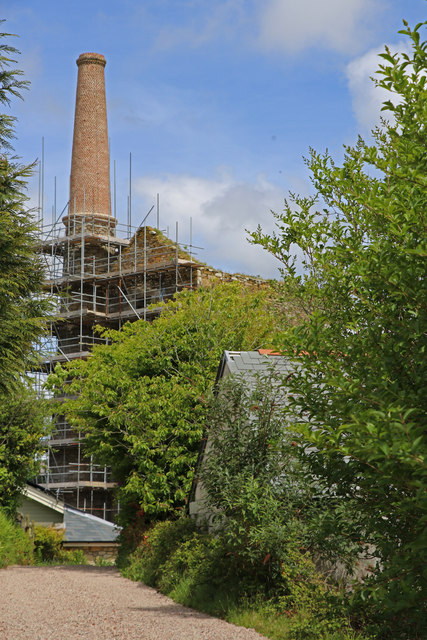
No significant remains survive at the Wheal Vor site itself. Its one substantial surviving engine house — built over the mine's Trelawney's Shaft — was dismantled stone by stone and rebuilt in 1864 at the neighbouring Wheal Metal's Ivey's Shaft, where it still stands today as the only large surviving engine house of this whole mining group; it was Grade II listed in 1987. A row of mine cottages associated with the sett has been separately Grade II listed since 1972.
The wider sett has formed part of the Cornwall and West Devon Mining Landscape World Heritage Site since 2006.
Related mines
- Wheal Metal — Wheal Metal was acquired in 1853 by Great Wheal Vor United and worked as part of one combined operation with Wheal Vor; the 85-inch pumping engine that came to stand over Wheal Metal's own Ivey's Shaft was physically relocated there, stone by stone, from Wheal Vor's own Trelawney's Shaft in 1860.
Nearby mines
- Wheal Fortune — 0.4 miles (0.7 km) SE
- Wheal Metal — 0.5 miles (0.8 km) NE
- Tregonning Hill China Clay Pits — 1.4 miles (2.3 km) W
- Wheal Grey Mine — 1.8 miles (2.8 km) W
- Great Work Mine — 1.9 miles (3.0 km) W
Straight-line distance, within 9 miles (15 km). Show on the map.
Recorded claims
Individual factual claims, each attached to the source(s) that support it below. Where sources disagree, both are kept.
- During the 1820s the mine produced over 1,000 tons of tin metal a year, a quarter of Cornwall's entire tin output, briefly running at 200 tons of white tin a month after striking an exceptionally rich lode at the 274-fathom level. 1,2
- The mine employed 1,174 people in 1836, falling to just 5 workers by 1881 and rising again to 103 at the 1906-1911 reopening's 1908 peak. 1
- The mine closed in 1848 not through exhaustion of its ore but because a 20-year legal dispute over mineral rights, following the 1828 bankruptcy of Gundry's company, left it without maintenance or investment. 1
- Cornish Tin Ltd began new exploration across the historic Wheal Vor sett in 2022, reporting a newly identified high-grade tin lode and a lithium-bearing granite in the same ground. 2
- Located at about 50.118 N, 5.327 W. 1
Sources
- (secondary) Wheal Vor — Wikipedia
- (secondary) Great Wheal Vor — Cornish Chamber of Mines & Minerals
- (primary) Wheal Vor Mine Plan (BGS Mine Plans Catalogue) — British Geological Survey / The Coal Authority
Record created: 22 August 2026 · Last researched: 22 August 2026