 MineArchive
Tregonning Hill China Clay Pits
| Also known as | Tregonning Hill Mine, Cookworthy Quarry, Tregonning Hill China Clay and Brick Works |
|---|---|
| Location | Tregonning Hill, between Germoe and Breage, near Helston, Cornwall — 50.1209, -5.3580 (approximate) |
| Commodity | China Clay |
| Type | Clay |
| Worked | c. 1746–By 1907 |
| Maximum depth | Unknown. |
| Operators | William Argall and Company (1871–1889), William Cookworthy (1746–?), John Lovering (1889–?) |
Overview
The china clay pits on Tregonning Hill, between Germoe and Breage near Helston, where the Plymouth chemist William Cookworthy found the first china clay in Britain in the 1740s and took the leases that supplied his experiments in hard-paste porcelain. The clay was stained with mica and soon outclassed by St Austell's, but the pits were worked again in the 19th century and fed a brickworks until early in the 20th.
History
In 1746, by the account of Germoe Parish Council's leaflet and Cornwall Calling, or 1745 by Wikipedia's, Cookworthy was staying with Captain Nancarrow of the Great Work Mine at Godolphin when he saw the miners repairing their furnaces with clay; they told him it came from the slopes of Tregonning Hill, where it was called moorstone. He took samples back to his laboratory in Plymouth, found that the clay fired with china stone made porcelain, and leased several pits on the hill, shipping the clay from Porthleven to Plymouth; by December 1766 he had a small factory making trial pieces, and a tankard he made on 14 March 1768 was the first hard-paste porcelain made in Britain. The Tregonning clay held dark specks of mica, and purer clay at St Stephen's near St Austell soon replaced it. The workings were abandoned in 1839 during a slump in the china clay trade. In 1851 William Browne of St Austell leased the setts and opened the Leeds works near Cookworthy's pits, while the original setts went to William Lobb, and in 1863 Henry Wheeler Higman opened a new pit at Tresowes Moor. In 1871 William Argall, a mine captain from Breage, backed by the ironfounders William Harvey of Hayle and John Toy of Helston, turned to brickmaking, building kilns and drying sheds on the northern slopes; the bricks, firebricks for hearths and building bricks, were stamped 'Tregonning Hill'. Clay shipments from Porthleven ran at 61 to 136 tons a year in 1876-79, exports of clay and firebricks to New York began through Hayle in 1880, and in 1882 Tregonning Hill produced 500 tons against Tresowes' 700; in the early 1880s the brickworks employed ten people and made about 150,000 bricks a year. Argall took over the Tresowes and Wheal Grey setts, in 1875 by one account and in 1886-89 by another, and by 1890 William Argall and Company controlled the whole area. He retired in 1889 or 1893 by the two accounts, and most of the setts passed to John Lovering and Company of St Austell. An Ordnance Survey map of 1907 shows the brickworks disused.
Geology
Tregonning Hill is a detached outcrop of the Cornubian granite batholith, partly altered by kaolinisation to china clay. The clay here carried dark specks of mica, which made it poorer for porcelain than the clay later found around St Austell.
Geological setting: Kaolinization and China Clay Deposits (well documented example)
Workings
Open clay pits on the hill, among them Cookworthy's pits and Cookworthy Quarry, the Leeds pit and works, and the Tresowes and Wheal Grey pits on the western side, with kilns and drying sheds for the brickworks on the northern slopes at Wheal Bunny and near Tresowes Green.
Closure
The first working declined once purer clay was found at St Austell, and the pits were abandoned in 1839 in a slump. Revived from 1851, the industry ended in the early 20th century; the Ordnance Survey map of 1907 shows the brickworks disused.
What remains
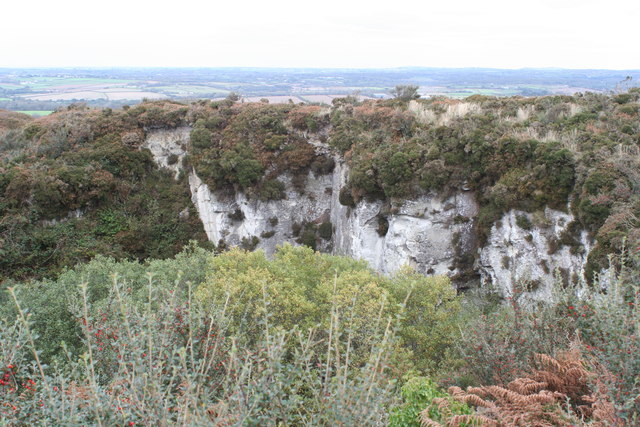
The pits are now filled with water and revegetating with gorse, and the bare slopes of the old china clay works are where the western rustwort, a liverwort once known in Britain only from this hill, grows; part of the hill is a Site of Special Scientific Interest, notified in 1994. A partly ruinous Scrivener kiln survives from the brickworks, listed Grade II in 1987. The hill lies within the Cornish Mining World Heritage Site, much of it is a scheduled monument on the Heritage at Risk Register, and in autumn 2023 the Cornwall Heritage Trust bought its 70 acres. A 2011 photograph shows one of Cookworthy's pits as a steep white-walled hollow under heather and scrub.
Water-filled clay pits, waste tips and gullies, Cookworthy Quarry, and the Scrivener kiln of the brickworks.
Redevelopment
None: the hill is heathland owned by the Cornwall Heritage Trust since 2023.
Related mines
- Great Work Mine — Great Work's miners mended their furnaces with Tregonning Hill clay, which is how Cookworthy found it in the 1740s.
Nearby mines
- Great Work Mine — 0.9 km NW
- Wheal Vor — 1.5 km SE
- Wheal Fortune — 2.3 km E
- Wheal Metal — 2.9 km E
- Wheal Prosper — 3.1 km S
Straight-line distance, within 15 km. Show on the map.
People
- William Argall · proprietor, 1871–1889 — via the operator record William Argall and Company
- William Browne · lessee, from 1851 — Of St Austell; leased the setts in 1851 and opened the Leeds works.
- William Cookworthy · lessee, from 1746 — via the operator record
- Henry Wheeler Higman · lessee, from 1863 — Of St Austell; opened the Tresowes Moor pit in 1863.
- William Lobb · lessee, from 1851 — Of St Austell; took Cookworthy's original setts.
- John Lovering · proprietor, from 1889 — via the operator record
- John Toy · partner, from 1871 — Helston ironfounder who backed Argall's works and worked the Leeds sett with him by 1876.
What's uncertain
Points where sources disagree or the record could not be settled; both accounts are kept. All open questions in the archive.
- Cookworthy discovered china clay at Tregonning Hill in 1746, after seeing miners at the Great Work Mine repair their furnaces with it. (disputed) 1,2,3
- Cookworthy observed the fine clay being used to repair furnaces while visiting the area in 1745. (disputed) 4
- Argall took over the Tresowes and Wheal Grey setts in 1875 and retired in 1893. (disputed) 2
- Argall took over Tresowes Hill works in 1886 and the other Tresowes setts in 1889, when he retired and his setts passed mostly to John Lovering and Company. (disputed) 1
Recorded claims
Individual factual claims, each attached to the source(s) that support it below. Where sources disagree, both are kept.
- Cookworthy discovered china clay at Tregonning Hill in 1746, after seeing miners at the Great Work Mine repair their furnaces with it. (disputed) 1,2,3
- Cookworthy observed the fine clay being used to repair furnaces while visiting the area in 1745. (disputed) 4
- A tankard Cookworthy made from Tregonning Hill kaolin, dated 14 March 1768, was the first hard-paste porcelain made in Britain. 4,5
- Cookworthy leased clay pits on the hill and shipped the clay from Porthleven to Plymouth. 4,1,2
- The Tregonning clay contained dark specks of mica, and purer clay found near St Austell replaced it. 1,2
- The workings were abandoned in 1839; William Browne leased the setts in 1851 and opened the Leeds works, and Henry Wheeler Higman opened Tresowes Moor in 1863. 1
- In 1871 William Argall, backed by William Harvey of Hayle and John Toy of Helston, began brickmaking on the hill; the bricks were stamped 'Tregonning Hill'. 4,2
- In 1882 Tresowes produced 700 tons of china clay and Tregonning Hill 500 tons. 4
- Argall took over the Tresowes and Wheal Grey setts in 1875 and retired in 1893. (disputed) 2
- Argall took over Tresowes Hill works in 1886 and the other Tresowes setts in 1889, when he retired and his setts passed mostly to John Lovering and Company. (disputed) 1
- The Cornwall Heritage Trust acquired the 70-acre site in 2023; it is within the Cornish Mining World Heritage Site and on the Heritage at Risk Register. 4,6
Photographs & further reading
Historic England's scheduling of the hill's archaeological landscape; not read for this record.
View sourceSources
- (secondary) Tregonning Hill Mine, Cornwall — Cornwall Calling
- (secondary) Tregonning Hill (walk leaflet) — Germoe Parish Council
- (observational) Quarry on Tregonning Hill (photograph, 2011) — Geograph Britain and Ireland
- (secondary) Tregonning Hill — Wikipedia
- (secondary) William Cookworthy - Discoverer of china clay in Cornwall — Cornwall Guide
- (secondary) Tregonning Hill — Cornwall Heritage Trust
Record created: 18 September 2026 · Last researched: 18 September 2026