 MineArchive
Great Work Mine
| Location | Between Godolphin Hill and Tregonning Hill, near Breage and Godolphin Cross, Cornwall — 50.1279, -5.3654 (exact) |
|---|---|
| Commodities | Tin, Copper, Lead |
| Type | Metal |
| Worked | By 1538–1939 |
| Maximum depth | At least 170 fathoms (about 311 m) at Crane and Goodfortune shafts, the deepest recorded on the sett |
| Operators | Godolphin family (?–1785), Duke of Leeds (1785–?), Great Work Consolidated Tin Mines Ltd (1888–1902), Great Work Tin Mines Ltd (1935–1938) |
Overview
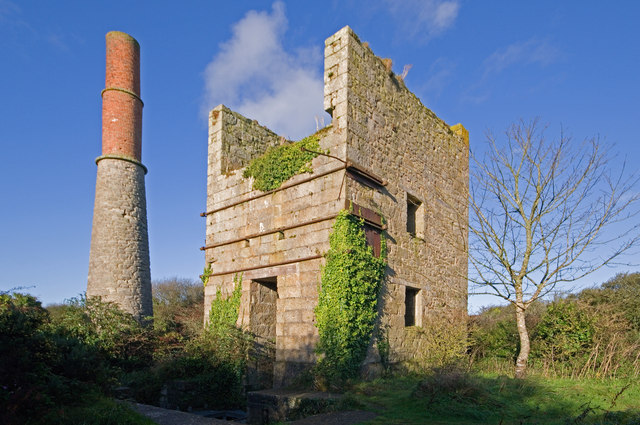
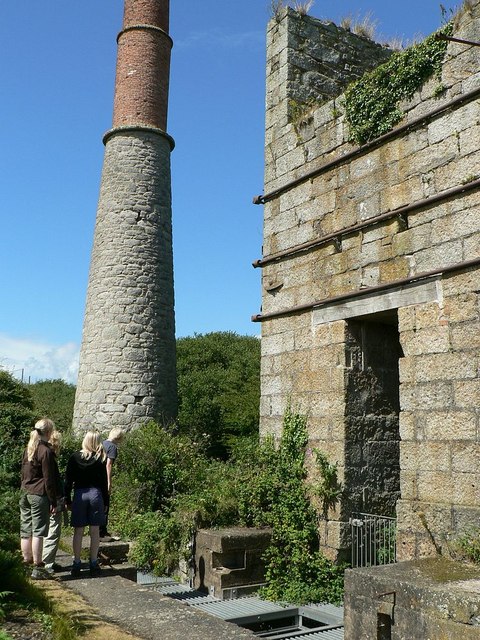
Great Work Mine worked tin, copper and lead lodes in the granite saddle between Godolphin Hill and Tregonning Hill, near Breage, from at least 1538 until final closure in 1939. One of the largest and longest-lived mines on the Godolphin estate, it passed through repeated cycles of closure and revival across four centuries, and its surviving Leeds shaft beam engine house and detached chimney — both Grade II listed and restored in 2005 — are now in the care of the National Trust as part of the Godolphin Estate and the Cornwall and West Devon Mining Landscape World Heritage Site.
History
Great Work had opened by 1538, worked on land leased from the Godolphin family. The antiquary John Leland visited and recorded that "there are no greater Tynne workes yn al Cornwal than be on Sir Wylliam Godolcan's Ground." By 1584 the mine is recorded as employing at least 300 people with annual profits of around £1000, though the figure of over 3,000 workers repeated on some tourism-oriented sites for the same period is uncorroborated by any cited source and is treated cautiously here (see Recorded claims). Ownership passed from the Godolphin family to the Duke of Leeds in 1785, and the mine's principal shaft — Leeds shaft — takes its name from this change of proprietor. It was here in 1689 that Thomas Epsley is credited with introducing blasting into Cornish mining for the first time, a significant technical advance for the industry generally.
The mine closed in 1793 as the price of tin fell, before being revived in 1810 as a major copper producer. This reworking employed over 400 people for most of the 19th century, working five lodes with five engines by the height of deep mining, though underground work ground to a halt in 1873. The mine was put up for sale as a going concern by William Teague of Treliske in January 1885, and when it did not sell, three engines and other machinery and materials were auctioned off in November 1885. C. M. Thomas purchased the mine in 1888, forming Great Work Consolidated Tin Mines Ltd with £100,000 of capital, and restarted the pumping and stamping engines on 10 October 1888.
The site saw several further, shorter-lived revivals into the 20th century: worked as Old Great Works between 1890 and 1902, then as South West Cornwall Mines from 1907 to 1912, and again from 1927 alongside neighbouring Wheal Reeth for about ten years. A final attempt came in 1935 as Great Work Tin Mines Ltd, which began de-watering the Deerpark shaft section before shifting attention to higher levels and allowing the lower workings to flood again; work stopped for good shortly after. Some miners continued working above adit level after the main 1930 closure, and a mid-1930s attempt to de-water the mine more generally was abandoned before it closed permanently. Sources differ slightly on the exact final year — 1938 or 1939 — but agree the closure was permanent. A terrace of twenty-six houses was built for miners on Bal Lane during the mine's working life.
Geology
The mine's lodes were worked within the granite outcrop that forms Godolphin Hill and Tregonning Hill, exploiting cassiterite-bearing veins along with copper and minor lead mineralisation. The mining engineer W. J. Henwood recorded in 1843 that where the Wheal Breage lode passed from granite into the surrounding greenstone (killas), the tin ore it carried "disappeared instantly" — a specific, documented illustration of how the tin mineralisation at Great Work was concentrated within the granite host rather than continuing uniformly into the country rock beyond it.
Geological setting: Hydrothermal Deposits (well documented example), Veins and Lodes (well documented example)
Workings
The sett was worked through at least 27 named shafts, including Leeds (160 fathoms/293 m), India (73 fathoms/134 m), Cooper's (49 fathoms/90 m), Pay-my-debt (66 fathoms/121 m), Trehayle (99 fathoms/181 m), Payhouse, Mollard's and Dudda's (each 83 fathoms/152 m), Blow (100 fathoms/183 m), Crane and Goodfortune (each 170 fathoms/311 m, the deepest on the sett), Pensandane (50 fathoms/91 m), Deerpark (180 fathoms/329 m), Blue Dipper (74 fathoms/135 m), Fire Engine (50 fathoms/91 m) and Burnt Whim, alongside Pool's, New Barker's, Planner's, Bank, Chain, Wheal Breage, Wheal Kine, Barker's, Richard's, Highburrow and Pennack's shafts. Five main lodes were worked: Main, Wheal Reeth, Middle, Wheal Breage and South Wheal Breage. The first engine house on the site held a pumping engine of unknown size brought from Ludgvan-Lees Mine in 1754; a pumping engine was also at work on Fire Engine shaft by 1768, alongside two sets of stamps. The surviving engine house, built circa 1829 on Leeds shaft, held a 60-inch pumping engine built in 1835 by Harvey's and Co. of Hayle, rebuilt in situ by the same firm in 1857.
Closure
Recorded output between 1832-40 and 1848-1902 totalled 6,256 tons of black tin, 1,020 tons of 7.5%-grade copper ore and 2 tons of arsenic. The mine's working life ended in stages rather than at a single point: underground work first halted in 1873, several short later revivals followed into the 1930s, and the final attempt — de-watering the Deerpark shaft from 1935 — was abandoned when the lower workings were allowed to flood again, with the mine closing permanently by 1939.
What remains
The Leeds shaft engine house and detached chimney survive as ruins and were restored in 2005; both structures are Grade II listed. Leeds shaft and Burnt Whim were capped with metal grates for public safety and to allow bats to roost in the shafts below. As of a February 2021 update, the engine house and surrounding shaft remains were freely accessible with a small free car park alongside, and the site was described as partially restored and relatively safe to visit, though — as with any historic mine working — not completely so.
The 60-inch pumping engine house on Leeds shaft and its detached chimney, with distinctive two-stage brick upper stack, are the principal surviving structures. Remains of other buildings and machinery bases from later reworkings survive scattered across the site among vegetation.
Redevelopment
The site is owned by the National Trust as part of the Godolphin Estate, alongside Godolphin House, and forms part of the Cornwall and West Devon Mining Landscape UNESCO World Heritage Site.
Related mines
- Tregonning Hill China Clay Pits — Great Work's miners mended their furnaces with Tregonning Hill clay, which is how Cookworthy found it in the 1740s.
- Wheal Grey Mine — Part of Wheal Grey was incorporated into Great Work Mine in 1868.
Nearby mines
- Tregonning Hill China Clay Pits — 0.6 miles (0.9 km) SE
- Wheal Grey Mine — 1.0 miles (1.7 km) S
- Wheal Vor — 1.9 miles (3.0 km) E
- Halamanning Mine — 2.0 miles (3.3 km) W
- Wheal Fortune — 2.2 miles (3.6 km) SE
Straight-line distance, within 9 miles (15 km). Show on the map.
What's uncertain
Points where sources disagree or the record could not be settled; both accounts are kept. All open questions in the archive.
- Great Work had opened by 1538. By 1584 the mine is recorded as employing at least 300 people with annual profits of around £1000 (Aslet, 2010). A higher, uncited figure of over 3,000 workers for the same late-16th-century period appears on some tourism-oriented sites (gooseygoo.co.uk, a Geograph photo caption) but is uncited and no other account repeats it. (uncertain) 1,2,3
- Ownership of the mine passed from the Godolphin family to the Duke of Leeds in 1785; the mine's principal shaft, Leeds shaft, takes its name from this change of proprietor. (uncertain) 2,3
- The mine closed in 1793 as the price of tin fell, before being revived in 1810 as a major copper producer. (uncertain) 4
- The mine was worked again as Old Great Works between 1890 and 1902, as South West Cornwall Mines from 1907 to 1912, and from 1927 alongside neighbouring Wheal Reeth for about ten years. (uncertain) 4
- In 1930 the mine closed with some miners continuing to work above adit level; it was de-watered in the mid-1930s in an attempt to reopen it, and closed permanently in 1939 per Wikipedia. A more detailed account gives the final attempt as Great Work Tin Mines Ltd from 1935, de-watering the Deerpark shaft before abandoning it and allowing the lower workings to flood again, with work stopping for the last time in 1938. Both accounts describe the same closing episode; the exact final year is not fully reconciled between them. (disputed) 1,4
- Mining engineer W. J. Henwood recorded in 1843 that where the Wheal Breage lode passed from granite into the surrounding greenstone (killas), the tin ore it carried disappeared instantly — a specific, documented illustration of the tin mineralisation being concentrated within the granite host. (uncertain) 4
Recorded claims
Individual factual claims, each attached to the source(s) that support it below. Where sources disagree, both are kept.
- Great Work had opened by 1538. By 1584 the mine is recorded as employing at least 300 people with annual profits of around £1000 (Aslet, 2010). A higher, uncited figure of over 3,000 workers for the same late-16th-century period appears on some tourism-oriented sites (gooseygoo.co.uk, a Geograph photo caption) but is uncited and no other account repeats it. (uncertain) 1,2,3
- Ownership of the mine passed from the Godolphin family to the Duke of Leeds in 1785; the mine's principal shaft, Leeds shaft, takes its name from this change of proprietor. (uncertain) 2,3
- Thomas Epsley is credited with first introducing blasting into Cornish mining at Great Work in 1689, hailed as the beginning of a new method of mining. 1,4
- The mine closed in 1793 as the price of tin fell, before being revived in 1810 as a major copper producer. (uncertain) 4
- Deep mining began in 1816 and continued until 1873, working five lodes with five engines and employing 500 people at its height (Barton, 1965); the reworking employed over 400 people for most of the 19th century, with underground work halting in 1873. 1,4
- William Teague of Treliske offered the mine for sale as a going concern in January 1885; three engines and other machinery, plant and materials were auctioned on 30 November 1885 when it did not sell. C. M. Thomas purchased the mine in 1888, formed Great Work Consolidated Tin Mines Ltd with £100,000 capital, and restarted the pumping and stamping engines on 10 October 1888 — dated to contemporary reporting in The Cornishman. 1
- The mine was worked again as Old Great Works between 1890 and 1902, as South West Cornwall Mines from 1907 to 1912, and from 1927 alongside neighbouring Wheal Reeth for about ten years. (uncertain) 4
- Recorded output for the mine across these periods totalled 6,256 tons (6,356,389 kg) of black tin, 1,020 tons (1,036,368 kg) of 7.5%-grade copper ore, and 2 tons (2,032 kg) of arsenic — sourced to H. G. Dines (1956), The metalliferous mining regions of south-west England, British Geological Survey. 4
- In 1930 the mine closed with some miners continuing to work above adit level; it was de-watered in the mid-1930s in an attempt to reopen it, and closed permanently in 1939 per Wikipedia. A more detailed account gives the final attempt as Great Work Tin Mines Ltd from 1935, de-watering the Deerpark shaft before abandoning it and allowing the lower workings to flood again, with work stopping for the last time in 1938. Both accounts describe the same closing episode; the exact final year is not fully reconciled between them. (disputed) 1,4
- The surviving engine house on Leeds shaft is dated circa 1829 by Historic England (List Entry 1328328, Grade II, listed 26 August 1987) and held a 60-inch pumping engine built in 1835 by Harvey's and Co. of Hayle, rebuilt in situ by the same firm in 1857. It was the site's second engine house — the first, of unknown size, was moved from Ludgvan-Lees Mine in 1754 and no longer survives. A detached chimney at the same location, with distinctive two-stage brick upper section, is separately Grade II listed. 1,5,4
- The Leeds shaft engine house was restored in 2005. Leeds shaft and Burnt Whim were capped with metal grates for public safety and to allow bats to roost within the shafts. 1
- As of a February 2021 update, the engine house and surrounding shaft remains around Leeds shaft were freely accessible with a small free car park alongside. The site is described as partially restored and relatively safe to visit, though — as with any historic mine working — not completely so. 4,2
- At least 27 named shafts are recorded on the sett (Leeds, India, Cooper's, Pay-my-debt, Trehayle, Payhouse, Mollard's, Dudda's, Blow, Crane, Pensandane, Goodfortune, Deerpark, Blue Dipper, Pool's, New Barker's, Planner's, Bank, Chain, Wheal Breage, Wheal Kine, Barker's, Richard's, Highburrow, Pennack's, Fire Engine and Burnt Whim), with depths recorded up to 170 fathoms (about 311 m) at Crane and Goodfortune. Five main lodes were worked: Main, Wheal Reeth, Middle, Wheal Breage and South Wheal Breage — sourced to Nance & Brown (2014), A complete guide to the engine houses of West Cornwall. 4
- Mining engineer W. J. Henwood recorded in 1843 that where the Wheal Breage lode passed from granite into the surrounding greenstone (killas), the tin ore it carried disappeared instantly — a specific, documented illustration of the tin mineralisation being concentrated within the granite host. (uncertain) 4
- A plan of the mine's underground workings is catalogued by the British Geological Survey / Mining Remediation Authority mine plans collection as 'Wheal Reath and Great Work Mine' (feature 25006, plan title 'Wheal Reath; Plan of Mine'), custodian BGS, county Cornwall. No public scan of the plan itself is attached to the catalogue record. 6
Sources
- (secondary) Great Work Mine — Wikipedia
- (observational) Great Work Mine — GooseyGoo
- (observational) Great Work Mine (photograph) — Geograph Britain and Ireland (Ian Capper)
- (secondary) Great Work Mine — Explore Cornwall (citing Dines 1956 BGS memoir, Hamilton-Jenkin 1965, Nance & Brown 2014)
- (primary) Engine House at SW595307, Leeds Shaft, Great Work Mine, and Associated Remains — List Entry 1328328 — Historic England
- (primary) Wheal Reath and Great Work Mine — BGS/Mining Remediation Authority mine plans catalogue — British Geological Survey
- (observational) Leeds Shaft, Great Work Mine (Geograph) — Geograph Britain and Ireland, Rich Tea
Record created: 29 August 2026 · Last researched: 11 September 2026