 MineArchive
Atmospheric Engine
| Also known as | Newcomen engine, Fire engine, Newcomen fire engine |
|---|---|
| Category | Structures & Machinery |
The first practical steam engine, invented by Thomas Newcomen in 1712: steam let into a vertical cylinder was condensed to make a partial vacuum, and the pressure of the atmosphere pushed the piston down, rocking a beam that worked pump rods in a mine shaft.
Historical usage
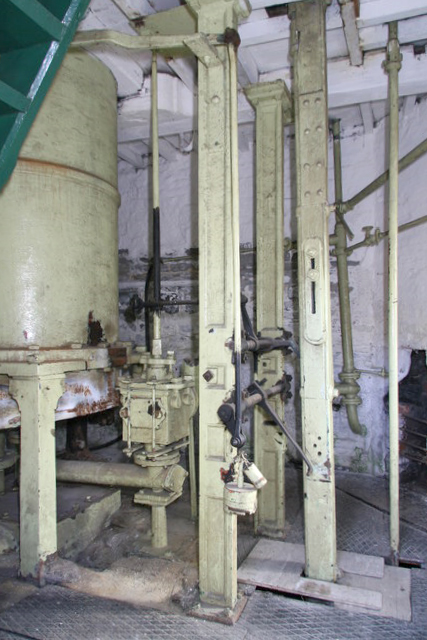
Newcomen's engine followed Savery's 'Miner's Friend' of 1698, a steam pump with no moving parts that could not lift water from any depth. The first Newcomen engine worked at a colliery near Dudley Castle in 1712 and one was pumping at Wheal Vor in Cornwall by 1715; by Newcomen's death more than a hundred had been put up in the West Country and the Midlands, north Wales, around Newcastle and in Cumbria, and hundreds were built through the 18th century, principally to pump water out of mines. John Smeaton improved the proportions and details of the design in the 1770s, and James Watt's separate condenser roughly doubled its fuel efficiency, so that many atmospheric engines were converted to the Watt pattern and Watt is now better remembered than Newcomen. The last in commercial use ran at Elsecar, near Barnsley, from 1795 until 1923, and still stands in its own engine house, conserved with its shaft in 2014; a working replica runs at the Black Country Living Museum.
How it worked
Steam from a boiler at little more than atmospheric pressure filled the cylinder as the weight of the pump rods, hung from the far end of the beam, pulled the piston up. A jet of cold water then condensed the steam, the partial vacuum let the atmosphere push the piston down, and the beam lifted the rods and the pump. The rods then descended by their own weight and drove a force pump in the shaft, so the engine did its work on the lifting stroke and was free of the thirty-foot limit that had crippled the vacuum pumps before it. Newcomen's engine house was as much the engine's frame as its shelter, and set the basic form that Cornish engine houses kept.
Why it was used
It was the first engine that could drain a deep mine reliably, at any depth the pump rods could be built for, and it was ordered by wet mines all over England within a few years of 1712. Where coal was cheap its thirst mattered less; in Cornwall, where coal had to be shipped in, the more efficient Watt engine and then the high-pressure Cornish engine took its place.
Risks & limitations
The cylinder was chilled at every stroke by the condensing spray, so much of each charge of steam was wasted reheating it; the engine used fuel very inefficiently and was expensive to run wherever coal had to be bought, which is why the Watt and later the high-pressure Cornish engine displaced it in the metal-mining districts.
Regional variation
Known as a fire engine in its own day and as a Newcomen engine since. Common on every 18th-century coalfield; in Cornwall, where coal was dear, it gave way early to Watt's design and then to the Cornish engine. Its rotary descendants, used to wind and to drive machinery, were built by Francis Thompson of Ashover and by Bateman and Sherratt of Manchester in the 1790s.
Related terminology
Beam Engine, Cornish Engine, Engine House, Pumping Engine
Mines associated with this term
5 examples chosen from 19 linked records — the term page is not an index.
- Auchenharvie Colliery — North Ayrshire (well documented example)
Named 5 times in this record, first in the summary: “One of the earliest steam-pumped collieries anywhere: a Newcomen engine was lifting water here in 1719, seven years after the first one was…” - Califat Coal Mine — Leicestershire (well documented example)
Named 4 times in this record, first in the summary: “…History Society over some fifty years, and the boiler of a Newcomen atmospheric engine that the mine reused as a water tank has been round three museums…” - Elsecar Colliery — South Yorkshire (well documented example)
Named 4 times in this record, first in the summary: “…deeper coal be reached. That engine is still there. It is the only Newcomen engine anywhere in the world remaining on its original site, and is now…” - Meliden Lead Mines — Denbighshire (well documented example)
Named 3 times in this record, first in the history: “…Asaph's land at Talargoch, having just built a successful Newcomen atmospheric engine nearby at Ewloe; by 1736 a Newcomen 'Fire Engine' had been erected…” - Watergrove Mine — Derbyshire (well documented example)
Named 4 times in this record, first in the summary: “…to 1872 and notable for two successive steam engines: a Newcomen atmospheric engine of 1794-95, since archaeologically excavated, and a larger…”
Disasters associated with this term
Included only where MineArchive's own research gives a reasonable evidential basis, with the nature of the relationship stated — not every disaster where this term might plausibly apply.
- Leadhills (Minehill) suffocation, 1817 (contextual relationship)
Named in this record’s contributing factors: “…trouble for months. On 30 December 1816 a young man who kept a fire-engine nearly 600 feet below the surface was found dead where the air was…” - Leeswood Main (Flue Pit) Inundation, 1864 (contextual relationship)
Named in this record’s rescue and recovery: “Water was cleared by pumps and by fire engines lent from Chester, with men from the Coed Talon and Leeswood Cannel…” - Page Bank Colliery shaft fire, 1858 (contextual relationship)
Named twice in this record, first in the summary: “…fell to the bottom. Fire followed at the shaft, and ten people died. Fire engines were called from the surrounding towns to pump river water down the…” - Wheal Mary Ann Footway Shaft Rescue (contextual relationship)
Named in this record’s narrative: “…water; the trapped man's own account describes a wait for four fire engines, paramedics, police, an air ambulance and an RAF Sea King helicopter…”
Sources
- (secondary) Engine Houses — Cornish Mining World Heritage Site (UNESCO)
- (secondary) Newcomen atmospheric engine — Wikipedia
Record created: 22 September 2026 · Last researched: 22 September 2026