 MineArchive
Beam Engine
| Category | Structures & Machinery |
|---|
A large stationary engine built around a massive pivoting overhead beam, used from the early 18th century to pump water from mine workings and, later, to wind ore, waste and men up the shaft — the machine, above all others, whose iconic engine houses still define the skyline of Cornwall's mining districts.
Historical usage
The first beam engines in British mining were Newcomen atmospheric engines, installed from the early 18th century onward — Wheal Vor in Cornwall had one before 1714, despite Cornwall having no coal of its own to fuel it, importing it instead at real expense from south Wales. Boulton and Watt's more efficient engines followed from the 1770s, charged to mine owners as a royalty on the fuel they saved rather than a flat purchase price. The defining Cornish improvement came from Richard Trevithick, whose high-pressure steam principle, developed in the early 19th century, allowed engines to work far more efficiently — and from 1810, competing engineers' fuel efficiency ('duty') was tracked and published for the whole industry to see in Lean's Engine Reporter, a competitive public scoreboard that helped drive duty from around 20 million foot-pounds per bushel of coal in 1810 to as much as 90 million by 1840. Not every beam engine pumped water: Levant's engine, installed in 1840, wound ore and men rather than pumping, and survives today as the only engine of its kind still operating in its original engine house anywhere in the world. Beam engines were also used well outside Cornwall — Wanlockhead's lead mines and the Peak District's Mandale and Millclose mines all installed Cornish-pattern pumping engines, some purchased second-hand from exhausted Cornish mines once cheaper coal made the north and Scotland more attractive markets for older machines.
How it worked
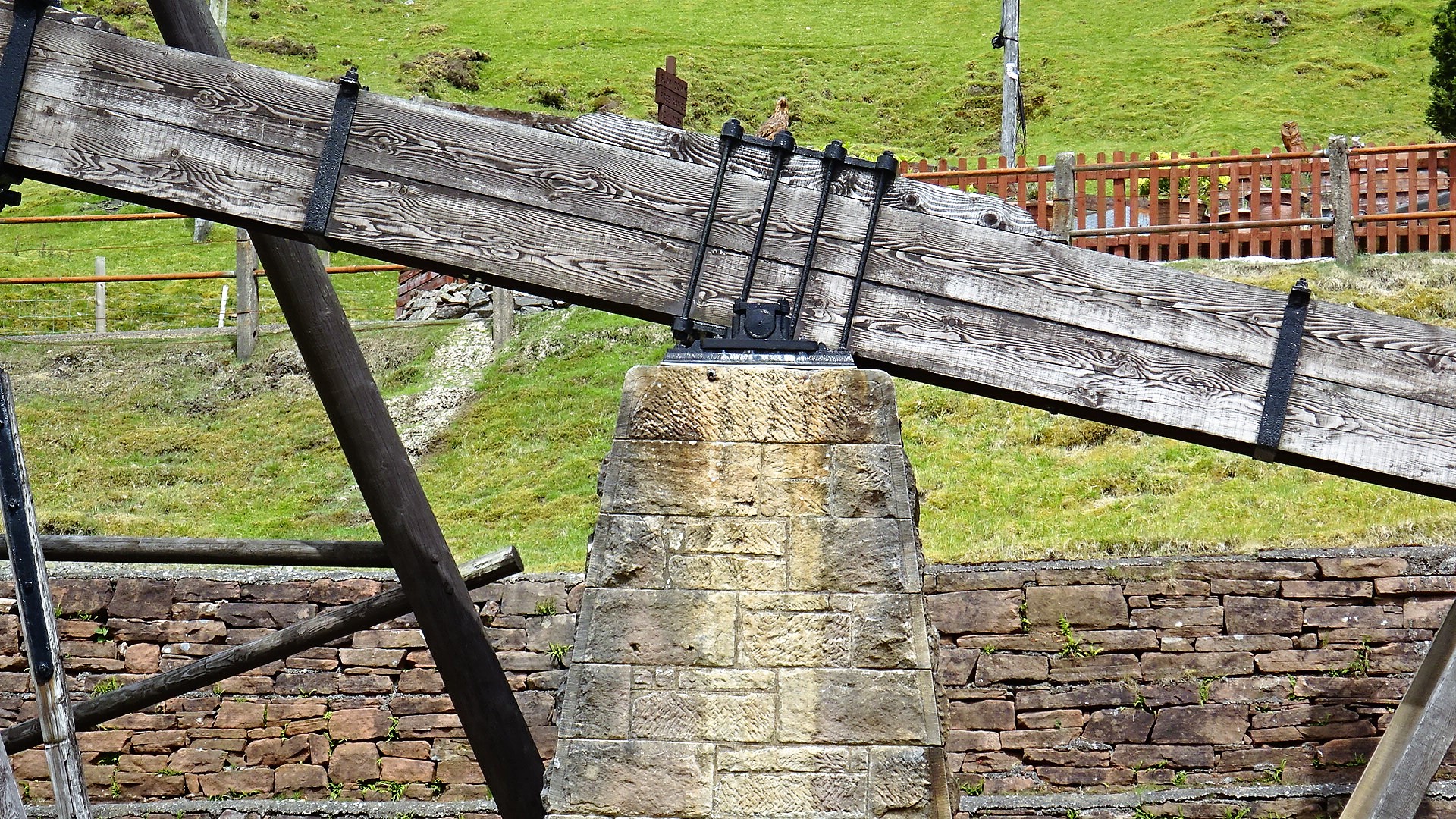
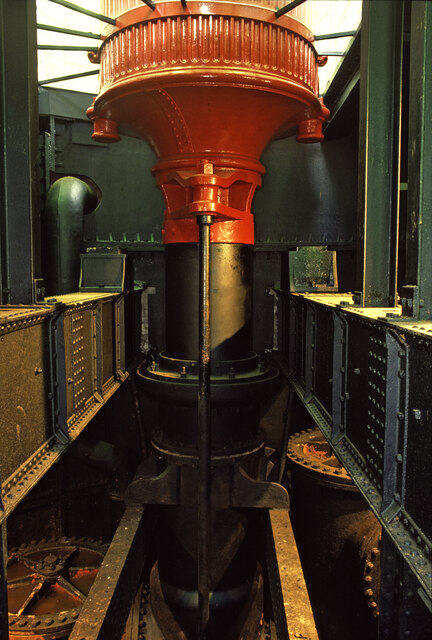
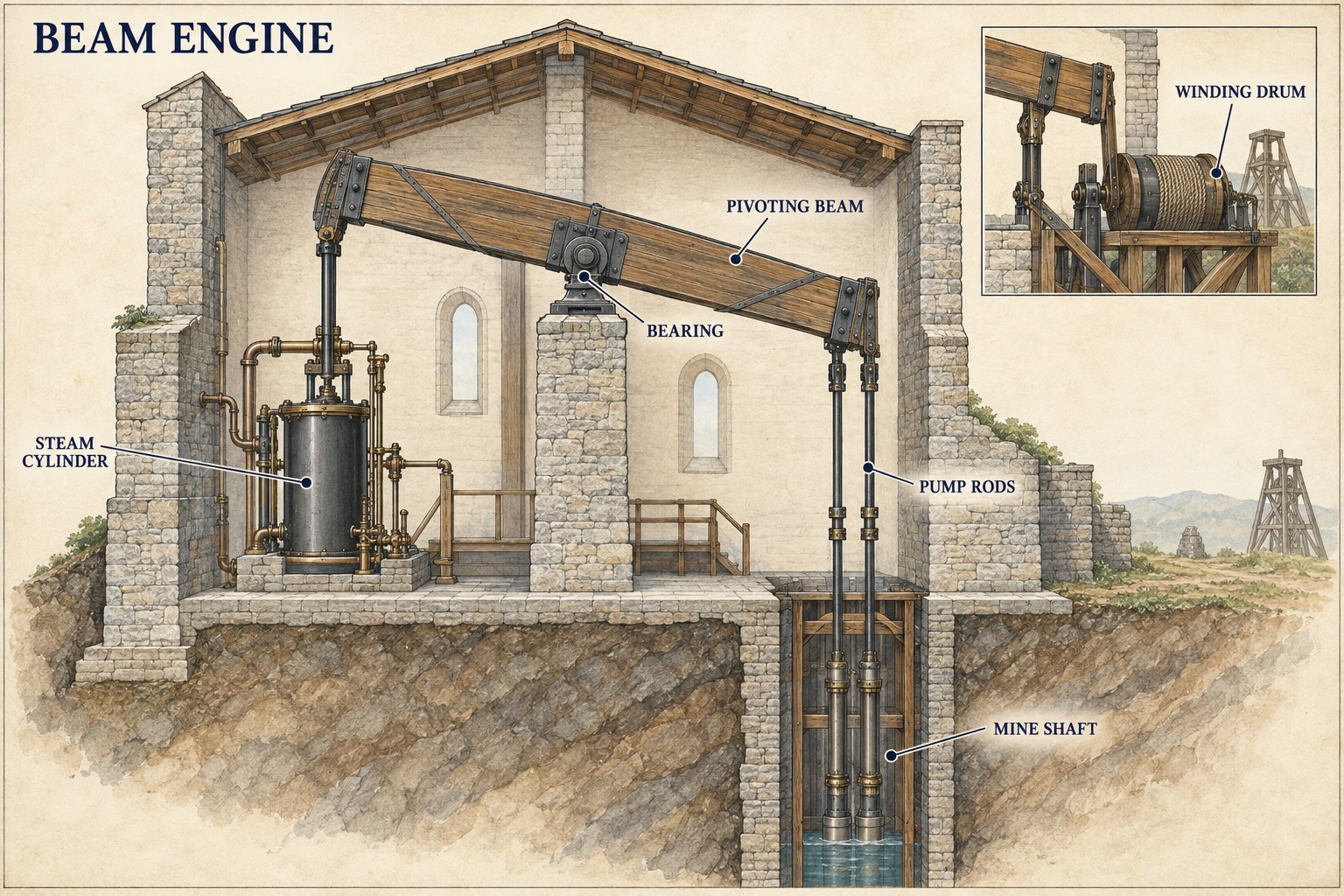
A vertical steam cylinder drove one end of the beam up and down as it pivoted on a massive stone or iron bearing block; the beam's other end was connected to pump rods reaching down the shaft (for pumping) or to a winding drum (for hoisting), converting the cylinder's vertical stroke into the reciprocating or rotary motion the mine actually needed. Most Cornish beam engines were purpose-built for pumping, but the same basic architecture could be adapted to wind ore and men instead, as at Levant.
Why it was used
Before reliable steam power, mines could only be pumped as deep as a waterwheel or horse-powered pump could reach; the beam engine's far greater power meant workings could be driven, and kept dry, at depths that would otherwise have flooded and become unworkable, directly enabling the very deep 19th-century shafts that made mines like Dolcoath possible.
Risks & limitations
Beam engines were hugely capital-intensive to buy, install and fuel, so their spread was itself a driver of the industry's shift from small partnerships toward larger, better-financed mining companies; engine houses had to be strongly built in stone specifically to withstand the beam's own rocking weight and force.
Regional variation
Most strongly associated with Cornwall and west Devon, where hundreds were built and whose surviving ruined engine houses are now the region's defining industrial silhouette, but Cornish-pattern engines and Cornish engineers themselves were exported wherever deep mines needed pumping, from Wanlockhead in Scotland's Lowther Hills to the lead mines of the Peak District.
Related terminology
Atmospheric Engine, Boiler House, Pumping Engine, Winding Engine
Mines associated with this term
5 examples chosen from 51 linked records — the term page is not an index.
- Dorothea Quarry — Gwynedd (well documented example)
Dorothea chased its vein so far below the water table that it needed the last new Cornish beam engine ever built to stay dry; the engine is still there. - Elsecar Colliery — South Yorkshire (well documented example)
Named twice in this record, first in the summary: “…collieries they built at Elsecar. The following year an atmospheric beam engine of Thomas Newcomen's type was erected over its pumping shaft to…” - Glyn Pits, Pontypool — Torfaen (well documented example)
Named 4 times in this record, first in the summary: “…works, where both engine houses still hold their engines: a rotative beam engine of 1845, probably built by the Neath Abbey Ironworks, and a vertical…” - Hemingfield Colliery — South Yorkshire (well documented example)
Named in this record’s workings: “…water in three lifts, and an oval bypass winding shaft wound by a beam engine through an external drum; two ventilation shafts of 1852-53 about…” - Levant Mine — Cornwall (well documented example)
Levant's 1840 engine is the only engine of its kind still operating in its original engine house anywhere in the world — unusually, a winding engine rather than a pumping one.
Disasters associated with this term
Included only where MineArchive's own research gives a reasonable evidential basis, with the nature of the relationship stated — not every disaster where this term might plausibly apply.
- Hartley Colliery disaster, 1862 (direct cause)
The pumping engine's cast-iron beam fractured and fell down the shaft, directly causing the disaster.
Sources
- (secondary) Lean's Engine Reporter — Wikipedia
- (secondary) Levant Mine and Beam Engine — Wikipedia
- (secondary) Wanlockhead beam engine — Wikipedia
- (secondary) West Country engine builders – Newcomen and Trevithick — British Manufacturing History
Record created: 22 August 2026 · Last researched: 22 August 2026