 MineArchive
Hemingfield Colliery
| Also known as | Low Elsecar Colliery |
|---|---|
| Location | Hemingfield, between Wombwell and Elsecar, South Yorkshire — 53.5034, -1.4086 (exact) |
| Commodity | Coal |
| Type | Coal |
| Worked | 1842 (sinking); Barnsley seam reached 1847–15 May 1920 (coal); pumping ended October 1989 |
| Maximum depth | 157 yards to the Barnsley seam (just over 140 m); the Rainborough ventilation shaft 175 yards. |
| Operators | Earls Fitzwilliam of Wentworth Woodhouse (1842–1920), National Coal Board (1947–1987), British Coal Corporation (1987–1989) |
Overview
One of Earl Fitzwilliam's Elsecar pits, sunk from 1842 under his mining engineer Benjamin Biram and a test bed for his fan ventilation, lift cages and bypass shaft. It drew coal until 1920, then pumped water for the district's pits until 1989; its mid-Victorian pithead survives as a scheduled monument, owned since 2014 by the Friends of Hemingfield Colliery.
History
Hemingfield, called Low Elsecar Colliery in Victorian papers, was developed by the fifth Earl Fitzwilliam (1786-1857) as part of his Elsecar group of collieries, overseen by his superintendent Benjamin Biram. Sinking began in earnest in 1842; with 8,000 gallons an hour entering the shafts, a Cornish pumping engine was installed, and the winding pit reached the Barnsley seam, 9 ft 5 in thick, in late 1847 at 157 yards. Biram used the pit for experiments: a hydraulically driven ventilating fan, described to the West Riding Geological Society in 1851 and soon replaced by a steam fan; an oval bypass winding shaft in which two cages passed at a mid-way widening, thought an early use of cages; and a beam winding engine enclosed in its house. Coal went out by the colliery's own basin on the Elsecar branch of the Dearne and Dove Canal and, from 1850, by the South Yorkshire Railway. An explosion on 22 December 1852 killed ten miners (see Disasters, below). Ventilation shafts followed in 1852-53 and a fan house in 1854, and the Rainborough shaft in 1864-65. By 1869 the pit raised 500 tons a day, and a decade later it was the busiest of the three Elsecar pits. It ceased drawing coal on 15 May 1920 and passed to the South Yorkshire Pumping Association, set up by fifteen collieries to keep water in the old Barnsley-seam workings from reaching live ones; electric pumps replaced the Cornish engine, whose house became a dwelling in 1934. Pumping continued under the National Coal Board and British Coal until October 1989.
Geology
The Barnsley seam, here 9 ft 5 in thick and known locally as the Elsecar coal, reached at 157 yards; the sinking met heavy water and gas. Later pumping also drew from the Kent's seam level.
Geological setting: Sedimentary Beds and Seams (well documented example)
Workings
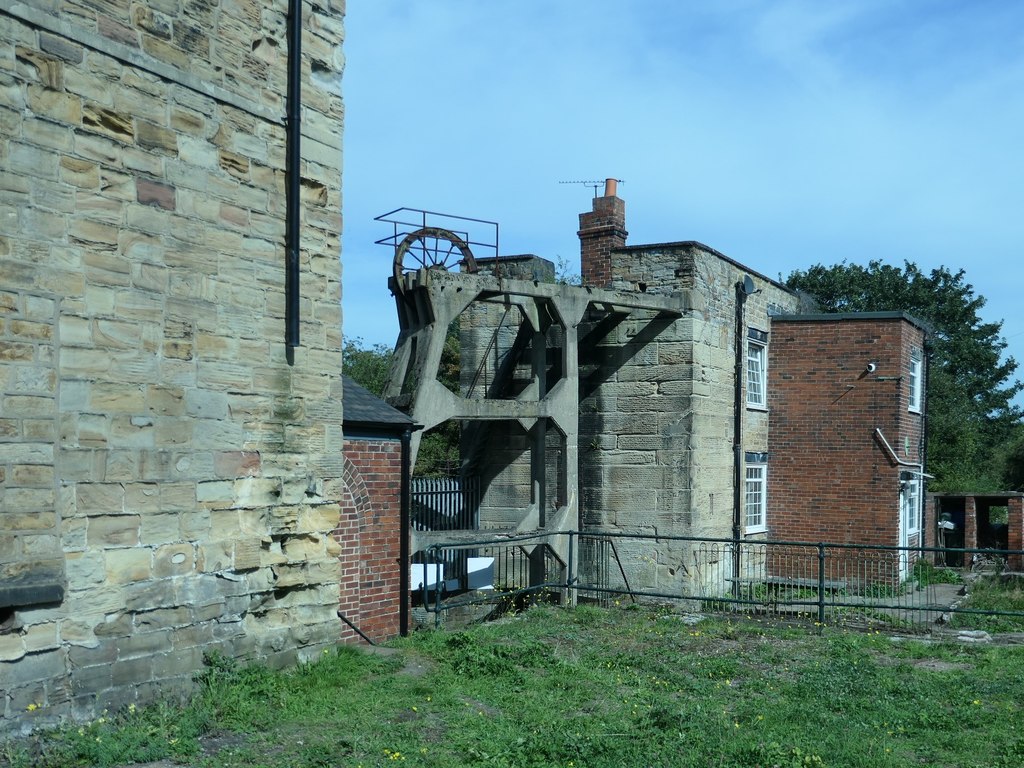
A circular pumping shaft with a 130 hp Cornish engine raising water in three lifts, and an oval bypass winding shaft wound by a beam engine through an external drum; two ventilation shafts of 1852-53 about half a kilometre south-west with an 1854 fan house, and the Rainborough downcast of 1864-65. Concrete headframes were put over the pumping shaft in 1934 and the winding shaft in 1940, when electric pumps and winders took over.
Closure
Worked out, it ceased drawing coal for Earl Fitzwilliam on 15 May 1920 and became a pumping station for the South Yorkshire Pumping Association; pumping was discontinued in October 1989.
What remains
Preserved and open to visitors on set days. After UK Coal's administration in 2013 the Friends of Hemingfield Colliery bought the site in 2014 and have restored the winding engine house roof and retaining walls.
The 1840s winding engine house and drum house, the Cornish pumping engine house (now a house, Grade II*), both shafts with their 1934 and 1940 concrete headframes, an ancillary range with engine beds, substation and ambulance room, and revetment walls; the canal basin below is listed Grade II.
Redevelopment
Being developed by the Friends of Hemingfield Colliery as a heritage and visitor site.
Related mines
- Elsecar Colliery — Both Elsecar pits of the Earls Fitzwilliam, worked as one group under Benjamin Biram and his successors.
Nearby mines
- Lundhill Colliery — 1.1 km NE
- Elsecar Colliery — 1.3 km SW
- Wombwell Main Colliery — 2.2 km N
- Cortonwood Colliery — 2.5 km SE
- Darfield Main Colliery — 3.2 km N
Straight-line distance, within 15 km. Show on the map.
Disasters & major incidents
-
Hemingfield Colliery Explosion, 1852
22 December 1852 · Explosion · 10 fatalities
An underground explosion at Earl Fitzwilliam's Hemingfield Colliery, near Elsecar, at 1.30 pm on 22 December 1852 killed ten miners and injured twelve. The inquiry praised Benjamin Biram's fan ventilation, which had divided the workings into two districts and is thought to have kept the toll from being worse.
People
- Benjamin Biram · engineer, 1842–1857 — Earl Fitzwilliam's superintendent of collieries, who oversaw Hemingfield's sinking and used it to test fan ventilation and bypass winding.
- John Hartop · manager, 1857–1886 — Succeeded Benjamin Biram as superintendent of Earl Fitzwilliam's mines in 1857; retired as general manager in 1886.
- Thomas Newbould · manager, 1886–1920 — General manager of Earl Fitzwilliam's collieries from 1886 to 1920, spanning Hemingfield's closure.
Recorded claims
Individual factual claims, each attached to the source(s) that support it below. Where sources disagree, both are kept.
- Sinking started in earnest in 1842; the winding pit reached the Barnsley seam in late 1847 at 157 yards. 1
- Shaft sinking was in progress in 1842, when 8,000 gallons an hour entered the shafts; the Barnsley seam was reached in 1847 at just over 140 m. 2
- Biram experimented at Hemingfield with a hydraulic, then a steam-powered ventilating fan (1851-52); the oval winding shaft is thought an early example of a bypass shaft fitted with lift cages. 2
- By 1869 Hemingfield produced 500 tons of coal a day and was the most productive of the three Elsecar pits a decade later. 2,1
- The colliery ceased drawing coal on 15 May 1920 and was taken over as a pumping station by the South Yorkshire Pumping Association. 2,1
- Pumping continued after nationalisation until October 1989 (the NCB/British Coal); the site was retained on a care-and-maintenance basis. 2,1
- Friends of Hemingfield Colliery bought the site after UK Coal Mining Ltd's administration; the purchase completed on 27 June 2014. 2,1
- The BGS / Mining Remediation Authority mine-plans catalogue holds plans filed under 'HEMINGFIELD COLLIERY' and 'HEMINGFIELD'. 3
- The pithead is a scheduled monument; the Cornish pumping engine house is listed Grade II*. 2,4
Photographs & further reading
The conservation group that owns the site: history, restoration news and open days.
View sourceSources
- (secondary) Hemingfield Colliery: 1842-2025 (History) — Friends of Hemingfield Colliery
- (primary) Hemingfield Colliery (Scheduled Monument 1465079) — Historic England
- (primary) BGS / Mining Remediation Authority mine plans: HEMINGFIELD COLLIERY — British Geological Survey
- (primary) Former Cornish pumping engine house at Hemingfield Colliery (List entry 1470733) — Historic England
Record created: 21 September 2026 · Last researched: 21 September 2026