 MineArchive
Drumhouse
| Also known as | Drum House (spacing variant used interchangeably in period and modern sources), Winding Drumhouse (used where a drumhouse's drum was turned by an added engine rather than working self-acting, e.g. at the West Somerset Mineral Railway) |
|---|---|
| Category | Structures & Machinery |
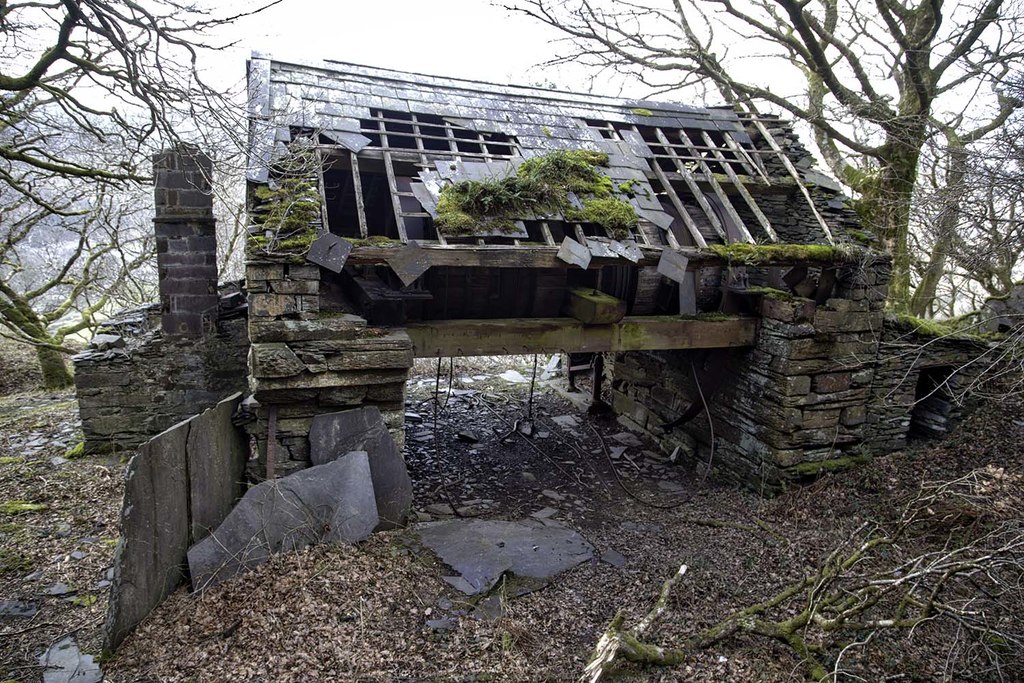
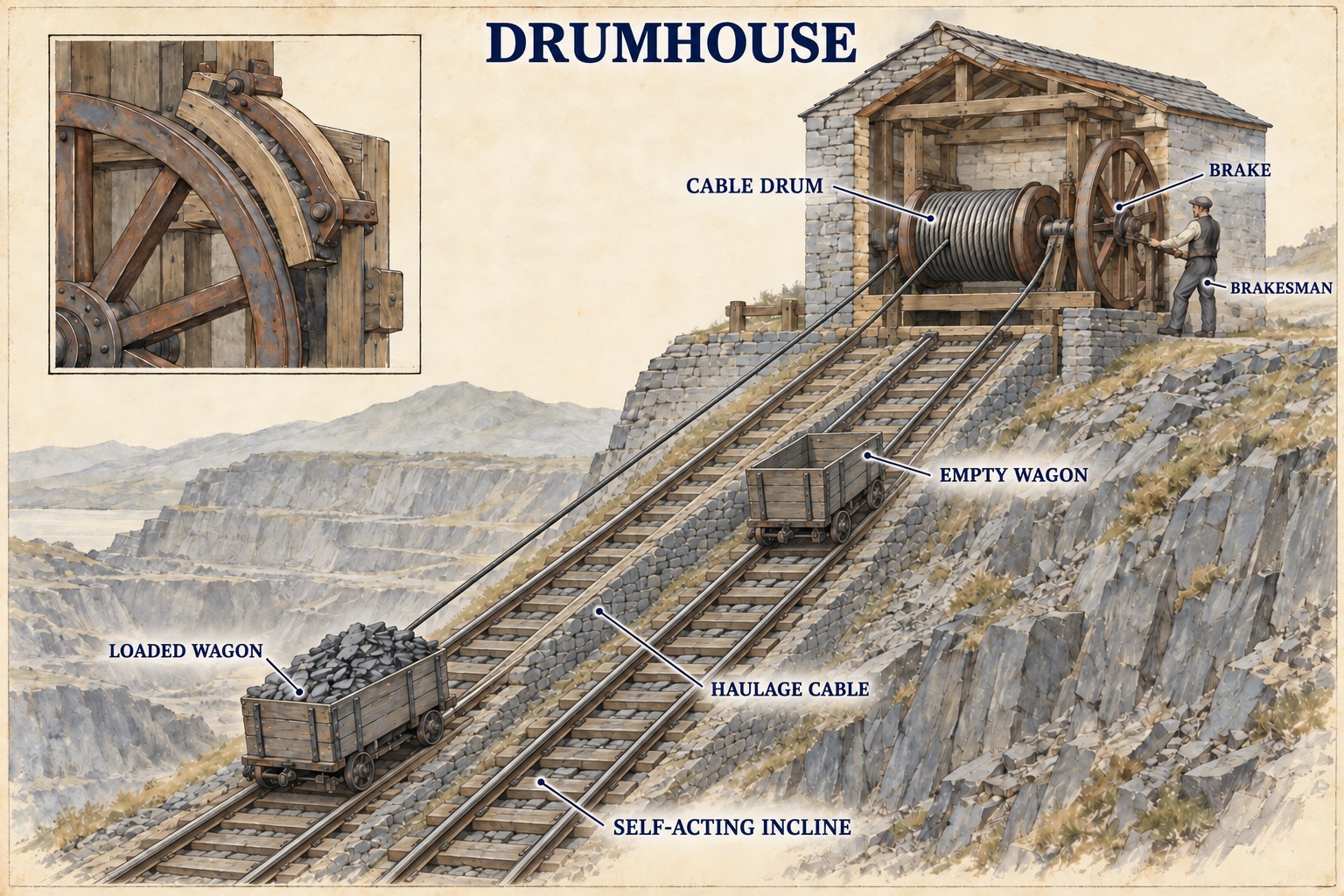
A small building at the head of an incline housing the large rope or cable drum, and its associated braking gear, around which the incline's haulage cable was wound.
Historical usage
Drumhouses are a defining feature of the self-acting and cable-worked inclines used throughout British metal-mining and slate-quarrying districts to move wagons up and down steep ground where a conventional railway gradient was impossible. Grade II-listed examples survive across the North Wales slate industry -- including at Dinorwig, Llanllyfni, Penmaenmawr and Ffestiniog -- and the type recurs across this archive's own Welsh quarry records.
How it worked
In a self-acting incline, a single cable ran from a drum in the drumhouse down to a descending, loaded wagon and back up to an ascending, empty one; the loaded wagon's own weight, controlled by a brake on the drum, pulled the empty wagon up as it went down, needing no external power at all. Where the loads were more evenly matched, or where an incline had to work in both directions carrying full loads, a steam engine or other power source was added to turn the drum directly -- as happened at the West Somerset Mineral Railway's own incline winding house once the self-acting principle stopped being viable after nearby mine closures.
Why it was used
A drum and cable let a mine or quarry move wagons safely and under full control up or down a gradient steep enough that ordinary locomotive or horse haulage was impossible, and did so, in the self-acting case, essentially for free -- gravity alone supplied the power, with the drumhouse structure existing purely to house the drum and let a brakesman control its speed.
Risks & limitations
The system depended entirely on the drum's brake and the cable's own condition; a cable failure or a brake that could not be applied in time risked a runaway wagon, a hazard recorded at more than one quarry incline in this archive's own mine records.
Related terminology
Mines associated with this term
5 examples chosen from 15 linked records — the term page is not an index.
- Alexandra Quarry — Gwynedd (well documented example)
Named twice in this record, first in the current condition: “…established themselves; slate tips, tramway remains and the ruined drumhouse at the top of the Moel Tryfan incline survive across the wider site.” - Hemingfield Colliery — South Yorkshire (well documented example)
Named in this record’s surface remains: “The 1840s winding engine house and drum house, the Cornish pumping engine house (now a house, Grade II*), both…” - Cae Coch Sulphur Mine — Conwy (well documented example)
Named in this record’s surface remains: “…foot, badly silted. Elsewhere on the hillside are the inclines, the drum house, storage bins, the foundations of the processing mill and other…” - Cedryn Quarry — Conwy (well documented example)
Named twice in this record, first in the history: “…Little was left at the quarry by 1991: the incline and its collapsed drumhouse, the embankment across to the mill, and the ruined mill with its…” - Deeside and Moelfferna Quarries — Denbighshire (well documented example)
Named twice in this record, first in the current condition: “…extensive remains at various levels: adits, weigh-houses, offices, a drum house holding horizontal sheave gear, a powder house, dressing sheds and a…”
Sources
- (primary) Incline, Drumhouses and Counter Balances ('A' Incline), Llanddeiniolen — British Listed Buildings (Cadw listing record)
- (primary) The Incline Winding House, West Somerset Mineral Railway — Exmoor National Park Historic Environment Record
Record created: 30 August 2026 · Last researched: 30 August 2026