 MineArchive
Slate
| Category | Commodities |
|---|---|
| Commodity page | Slate → |
A fine-grained metamorphic rock that splits cleanly into thin, flat sheets along its natural cleavage, quarried and worked chiefly as a roofing material.
Historical usage
Slate has been used for roofing in Britain since Roman times, with documented use from at least the 13th century, but large-scale quarrying only began in the 18th and 19th centuries. North Wales — above all the Penrhyn, Dinorwig and Ffestiniog quarries in Snowdonia — became the heart of the industry: by the late 1890s Wales was producing around 485,000 tons of finished slate a year, employing some 17,000 workers and supplying roughly a third of the world's roofing slate.
How it worked
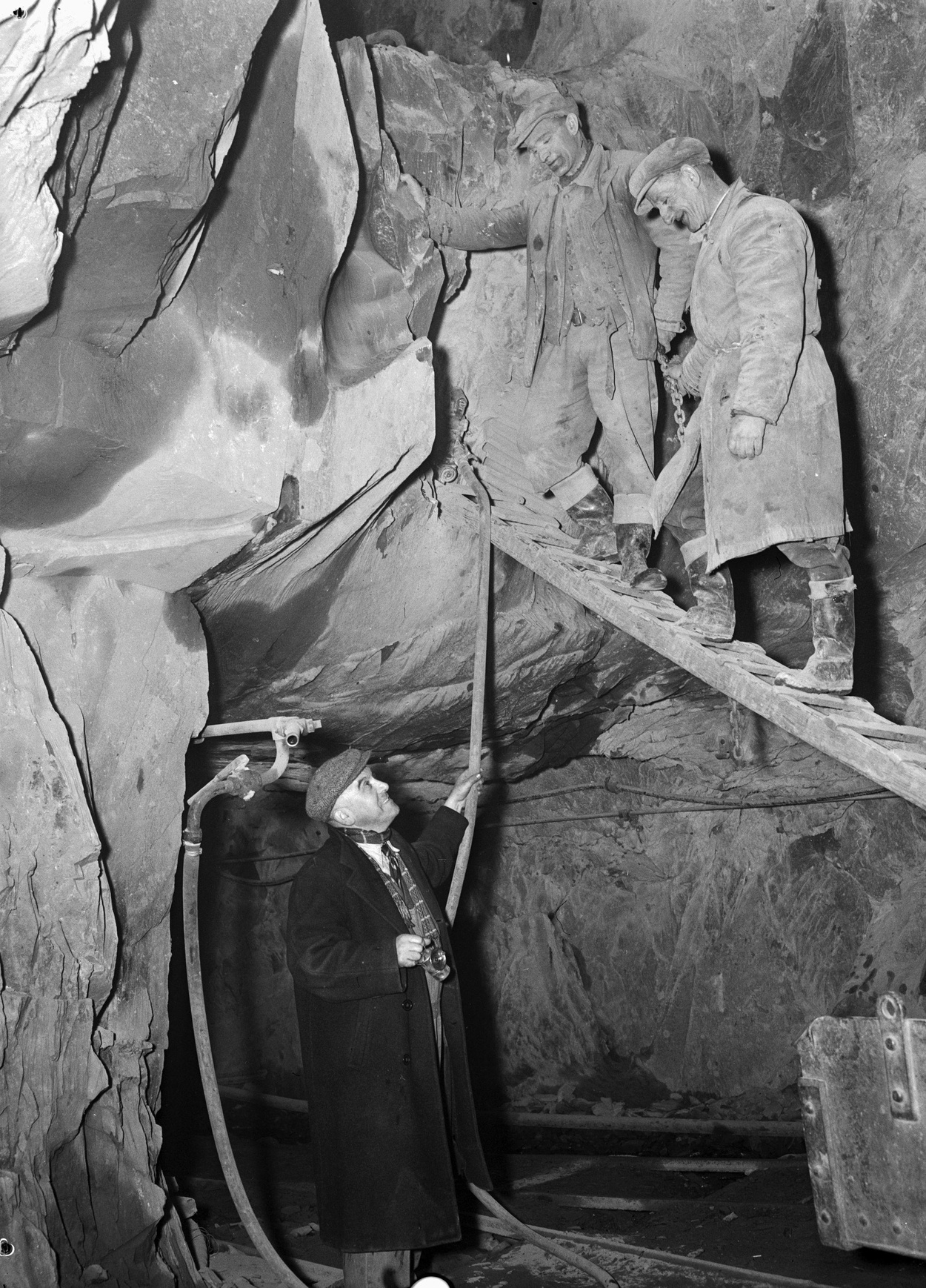
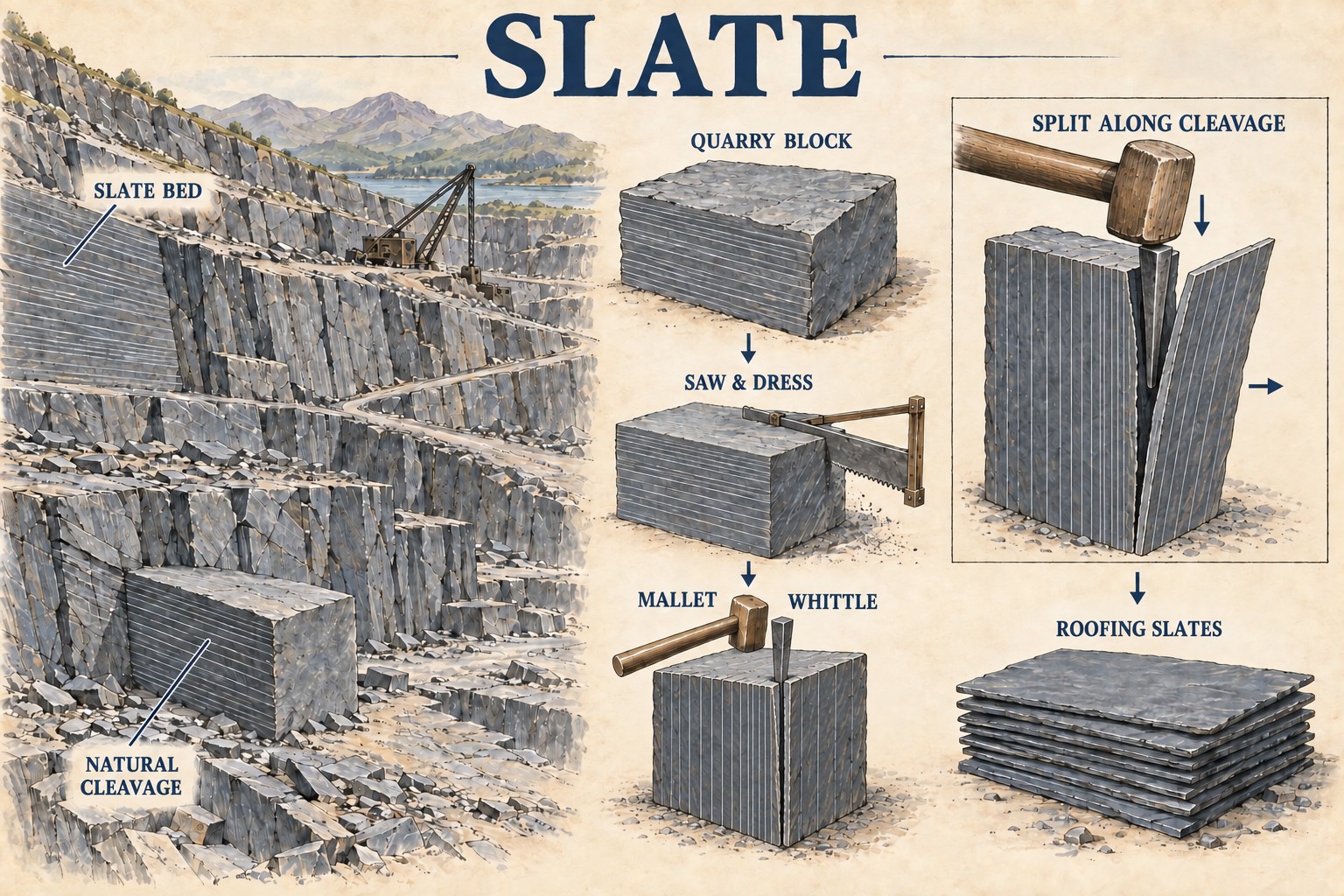
At quarries like Penrhyn, men worked open galleries and terraces, sometimes hanging from ropes tied round their waists, using hand tools and gunpowder-packed boreholes to break slate rock from the face. The critical skill came afterwards: splitting the rock down its natural grain into thin sheets using a mallet, chisel and a splitting knife called a whittle — a practised splitter could get four roof slates from a block barely an inch thick. Sawing, planing and other dressing was mechanised in slate mills from around 1840-1860, but splitting itself resisted mechanisation and stayed a hand craft throughout the industry's life.
Why it was used
Slate's natural cleavage lets it be split into sheets thin enough to be light on a roof yet strong and completely waterproof, and — unlike thatch or timber shingle — effectively fireproof and durable for well over a century with no maintenance.
Value over time
Welsh slate exports peaked in 1889 at almost 80,000 tons, with Germany alone taking around 39,000 tons a year by the mid-1890s (worth some £226,000 in 1876 terms). Cyclical trade depressions from the 1880s, a severe downturn as Victorian building activity slowed, and growing competition from cheaper imported slate then eroded the industry through the early 20th century — German imports alone fell from 21,000 tons in 1901 to just 11,000 tons by 1910 — and Welsh production drifted into near-total inactivity by the 1970s, a striking fall from supplying a third of the world's roofing slate within living memory of its collapse.
Hazards & challenges
Splitting and dressing slate generated fine, constant rock dust in the sheds where that work was done, and slate quarrymen suffered heavily from it: an official inquiry (the Wardell inquiry) found excess mortality among slate and stone quarrymen specifically attributable to lung disease, years before the mechanism was well understood. Silicosis was formally recognised for compensation in Britain only in 1918, and slate dust is now also linked to reduced lung function and COPD in quarrymen independently of silicosis itself. Rock-face work added a second, more immediate danger: at quarries like Penrhyn, men worked exposed open galleries, sometimes hanging from ropes tied round their waists to reach the rock face at all.
Risks & limitations
Splitting slate was skilled, labour-intensive work that never mechanised, keeping production costs comparatively high; once cheaper slate (and, later, other roofing materials entirely) became widely available, an industry built on skilled hand labour had little room to compete on price.
Regional variation
North Wales was Britain's dominant slate-producing region by far, but the material and technique are far from unique to it — the Lake District, Cornwall and Scotland's Slate Islands (including Easdale, on this site) all worked their own slate on a smaller scale, and colour and texture vary noticeably by source: Welsh slate is typically blue-grey to purple, while, for example, Lake District slate runs distinctly green.
Related terminology
Mines associated with this term
5 examples chosen from 110 linked records — the term page is not an index.
- Cann Quarry — Devon (well documented example)
Named 7 times in this record, first in the summary: “A Devon slate quarry recorded from 1671 to 1915 whose stone paved the streets of…” - Delabole Slate Quarry — Cornwall (well documented example)
A hole a mile and a half round and 425 feet deep, worked continuously for some seven hundred years — the oldest working slate quarry in England. - Dorothea Quarry — Gwynedd (well documented example)
The greatest of the Nantlle Valley slate quarries, worked as six open pits rather than underground chambers. - Graig Ddu Quarry — Gwynedd (well documented example)
Named 13 times in this record, first in the summary: “A remote, high-altitude slate quarry above Blaenau Ffestiniog — reputedly the highest industrial…” - Honister Slate Mine — Cumbria (well documented example)
The last working slate mine in England — closed after three centuries in the 1980s and reopened by one man in 1997.
See every mine that worked slate →
Disasters associated with this term
Included only where MineArchive's own research gives a reasonable evidential basis, with the nature of the relationship stated — not every disaster where this term might plausibly apply.
- Cwmorthin Back Vein collapse (contextual relationship)
Named twice in this record, first in the narrative: “…which meant development work that produced little saleable slate and left them paying to pump water out and to raise rock up to the…” - Cwmorthin fatal accident and mine-status test case (contextual relationship)
Named twice in this record, first in the narrative: “…injuries, the men and boys they employed and their output. Like many slate concerns, Cwmorthin's owners argued that they ran a quarry, not a…” - Long Grass Quarry cliff fall, Tintagel, 1886 (contextual relationship)
Named 4 times in this record, first in the cause: “The block of slate the men were drilling broke away from the cliff face and fell into…” - Troutbeck Park Fall of Rock, 1887 (contextual relationship)
Named in this record’s summary: “Two miners at the Troutbeck Park green slate works, John Rowlandson and Joseph Woodcock, were killed on 21…”
Sources
- (secondary) Chronic obstructive pulmonary disease in Welsh slate miners — Occupational Medicine (Oxford Academic)
- (secondary) DUST TO DUST: Silicosis cases expose government complacency on deadly engineered stone — Hazards magazine
- (secondary) Historical aspects of the Welsh slate industry — D. Dylan Pritchard, via slateroof.co.uk
- (secondary) Historical aspects of the Welsh slate industry: causes of contraction — D. Dylan Pritchard, via slateroof.co.uk
- (secondary) Slate Quarrying Techniques - Working the Slate — Llechi Cymru / Welsh Slate
- (secondary) Welsh slate: chiselling through time — The Past
Record created: 20 August 2026 · Last researched: 20 August 2026