 MineArchive
Cwmorthin fatal accident and mine-status test case
A fatal accident at Cwmorthin — nicknamed 'The Slaughterhouse' after 21 workers died there between 1875 and 1893 — led to a test case that reclassified the site as a mine rather than an exempt quarry under new safety law, and the company was wound up soon after.
| Date | 1875 |
|---|---|
| Mine | Cwmorthin Slate Mine |
| Region | Gwynedd |
| Type | Other |
| Fatalities | 1 |
| Context | During active mining |
What happened
Cwmorthin gained a reputation for exceptionally dangerous conditions, earning the name 'The Slaughterhouse': 21 workers died there between 1875 and 1893, out of a workforce of around 550. Cause of death for individual incidents is not established.
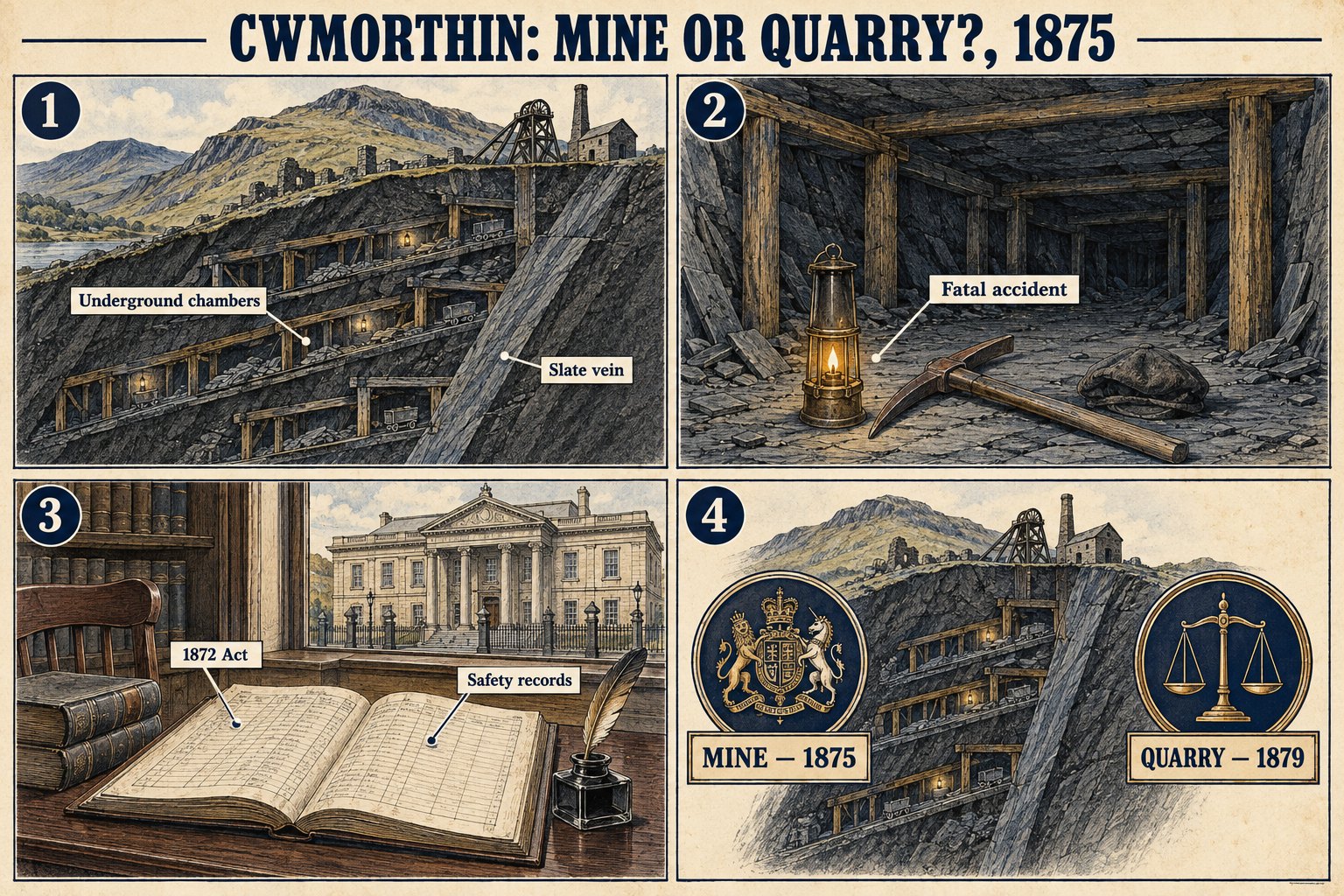
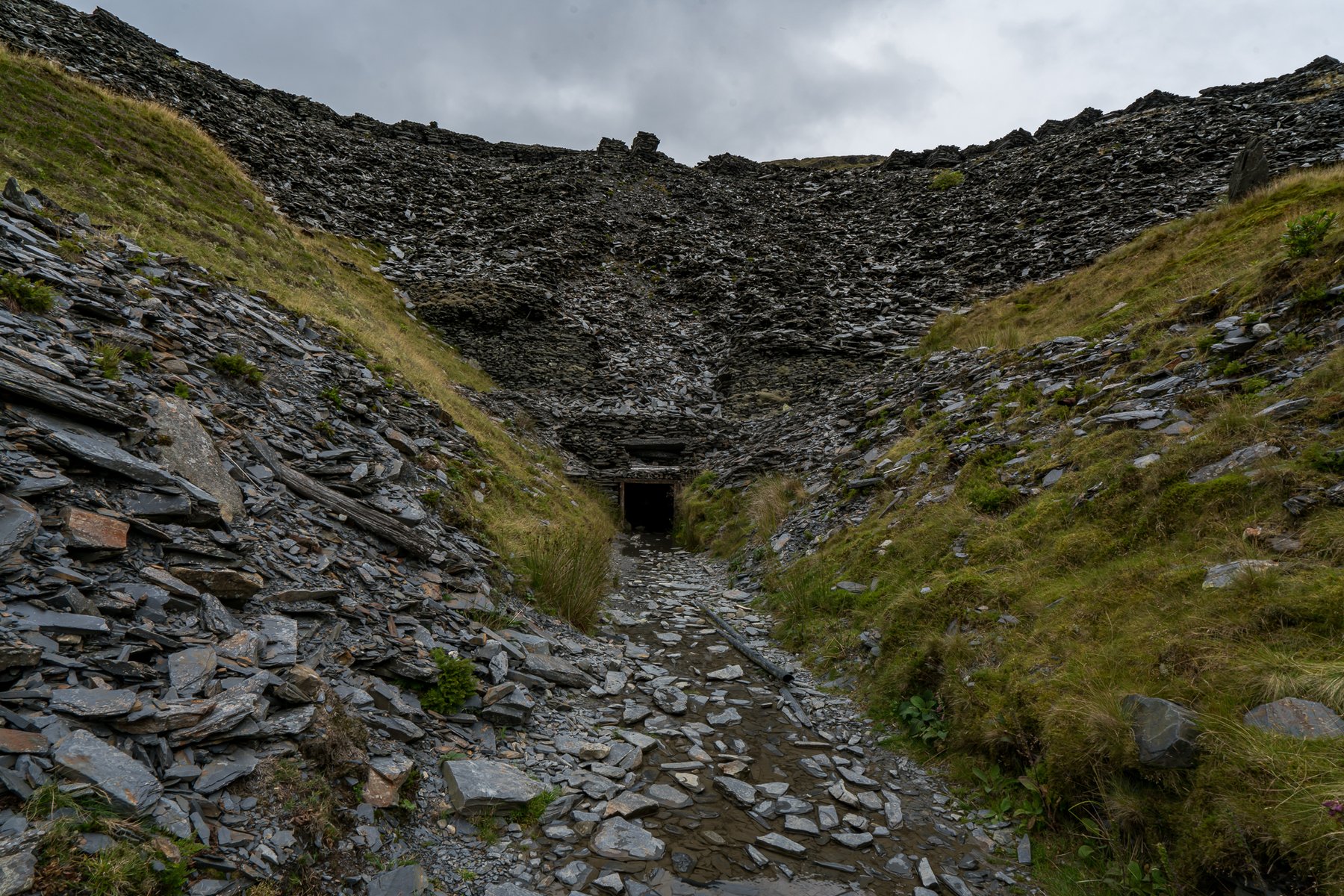
The Metalliferous Mines Regulation Act 1872 required mines to keep records of their operations and to report fatal injuries, the men and boys they employed and their output. Like many slate concerns, Cwmorthin's owners argued that they ran a quarry, not a mine, and that the Act therefore did not apply to them — a distinction that mattered because slate at Cwmorthin was in fact worked underground, the chambers following veins that dip at 20 to 45 degrees. After a fatal accident in 1875 a test case was brought, and the undertaking was held to be a mine within the meaning of the Act. The company went into liquidation shortly afterwards, and a new Cwmorthin Company was formed in 1876; Coflein records that company as running the quarry from 1876 to 1888.
The classification did not stay settled. A second test case was brought in 1879 on the same question, this time in relation to the assessment of profits — and on that occasion the undertaking was deemed a quarry. The same workings were therefore a mine for the purposes of safety regulation and a quarry for the purposes of tax.
Investigation & inquiry
The 1875 test case found Cwmorthin to be a mine, not an exempt quarry, under the Metalliferous Mines Regulation Act 1872 (35 & 36 Vict. c. 77). The company went into liquidation shortly afterwards and a new Cwmorthin Company took over in 1876. A further test case in 1879, on whether the undertaking was a mine or a quarry for the assessment of profits, went the other way and held it to be a quarry.
Recorded claims
Individual factual claims, each attached to the source(s) that support it below. Where sources disagree, both are kept.
- Cwmorthin was nicknamed 'The Slaughterhouse'; 21 workers died there between 1875 and 1893, out of a workforce of around 550. A fatal 1875 accident led to a test case that found the site to be a mine, not an exempt quarry, under the Metalliferous Mines Regulation Act 1872, and the company was wound up soon after. 1
- The Metalliferous Mines Regulation Act 1872 (35 & 36 Vict. c. 77) required mines to keep records of their operations and to report fatal injuries, details of the men and boys employed, and the output of the mine; Cwmorthin argued, like many slate concerns, that it was a quarry and the law did not apply. 1
- A second test case was brought against the company in 1879 on the same mine-or-quarry question, this time in relation to the assessment of profits; on that occasion the undertaking was deemed to be a quarry. 1
- The Royal Commission records the quarry as developed by the Cwm-Orthin Slate Co from 1861 and taken over by the New Cwmorthin Company from 1876 to 1888. 2
Related terminology
Mining terms this disaster is structurally linked to, with the nature of the relationship.
- Slate (contextual relationship)
Named twice in this record, first in the narrative: “…injuries, the men and boys they employed and their output. Like many slate concerns, Cwmorthin's owners argued that they ran a quarry, not a…” - Vein (contextual relationship)
Named in this record’s narrative: “…at Cwmorthin was in fact worked underground, the chambers following veins that dip at 20 to 45 degrees. After a fatal accident in 1875 a test…”
Sources
- (secondary) Cwmorthin quarry — Wikipedia
- (primary) Cwmorthin Slate Quarry (NPRN 40594) — Royal Commission on the Ancient and Historical Monuments of Wales
Record created: 20 August 2026 · Last researched: 5 September 2026