 MineArchive
Cwmorthin Slate Mine
| Location | West of Tanygrisiau, Blaenau Ffestiniog, Gwynedd — 52.9942, -3.9672 (approximate) |
|---|---|
| Commodity | Slate |
| Type | Slate |
| Worked | 1810–1997 |
| Operators | Cwmorthin Slate Company (1861–1876), Oakeley Company (1900–1970) |
Overview
Cwmorthin, on the shores of Llyn Cwmorthin above Blaenau Ffestiniog, was one of the great slate mines of Snowdonia — worked almost continuously for over 150 years, notorious enough in its Victorian heyday to be nicknamed ‘The Slaughterhouse’, and now partly reused as an underground hotel.
History
The Casson family opened a small quarry at Cwmorthin in 1810, and as extraction followed the slate veins underground, quarrying turned into true mining. Operations ceased around 1830, resuming in 1840 under John Edwards and Magnes and passing to W.B. Chorley the same year. The Cwmorthin Slate Company, formed in January 1861 with £100,000 of capital, bought the Cwmorthin Isaf estate and part of Tanygrisiau village, built a narrow-gauge tramway to the Ffestiniog Railway, and ran Lake Mill and Cross Mill to split and dress the slate. Output rose from 350 tons in 1862 to 12,500 tons of finished slate in 1876, but conditions were notoriously dangerous, and a fatal 1875 accident had major legal and financial consequences for the company (see Disasters, below). A successor company operated from 1876 until a catastrophic collapse in 1884 forced liquidation by 1888 (see Disasters, below). The New Welsh Slate Company then extended the mine downward with five new floors below the level of the lake, before mounting debts brought voluntary liquidation in 1902. The Oakeley Company bought Cwmorthin for £10,000 in 1900, connecting the two mines underground, stripped its machinery, flooded the old workings and demolished Lake Mill; renewed small-scale working through the 1920s-1960s, with a restored tramway, inclines and mills, proved uneconomic. When Oakeley finally closed in 1970, Cwmorthin was sold on separately and continued in various small-scale forms for almost three decades more before all extraction finally ceased in 1997 (see Closure, below).
Geology
Cwmorthin worked two of Blaenau Ffestiniog's five named slate veins, the Old Vein and the Back Vein — early workings, thought to be on one or the other, had their evidence destroyed by later extraction, while the Back Vein saw the major collapses of 1884 and the subsequent lower chambers driven below Llyn Cwmorthin itself. The veins slope downward at 20-45 degrees; rather than strip away the overlying rock to follow them at the surface, the workings soon went underground, turning quarrying into true mining. The slate itself is Ordovician, laid down over 470 million years ago.
Workings
Slate was worked underground following the sloping veins through a long sequence of numbered floors and chambers, extended by five new floors below the level of the lake added by the New Welsh Slate Company in the early 1900s. By 1882 the mine employed over 500 workers and produced 10,376 tons of slate a year across three mills fitted with around 50 saws and 50 dressers; between 1861 and 1876 alone, around 96,000 tons were extracted, and the New Welsh Slate Company's own tenure produced a further 77,367 tons before its 1902 liquidation.
Closure
Cwmorthin's closure was gradual rather than sudden. When the main Oakeley Quarries closed in 1970, Cwmorthin was sold off separately, and local workers kept a small-scale operation going for years afterwards, clearing tunnels and salvaging fallen rock with improvised equipment, including a Land Rover stripped down to its frame and engine for underground transport. Outside capital rebuilt a mill in the 1980s, but the venture failed; a local company made a final attempt to revive the site from 1995, before all work ceased in 1997.
What remains
Deep Sleep, an underground hotel, opened within the old workings in 2023, at a depth of around 1,375 feet (419m) below the surface — an unusual modern reuse of one of Snowdonia's most extensive slate mines.
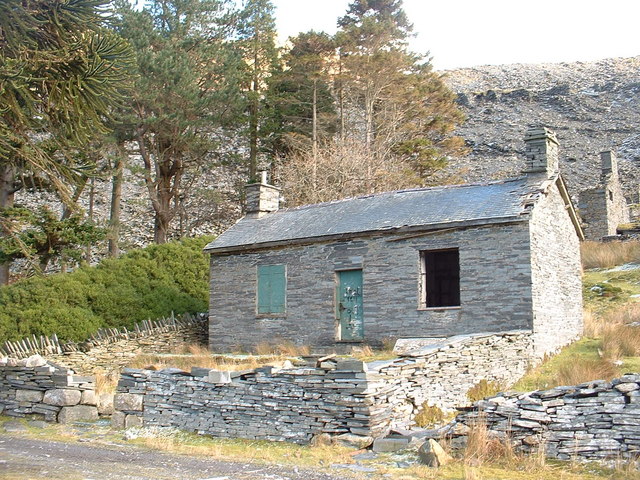
Much of Cwmorthin's original surface fabric was lost to later 'untopping' work, including the 1925 explosives store nicknamed the 'Beau Geste Fort'. What survives includes traces of the steam-powered Lake Mill near the lake and part of its slate-built terrace, the decaying Tiberias Chapel, a Pelton wheel and generator beside a holding pond fed by well-preserved leats, the site of the original Dolwen power station on the channelled river, cast iron boundary markers marking the line with the neighbouring Oakeley quarry, and two tramway inclines, Tan y Murian and Village, with their cuttings and embankments still prominent in the landscape.
Nearby mines
- Wrysgan Quarry — 0.3 miles (0.5 km) SW
- Nyth-y-Gigfran Quarry — 0.6 miles (1.0 km) E
- Conglog Quarry — 0.8 miles (1.3 km) NW
- Gloddfa Ganol Quarry — 1.0 miles (1.6 km) NE
- Oakeley Quarry — 1.0 miles (1.6 km) NE
Straight-line distance, within 9 miles (15 km). Show on the map.
Disasters & major incidents
-
Cwmorthin fatal accident and mine-status test case
1875 · Other · 1 fatality
A fatal accident at Cwmorthin — nicknamed 'The Slaughterhouse' after 21 workers died there between 1875 and 1893 — led to a test case that reclassified the site as a mine rather than an exempt quarry under new safety law, and the company was wound up soon after. -
Cwmorthin Back Vein collapse
1884 · Collapse / Roof Fall
Most of Cwmorthin's workings in the Back Vein collapsed in 1884, fracturing the ground all the way to the top of Allt-fawr and draining a lake on the summit ridge. About half the mine was left inaccessible, production nearly halved, and the company was wound up within four years.
What's uncertain
Points where sources disagree or the record could not be settled; both accounts are kept. All open questions in the archive.
- A July 2014 report describes severely deteriorated conditions in the Old Vein workings, with numerous roof falls and delaminating slabs, alongside abandoned mining carts still standing on Floor B and miners' barracks visible from the surface. (uncertain) 2
Recorded claims
Individual factual claims, each attached to the source(s) that support it below. Where sources disagree, both are kept.
- After buying Cwmorthin in 1900, the Oakeley Company stripped its machinery, flooded the old workings and demolished Lake Mill, before renewed small-scale working through the 1920s-1960s proved uneconomic. 1
- An underground hotel, Deep Sleep, opened within the old Cwmorthin workings in 2023, at a depth of around 1,375 feet (419m) below the surface. 1
- A July 2014 report describes severely deteriorated conditions in the Old Vein workings, with numerous roof falls and delaminating slabs, alongside abandoned mining carts still standing on Floor B and miners' barracks visible from the surface. (uncertain) 2
- Cwmorthin worked two of Blaenau Ffestiniog's five named slate veins, the Old Vein and the Back Vein, sloping downward at 20-45 degrees; the Back Vein saw the major collapses of 1884 and the subsequent lower chambers driven below Llyn Cwmorthin. 1
- By 1882 the mine employed over 500 workers and produced 10,376 tons of slate a year across three mills; between 1861 and 1876 around 96,000 tons were extracted in total, and the New Welsh Slate Company's tenure produced a further 77,367 tons before its 1902 liquidation. 1,3
- After the main Oakeley Quarries closed in 1970, Cwmorthin was sold off separately and kept going on a small scale by local workers using improvised equipment, including a Land Rover stripped down for underground transport; outside capital rebuilt a mill in the 1980s but the venture failed, and a local company's final attempt to revive the site from 1995 ended when all work ceased in 1997. 1,3
- Surviving surface features include traces of the steam-powered Lake Mill and its slate-built terrace, the decaying Tiberias Chapel, a Pelton wheel and generator beside a leat-fed holding pond, the site of the original Dolwen power station, cast iron boundary markers with the neighbouring Oakeley quarry, and the Tan y Murian and Village tramway inclines. 3
- Much of Cwmorthin's original surface fabric, including a 1925 explosives store nicknamed the 'Beau Geste Fort', was lost to later underground 'untopping' work. 3
- Cwmorthin ceased working as a separate quarry around 1939, after which it was accessed from the neighbouring Oakeley quarry in the post-war period. 4
Photographs & further reading
An underground report covering the Old Vein, Back Vein and several numbered floors of the mine.
View sourceSources
- (secondary) Cwmorthin quarry — Wikipedia
- (observational) Cwmorthin Slate Mine, Blaenau Ffestiniog, Wales — July 2014 — 28DaysLater
- (secondary) Cwmorthin — Buddlepit Mine Database
- (secondary) Cwmorthin Slate Quarry — Subterranea Britannica
Record created: 20 August 2026 · Last researched: 27 August 2026