 MineArchive
Votty and Bowydd Quarry
| Location | Blaenau Ffestiniog, Gwynedd — 52.9985, -3.9279 (exact) |
|---|---|
| Commodity | Slate |
| Type | Slate |
| Worked | c. 1800–1963 |
| Operators | John Whitehead Greaves (1833–?), Percival family (1870–1933), Votty and Bowydd Slate Quarry Company (1875–1950), Oakeley Company (1933–1963) |
Overview
Votty and Bowydd, immediately northeast of Blaenau Ffestiniog, grew from small beginnings into one of the town's major slate quarries — merged from two separate workings in 1870, producing 17,000 tons of slate a year at its Edwardian peak, and finally absorbed into its neighbours after closure in 1963.
History
Bowydd quarry was first worked on a small scale from around 1800, but it was not until 1833, under John Whitehead Greaves — who went on to found the neighbouring Llechwedd quarry in 1846 — that it began commercial production. The separate Votty quarry and Bowydd merged in 1870 under the ownership of the Percival family, who retained control until 1933. At its peak around 1900 the combined quarry produced roughly 17,000 tons of slate a year and employed around 500 men. Oakeley Slate Quarries Co. Ltd took over the site in 1933, and Votty and Bowydd finally closed in 1963; its workings were sold to the owners of the adjoining Maenofferen quarry, which was itself later acquired by the Greaves family's Llechwedd quarry. Crushed slate continued to be produced from the site on a limited scale under Llechwedd's ownership.
Geology
The quarry worked the same thick Cambrian slate beds of the Ffestiniog district exploited at neighbouring Llechwedd, Oakeley and Maenofferen, extracted from underground chambers rather than open terraces.
Geological setting: Slate and Regional Metamorphism (well documented example)
Workings
Slate was worked through a series of underground pitches and chambers, connected to Blaenau Ffestiniog by an incline system whose engine house — providing power for working the inclines — survives on the site; a tramway also linked the workings to the Rhiwbach tramroad system.
Closure
Votty and Bowydd finally closed in 1963, with its workings sold to the neighbouring Maenofferen quarry. Wikipedia's article gives the closure as 5 October 1962, with liquidation in 1964, and Wilkinson's gazetteer records the company to 1950.
What remains
Crushed slate has continued to be produced from part of the site on a limited scale under the ownership of the neighbouring Llechwedd quarry; the former Votty-Bowydd pit is now used as a quarry reservoir.
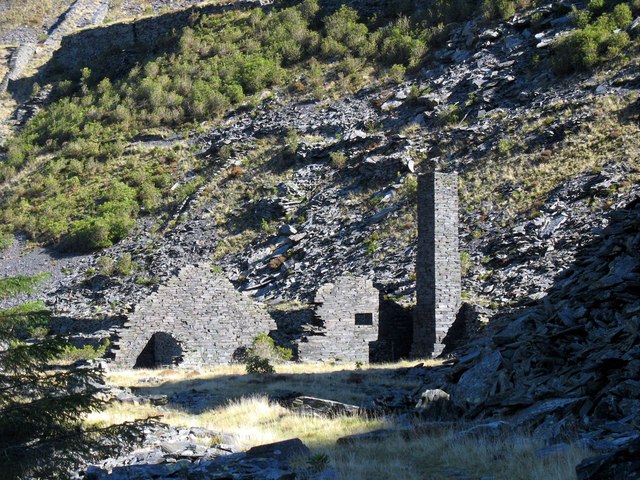
A ruined engine house that once powered the quarry's inclines survives, along with spoil tips, tramway formations and the ruins of the manager's residence at Quarry Bank.
Related mines
- Llechwedd Slate Caverns — Llechwedd has untopped the Votty and Bowydd chambers for crushed slate since the mid-1980s.
- Maenofferen Quarry — Votty and Bowydd's workings were sold to the neighbouring Maenofferen quarry on closure in 1963.
Nearby mines
- Maenofferen Quarry — 0.2 miles (0.3 km) NE
- Diphwys Casson Quarry — 0.5 miles (0.8 km) E
- Llechwedd Slate Caverns — 0.7 miles (1.1 km) NW
- Cwt-y-Bugail Quarry — 0.9 miles (1.4 km) NE
- Gloddfa Ganol Quarry — 0.9 miles (1.5 km) W
Straight-line distance, within 9 miles (15 km). Show on the map.
Recorded claims
Individual factual claims, each attached to the source(s) that support it below. Where sources disagree, both are kept.
- At its peak around 1900 the quarry produced roughly 17,000 tons of slate a year and employed around 500 men. 1
- Wilkinson's gazetteer places the quarry at SH 708 464, worked from 1863 to 1950, with F. S. Percival and Co. as owners in 1874, the Votty and Bowydd Slate Quarry company as operator from 1875 to 1950, and J. Lloyd Jones as agent from 1882 to 1932; in 1945 it employed 63 underground and 60 on the surface. 2
- The British Geological Survey holds a coloured plan and section of the quarry from the Gwynedd Archives, viewable online, with plans of the Votty workings in No. 1 or Back Vein and a correlation of the Maenofferen workings with those of Votty and Bowydd, and the Mining Remediation Authority the abandonment plans OM15215. 3,4
- By 1882 the merged quarry produced nearly 12,100 tons with nearly 350 men; the works closed on 5 October 1962 and the company was liquidated in 1964, and since the mid-1980s Llechwedd has been untopping the Votty and Bowydd chambers for crushed slate. 1
Photographs & further reading
A May 2025 report on the Fotty and Bowydd workings, with a full history — Bowydd worked from about 1800 and commercially from 1833 under John Whitehead Greaves, who went on to found Llechwedd; the 1854 incline to the Ffestiniog Railway replaced by the Rhiwbach Tramway in 1863; the 1870 merger under the Percival family, who held it until 1933; and nearly 12,100 tons a year by 1882.
View sourceThe scanned coloured plan, viewable online.
View sourceSources
- (secondary) Votty & Bowydd quarry — Wikipedia
- (secondary) Votty & Bowydd Quarry, Ffestiniog: entry in Wilkinson's Gazetteer and Bibliography of the Mines and Quarries of Wales (hendrecoed.org.uk) — Jeremy Wilkinson / Dave Linton (hendrecoed.org.uk)
- (primary) Votty and Bowydd Slate Quarries mine plans — British Geological Survey / The Coal Authority
- (primary) Plan of Votty and Bowydd slate quarry (BGS mine plans catalogue, Gwynedd Archives collection) — British Geological Survey
- (secondary) Votty and Bowydd Slate Quarry Co. Ltd Records — Archives Hub
Record created: 24 August 2026 · Last researched: 24 September 2026