 MineArchive
Oakeley Quarry
| Location | Rhiwbryfdir, Blaenau Ffestiniog, Gwynedd — 53.0032, -3.9483 (exact) |
|---|---|
| Commodity | Slate |
| Type | Slate |
| Worked | 1818–1969 (underground) |
| Maximum depth | 26 floors spanning almost 1,500 feet (460m) of vertical height |
| Operators | Welsh Slate Company (1825–1883), W. E. Oakeley (1878–1972) |
Overview
Once the largest underground slate mine in the world, worked through 26 floors spanning almost 1,500 feet beneath the hills above Blaenau Ffestiniog, with over 50 miles of underground tramway connecting its vast chambers — brought into being, in its final combined form, by one of the largest rockfalls in British mining history.
History
Samuel Holland, a Liverpool merchant, leased land near Rhiwbryfdir farm in 1818 and began the first quarrying on what became the Oakeley site; he sold the lease to the Welsh Slate Company in 1825, which developed it into the Lower Quarry. By 1842 three separate operations were working the same hillside — the Welsh Slate Company's Lower Quarry, Holland's own Upper Quarry, and the Rhiwbryfdir Slate Company's Middle Quarry. Conflict between them turned serious once the Lower Quarry's underground workings extended beneath the Middle Quarry: a rockfall on 6 December 1882 forced the Welsh Slate Company to halt operations, and a far larger fall on 16 February 1883 brought down an estimated 6.25 million tons of rock in a single event. The three quarries were forced into a single combined business, Oakeley Quarry, under landowner W. E. Oakeley, becoming — at the time — the largest underground slate mine in the world. The company went on to absorb the neighbouring Nyth-y-Gigfran and Cwmorthin quarries by 1900, and later Votty & Bowydd (1933) and Diphwys Casson (1936). Oakeley was also a technical pioneer, installing gas lighting in 1856, steam-driven cutting mills in 1860, and by 1906 hydroelectric power transmitted from the Cwm Dyli power station over the Crimea Pass.
Geology
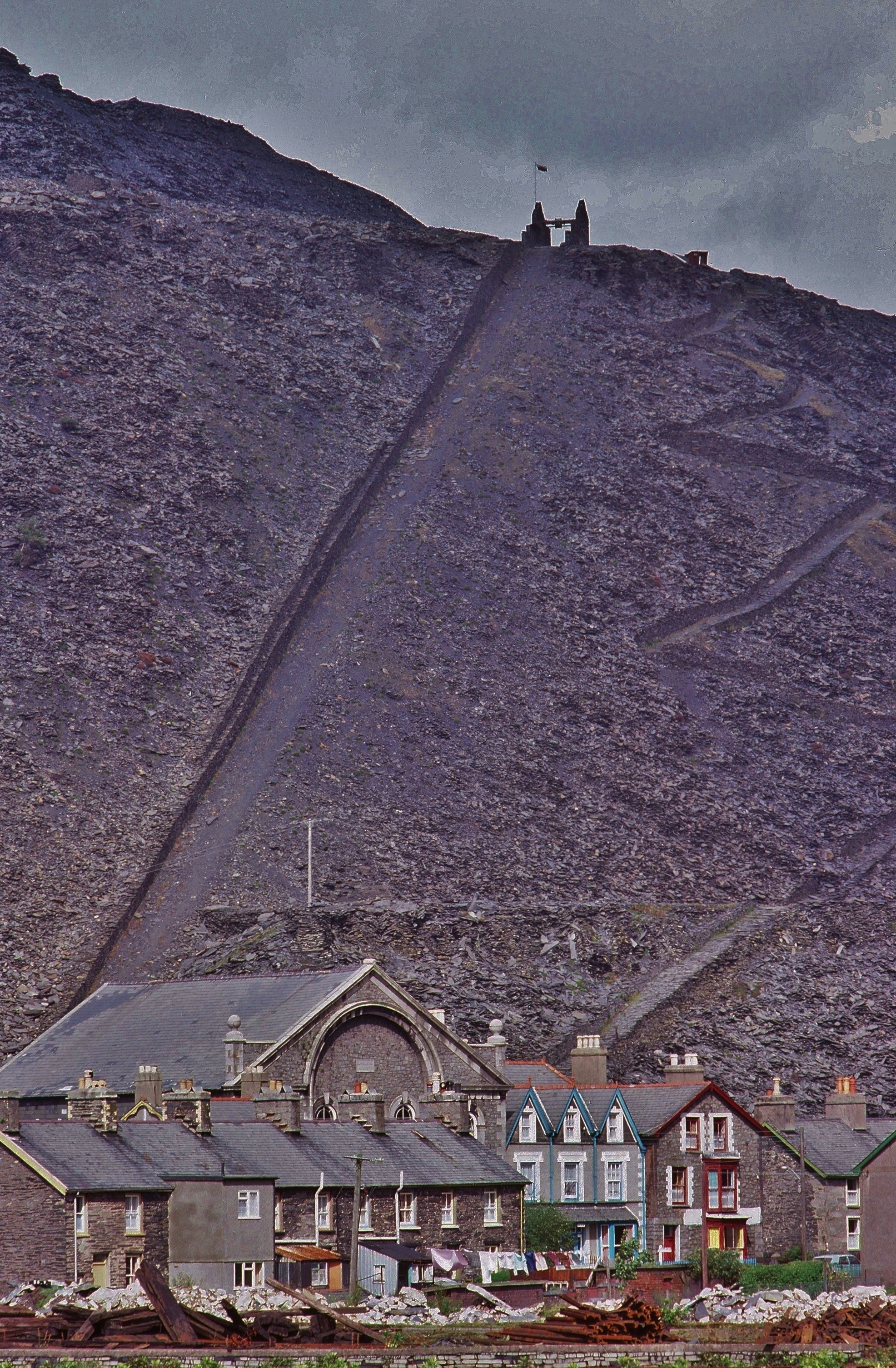
Oakeley worked the Cambrian slate beds of the Ffestiniog district, prized for splitting into exceptionally thin, durable roofing slate. Extraction was extremely wasteful of rock: for every ton of finished slate sold, around nine tons of waste had to be removed and tipped, and over the mine's working life more than 100 million tons of waste rock was generated — enough that the original village of Rhiwbryfdir, and a chapel within it, were bought up by the company and buried beneath a single vast spoil tip.
Geological setting: Slate and Regional Metamorphism (well documented example)
Workings
Slate was worked through a series of enormous underground chambers reached from 26 separate floors, connected by more than 50 miles of narrow-gauge (roughly 2-foot) tramway. The 'K Trwnc' incline carried slate up from workings 300 feet below ground at a 45-degree gradient, converted from steam to a 100hp electric motor in 1906; at the surface, the Oakeley Incline linked the quarry down to the Ffestiniog Railway for export. At its peak the combined operation produced up to 60,000 tons of slate a year, employing around 1,700 men, and ranked as the third-largest slate producer in the United Kingdom.
Closure
Underground working ended in 1969 amid a collapse in worldwide demand for slate, and the company was formally liquidated in 1972. Most of Oakeley's vast underground chambers are now flooded, and all original access to them has since been obliterated.
What remains
Part of the site reopened in 1978 as the Gloddfa Ganol Mountain Tourist Centre, offering guided tours into sections of the old underground workings alongside a large collection of narrow-gauge slate industry locomotives, until new owners McAlpine closed the tourist operation in 1998. A small-scale opencast operation continued reworking parts of the former underground mine from the surface until March 2010, when quarrying finally ended for good following the discovery of subsidence.
The Oakeley Incline still runs as a visible scar directly up the vast grey spoil tip above Blaenau Ffestiniog, one of the most recognisable industrial landscapes in Snowdonia; former quarry buildings, inclines and tramway routes survive across the wider site, though the underground workings themselves are inaccessible.
Redevelopment
The Gloddfa Ganol Mountain Tourist Centre operated from 1978 to 1998, combining underground tours with a heritage narrow-gauge railway collection, before the tourist side of the business closed under new ownership.
Related mines
- Gloddfa Ganol Quarry — Gloddfa Ganol formed part of the vast Oakeley slate quarry complex.
- Nyth-y-Gigfran Quarry — Nyth-y-Gigfran closed in 1870 after Oakeley won a legal injunction over encroaching workings, and was later absorbed into Oakeley itself in the 1920s.
- Palmerston Quarry — Palmerston, the Lower Quarry, was amalgamated into Oakeley after the Great Fall of 16 February 1883 and the lawsuit the Welsh Slate Company lost, and was worked as part of the single Oakeley operation thereafter.
Nearby mines
- Gloddfa Ganol Quarry — 0.0 miles (0.0 km) NW
- Palmerston Quarry — 0.2 miles (0.4 km) N
- Llechwedd Slate Caverns — 0.3 miles (0.6 km) E
- Nyth-y-Gigfran Quarry — 0.5 miles (0.8 km) SW
- Votty and Bowydd Quarry — 0.9 miles (1.5 km) E
Straight-line distance, within 9 miles (15 km). Show on the map.
Recorded claims
Individual factual claims, each attached to the source(s) that support it below. Where sources disagree, both are kept.
- Oakeley was, at its peak, the largest underground slate mine in the world, worked through 26 floors spanning almost 1,500 feet (460m) of vertical height, with more than 50 miles of underground tramway. 1
- A rockfall on 6 December 1882 forced the Welsh Slate Company to close its Lower Quarry; a much larger fall on 16 February 1883 saw an estimated 6.25 million tons of rock collapse in a single event, among the largest rockfalls recorded in British mining history. 1,2
- The three previously separate quarries were forced into a single combined operation, Oakeley Quarry, as a direct result of the 1882-83 rockfalls. 1
- Waste rock outweighed finished slate by roughly nine to one; over the mine's working life more than 100 million tons of waste was generated, enough that the original village of Rhiwbryfdir was purchased and buried beneath a single spoil tip. 1
- Final closure was announced in March 2010, following the discovery of subsidence. 1
- Located at about 53.003 N, 3.948 W. 1
Sources
- (secondary) Oakeley quarry — Wikipedia
- (secondary) Oakeley Slate Quarries — Festipedia
- (secondary) Gloddfa Ganol — Wikipedia
- (secondary) Oakeley Quarry — Penmorfa (Gwynn family history/slate industry site)
Record created: 22 August 2026 · Last researched: 22 August 2026