 MineArchive
Slate Chamber
| Also known as | Chamber and Pillar, Chamber-and-Pillar, Slate Chambers, Underground Chamber |
|---|---|
| Category | Mine Workings & Access |
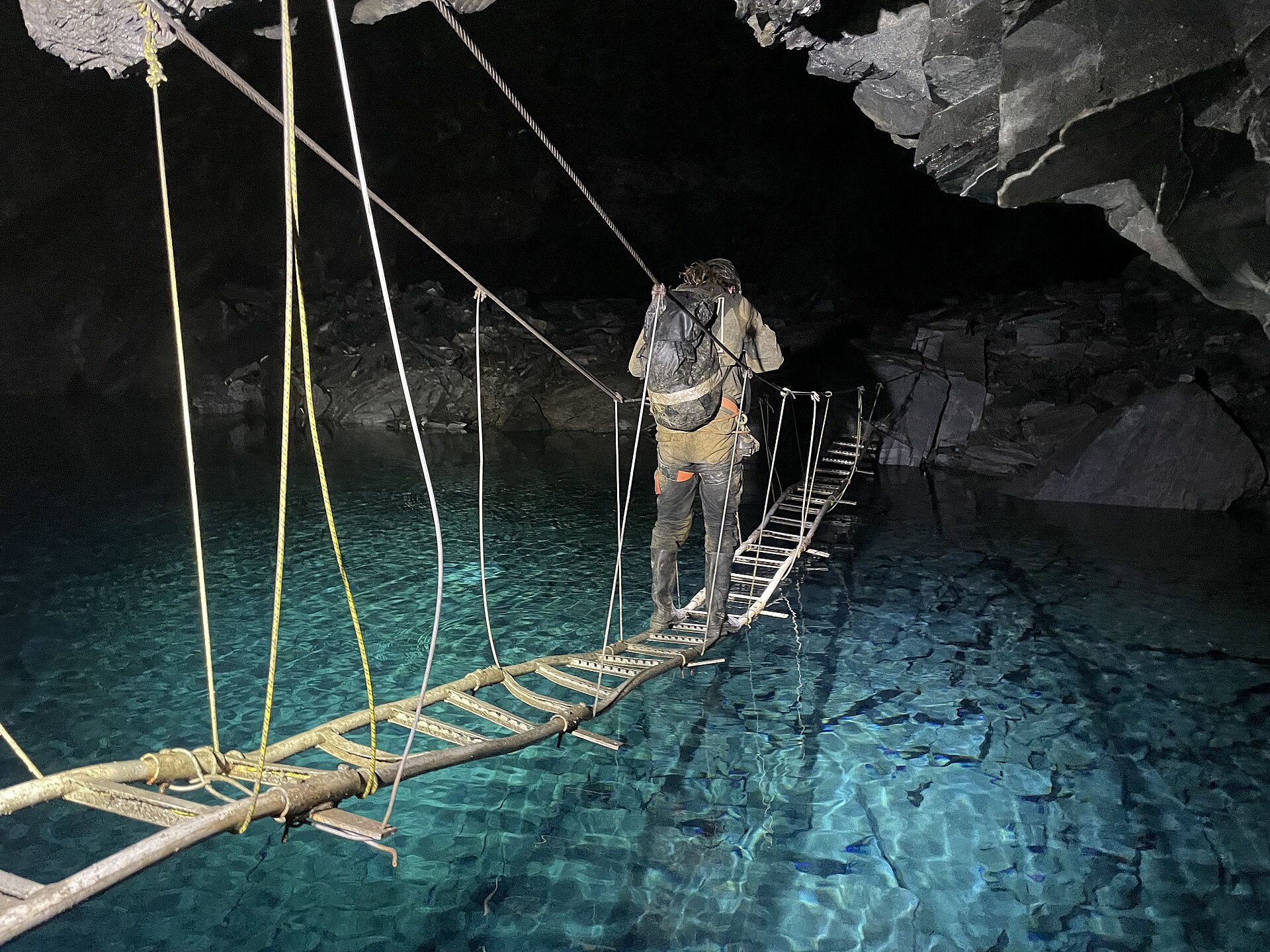
The large underground void from which slate was taken in a Welsh slate mine, worked in a regular pattern with solid pillars of rock left standing between the chambers to carry the roof. Chamber working is what distinguishes an underground slate mine from an open slate quarry, and the chambers are the mine: Rhosydd had a hundred and seventy of them.
Historical usage
Chamber working made the great underground slate mines of Blaenau Ffestiniog and the ground around it possible from the middle of the nineteenth century, and it is the reason those workings are mines rather than quarries. By 1883 Rhosydd was one of the largest underground workings in Wales outside Blaenau Ffestiniog itself, with its hundred and seventy chambers shipping over five and a half thousand tons of finished slate a year. The chambers survive largely as they were left, since nothing was ever backfilled, and they are now the defining feature of the Slate Landscape of Northwest Wales.
How it worked
A chamber was started from a level driven in along the vein. Miners cut a roofing shaft upwards, then widened it and drove a trench down one side so that the rockmen could get at the face and free blocks of slate, working the chamber downwards and outwards from the top.
Widths varied, but at Rhosydd a chamber ran about fifty feet across and the pillar left between one chamber and the next about thirty. The critical discipline was vertical alignment: the pillars on each floor had to stand directly above the pillars on the floor below, so that a continuous wall of solid slate ran from the bottom of the mine to the top. Get that wrong and the load came onto rock that could not carry it.
The chambers were reached by adits driven in at successive levels down the hillside and connected by inclines, so that finished blocks could be brought out to the mill. At Conglog open pits at the surface led down into underground levels and chambers in the Back Vein and North Vein of the Blaenau Ffestiniog sequence — the same vein worked at several depths.
Why it was used
Slate is worth having only in sound, large blocks, which rules out any method that shatters the rock or mixes it with waste. Chamber working takes the vein in bulk while leaving enough of it in place to hold the hill up, and it follows a vein that dips underground long after an open quarry would have become uneconomic to deepen. It also keeps the work under cover, which matters in that climate.
Risks & limitations
Every chamber is bought with the slate left in its pillars, which is good rock that can never be sold; the economics of a slate mine turn on how narrow the pillars can safely be. Misalignment between floors, or robbing a pillar late in a quarry's life, transfers load onto rock not meant to carry it, and collapses in disused slate mines have taken chambers and the ground above them. The roofs are of unsupported slate at a great height, and the workings flood once pumping stops.
Regional variation
The method is specifically Welsh slate practice and the English-language sources call it chamber-and-pillar to distinguish it from the room and pillar of the coalfields, which is worked flat in a bedded seam rather than downwards along a steeply dipping vein.
Mines associated with this term
5 examples chosen from 32 linked records — the term page is not an index.
- Manod Quarry — Gwynedd (surviving physical example)
Five disused slate chambers were identified in September 1940 as secure, climate-stable storage for the National Gallery's paintings; the chambers that held them survive. - Blaen y Cwm Quarry — Gwynedd (surviving physical example)
Surviving photographs show large exposed chambers within the pit walls, indicating part-galleried working alongside the open pit rather than pure open-cast extraction. - Deeside and Moelfferna Quarries — Denbighshire (surviving physical example)
Moelfferna was a mine rather than an open quarry, with adits on seven levels and much chambering underground; on level six a large wooden cog supports the chamber roof, a technique more usual in coal mining. - Loughrigg Fell Slate Quarry — Cumbria (surviving physical example)
Abandoned slate working on the northern slopes above Rydal Water left the huge flooded chamber now known as Rydal Cave, among the most visited industrial remains in the Lake District. - Banks Slate Quarry, Chapel Stile — Cumbria (well documented example)
Named twice in this record, first in the geology: “Westmorland green slate of the Borrowdale Volcanic Group, worked in underground chambers up to thirty feet high on the Lingmoor slopes above Chapel Stile.”
Disasters associated with this term
Included only where MineArchive's own research gives a reasonable evidential basis, with the nature of the relationship stated — not every disaster where this term might plausibly apply.
- Flooding of the Adelaide Mine (contextual relationship)
Named in this record’s narrative: “…through the evening, eventually displacing all the air from the underground chambers. Investigation afterwards traced the source to millions of gallons…”
Sources
- (primary) Conglog Slate Quarry (NPRN 40590) — Coflein, Royal Commission on the Ancient and Historical Monuments of Wales
- (secondary) Rhosydd quarry — Wikipedia
Record created: 29 September 2026 · Last researched: 29 September 2026