 MineArchive
Deeside and Moelfferna Quarries
| Also known as | Moelfferna Quarry, Deeside Quarry, Moel Fferna Slate Mine, Deeside Slate Quarry |
|---|---|
| Location | Glyndyfrdwy, Denbighshire — 52.9490, -3.3024 (exact) |
| Commodity | Slate |
| Type | Slate |
| Worked | 1870–1947 |
| Maximum depth | Not a shaft mine: worked on seven adit levels into the mountain from about 500 m. |
| Operators | Moelferna and Dee Side Slate and Slab Quarries Company (1876–1947) |
Overview
Two neighbouring slate quarries above Glyndyfrdwy worked by one company and linked by the Deeside Tramway to the Llangollen and Corwen Railway. Moelfferna, high on the mountain at five hundred metres, won its roofing slate almost entirely underground on seven levels, and in 1926 was the first Welsh quarry to use diamond-tipped circular saws. Two men were crushed by a hundred-ton rockfall in 1915.
History
The opening of the Llangollen and Corwen Railway in 1865 is what made these quarries worth developing. The Dee Side Slate and Slab Quarry Ltd of 1870 was the first owner of the Deeside quarry and was sold in 1875; the following year the Moelferna and Dee Side Slate and Slab Quarries Company was formed to buy both it and the Moelfferna quarry, and one company ran the pair from then on. In 1885 the quarries supplied Guinness's brewery in Dublin with a slab cistern fifty feet by eight by five, believed at the time to be one of the largest stone tanks ever built.
Moelfferna is the larger story. It sits at the head of the valley of Nant Pandy at five hundred metres, and its roofing slate was won almost entirely from underground working, on adits at seven levels, with a large mill powered first by steam and later by internal combustion — a gas engine in 1912, an oil-engined generator for the saws in 1923. In 1926 it became the first quarry in Wales to use high-speed circular saws with blades coated in industrial diamonds or carborundum. It employed a hundred and eighty-four men in 1898 and a hundred in 1937 and 1938.
The company's chairman after the First World War was Percy Dean, Member of Parliament for Blackburn. The Deeside quarry stopped working in the 1920s, though the Deeside slate works kept going on Moelfferna's stone. The end of the whole enterprise is dated to 1947; the Royal Commission's record of Moelfferna says the mine closed in 1960.
Geology
Several beds of Ordovician shales and mudstones run across mid Wales from Tywyn in the south-west to Chirk in the north-east, and at points along that band the sedimentary rock has been compressed and metamorphosed into slate. These quarries sit at the north-eastern end of it, on the flank of Moel Fferna above the Dee.
Geological setting: Slate and Regional Metamorphism (well documented example)
Workings
Moelfferna was a mine rather than an open quarry: adits on seven levels, with much chambering underground and gravity inclines between the levels that still hold their rollers and drums. On level six a large wooden cog supports the chamber roof, a technique more usual in coal mining. After 1872 a trwnc or table incline, at first only as far as level three, was extended as new levels opened; it connected the levels and lowered the finished slate to the tramway. Surface and underground ran on different gauges — two foot six inches above, two foot below — and two massive pillars carried the gantry on which wagons were transferred between them. The mill is crudely walled with a corrugated iron roof and a massive concrete base at one end for the oil engine.
Closure
The Deeside quarry ceased working in the 1920s and the slate works continued on Moelfferna stone. The enterprise is dated as ending in 1947; Coflein gives 1960 for the closure of the Moelfferna mine.
What remains
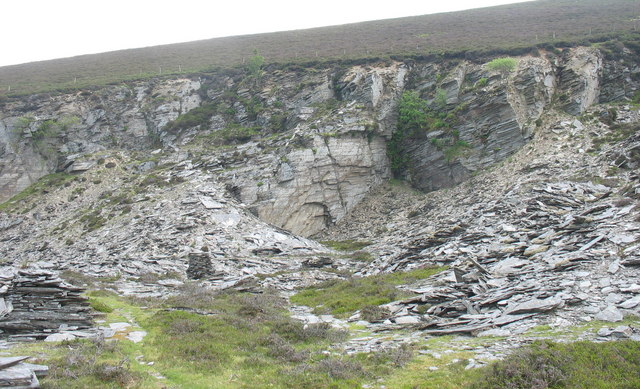
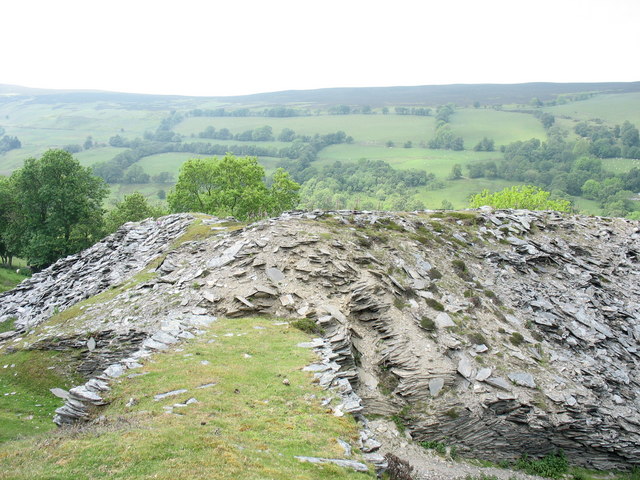
In the 1990s the Royal Commission recorded extensive remains at various levels: adits, weigh-houses, offices, a drum house holding horizontal sheave gear, a powder house, dressing sheds and a large stockyard near the mill. Underground, access is difficult, with a bridge across the workings and the inclines' rollers and drums in place but no rails.
Adits at several levels, weigh-houses, offices, a drum house, a powder house, dressing sheds, the mill with its oil-engine base, and the gantry pillars.
Redevelopment
Unknown.
Nearby mines
- Cynwyd Forest Quarry — 2.1 miles (3.4 km) W
- Cambrian Quarry — 4.2 miles (6.7 km) E, Wrexham
- Wynne Quarry — 4.7 miles (7.6 km) E, Wrexham
- Craig-y-Mwyn Mine — 7.8 miles (12.6 km) SW, Powys
Straight-line distance, within 9 miles (15 km). Show on the map.
Disasters & major incidents
-
Moelfferna Quarry Rockfall, 1915
1915 · Collapse / Roof Fall · 2 fatalities
Two quarrymen, Robert Jones and John Lloyd, were crushed by an unexpected rockfall weighing a hundred tons at the quarry in 1915.
What's uncertain
Points where sources disagree or the record could not be settled; both accounts are kept. All open questions in the archive.
- Wikipedia gives 1947 for the closure of the enterprise; the Royal Commission's record says the Moel Fferna mine closed in 1960. (disputed) 1,2
Recorded claims
Individual factual claims, each attached to the source(s) that support it below. Where sources disagree, both are kept.
- The Dee Side Slate and Slab Quarry Ltd of 1870 owned the Deeside quarry and was sold in 1875; the Moelferna and Dee Side Slate and Slab Quarries Company was formed in 1876 to buy both quarries and operated them together. 1
- In 1885 the quarries supplied a slab cistern to the Guinness brewery in Dublin measuring fifty feet by eight by five, believed to be one of the largest stone tanks built at the time. 1
- Moel Fferna was a substantial producer of roofing slate won almost entirely underground, with adits on seven levels, and in 1926 was the first Welsh quarry to use high-speed circular saws with blades coated in industrial diamonds or carborundum. 2
- A hundred and eighty-four men were employed in 1898 and a hundred in 1937 and 1938. 2
- Wikipedia gives 1947 for the closure of the enterprise; the Royal Commission's record says the Moel Fferna mine closed in 1960. (disputed) 1,2
Photographs & further reading
The Royal Commission's record — the seven adit levels, the mill and its engines, the trwnc incline, the two gauges and the transfer gantry, and a survey of what survives above and below ground.
View sourceSources
- (secondary) Deeside and Moelfferna quarries — Wikipedia
- (primary) Moel Fferna Slate Mine, NPRN 308669 — Coflein, Royal Commission on the Ancient and Historical Monuments of Wales
Record created: 9 September 2026 · Last researched: 9 September 2026