 MineArchive
Royal Commission
| Also known as | Children's Employment Commission (The 1842 inquiry into children in mines), Royal Commission on Mines (Appointed 1906, reported 1907 to 1911), Sankey Commission (The Coal Industry Commission of 1919), Samuel Commission (The Royal Commission on the coal industry of 1925), Royal Commission on Safety in Coal Mines (Reported 1938), Royal Commission on Accidents in Mines (Reported 1886) |
|---|---|
| Category | Law & Custom |
An inquiry appointed by the Crown on the government's advice, whose commissioners take evidence and report. In mining they were the means by which the state examined child labour, accidents, safety and the ownership of the coal industry, and their reports stand behind most of the Acts that regulated the pits.
Historical usage
Lord Ashley, later Earl of Shaftesbury, had the Children's Employment Commission appointed after the Factory Act of 1833 had protected mill children and the Huskar pit disaster of 4 July 1838 had killed twenty-six children at Silkstone. Four commissioners and district sub-commissioners went into every coalfield; Symonds visited two hundred Yorkshire pits and went down seventy, interviewing everyone from the owners to the youngest trapper. The 1842 report, compiled by Richard Henry Horne and the first Royal Commission report to carry illustrations, shocked the country with women and girls working all day beside men who worked naked, inspired Disraeli, Gaskell, Elizabeth Barrett Browning and Dickens, and produced the Mines and Collieries Act 1842. The Royal Commission on Accidents in Mines tested safety lamps and in 1886 recommended rescue stations. After the Courrières explosion of 1906 killed more than a thousand French miners, a Royal Commission on Mines reported in 1907, 1909 and 1911, recommended central rescue stations with full-time brigades in every coalfield, and led to the Coal Mines Act 1911. The Sankey Commission, set up by Act of 26 February 1919 with Sidney Webb, R. H. Tawney and Leo Chiozza Money among its members, recommended nationalisation in June and was rejected; the Samuel Commission, whose warrant issued on 5 September 1925, opposed nationalisation and recommended a wage cut of 13.5 per cent, and the General Strike followed in 1926. The Royal Commission on Safety in Coal Mines reported in 1938.
How it worked
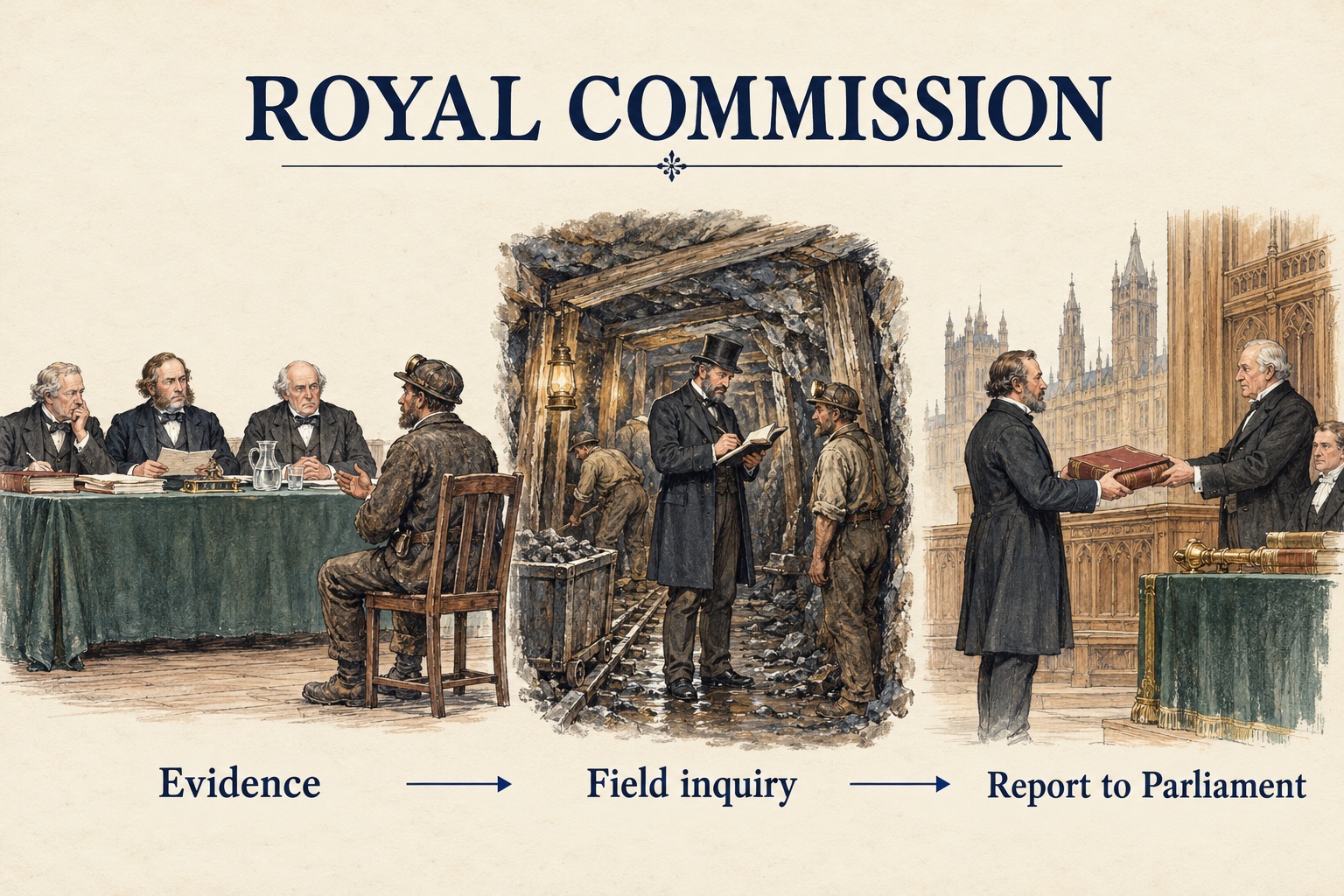
A commission's warrant named its members and its terms of reference. It sat in public, heard witnesses and could send sub-commissioners into the field as the 1842 inquiry did, though its evidence was not taken on oath and some men, afraid for their jobs, made light of their conditions. It reported to Parliament in a command paper, often in stages, and the government then decided what to do. The 1906 commission's recommendations were written into the 1911 Act; the Sankey report's four separate approaches, from full nationalisation to continued private ownership, gave the government its reason to reject nationalisation; and the Royal Commission on Safety in Coal Mines was followed by departmental committees, among them one on the use of electricity underground, and by action that the Ministry of Power's files record continuing into the 1960s.
Why it was used
A Royal Commission carried an authority that no departmental inquiry had, and its report, resting on evidence, made legislation possible that the coal owners would otherwise have resisted. It was also a way of deferring a question: the ownership of the industry was examined in 1919 and 1925 and settled only by nationalisation in 1947.
Risks & limitations
A commission could be ignored. Sankey's recommendation of nationalisation was rejected, the rescue stations the 1886 commission asked for were not made compulsory for twenty-five years, and the Samuel report's wage cut precipitated the very conflict it was meant to avert. Reports came slowly, in stages over years, and their evidence reflected who was willing to speak.
Regional variation
Commissions covered the whole United Kingdom; the 1842 inquiry worked by districts, each with its own sub-commissioner and its own report.
Related terminology
Coal Mines Act 1911, Coal Mines Regulation Act, HM Chief Inspector of Mines, Miners' Strike, Mines Rescue Station, Rescue Brigade, Safety Lamp
Mines associated with this term
5 examples chosen from 59 linked records — the term page is not an index.
- Glyn Pits, Pontypool — Torfaen (well documented example)
Named twice in this record, first in the history: “…yards deep by Welsh Coal Mines and as 190 feet (58 metres) by the Royal Commission, and the pit is said to have been one of the first collieries to…” - Kimmeridge Oil Shale Workings — Dorset (well documented example)
Named in this record’s surface remains: “…in the cliffs, along with fragments of the piers and tramways. The Royal Commission recorded Sir William Clavell's pier on the east side of the bay as…” - Maenofferen Quarry — Gwynedd (well documented example)
Named twice in this record, first in the history: “…afterward. A detailed archaeological survey of the workings by the Royal Commission on the Ancient and Historical Monuments of Wales in 2010-11…” - Argoed Colliery — Caerphilly (well documented example)
Named in this record’s history: “…41 of them under eighteen and 20 under thirteen. Evidence to the Children's Employment Commission that year described working on the level only, ventilated by air…” - Bellstone Quarry — Pembrokeshire (well documented example)
Named 3 times in this record, first in the summary: “…by 1891. It ran intermittently for sixty-odd years and by the Royal Commission's account was never successful.”
Disasters associated with this term
5 examples chosen from 7 linked records, most direct relationship first.
- Broadmoor Colliery chain break, 1844 (contextual relationship)
Named in this record’s narrative: “…Thomas. Benjamin Thomas had been questioned at the colliery by the Children's Employment Commission two years earlier, aged eight.” - Clifton Hall Colliery explosion (contextual relationship)
Named in this record’s changes to practice: “…explosion — the argument Galloway had been making and which the Royal Commission on Explosions in Mines was then examining.” - Huskar Pit Flooding, 1838 (contextual relationship)
Named in this record’s investigation: “Evidence given to the Royal Commission on Children's Employment in 1841 by Benjamin Mellor, underground…” - Oaks Colliery explosion, 1866 (contextual relationship)
Named in this record’s changes to practice: “…after twelve further colliery explosions elsewhere in Britain; a Royal Commission was established to examine colliery safety more broadly in the…” - Seaham Colliery Explosion (contextual relationship)
Named in this record’s changes to practice: “…in gassy seams fed directly into the argument that produced the Royal Commission on Accidents in Mines and, in time, the restriction of blasting practice in fiery pits.”
Sources
- (primary) ACCIDENT PREVENTION (2): Royal Commission on Safety in Coal Mines: action on report, POWE 8/234 — The National Archives
- (secondary) Background information: the 1842 Royal Commission — National Coal Mining Museum for England
- (secondary) Coal Industry Commission Act 1919 — Wikipedia
- (secondary) Coal Mines Act 1911 — Wikipedia
- (secondary) Mining lamp — Wikipedia
- (secondary) Our heritage — MRS Training & Rescue
- (secondary) Royal Commission of Inquiry into Children's Employment — Wikipedia
- (secondary) Samuel Commission — Wikipedia
- (secondary) The beginning of Rescue Stations (Part 2) — Nottinghamshire Mining Museum
- (secondary) Use of Electricity in Coal Mines (Nature, 1939) — Nature
Record created: 18 October 2026 · Last researched: 18 October 2026