 MineArchive
Coal Mines Regulation Act
| Also known as | Coal Mines Regulation Act 1872, Coal Mines Regulation Act 1887 |
|---|---|
| Category | Law & Custom |
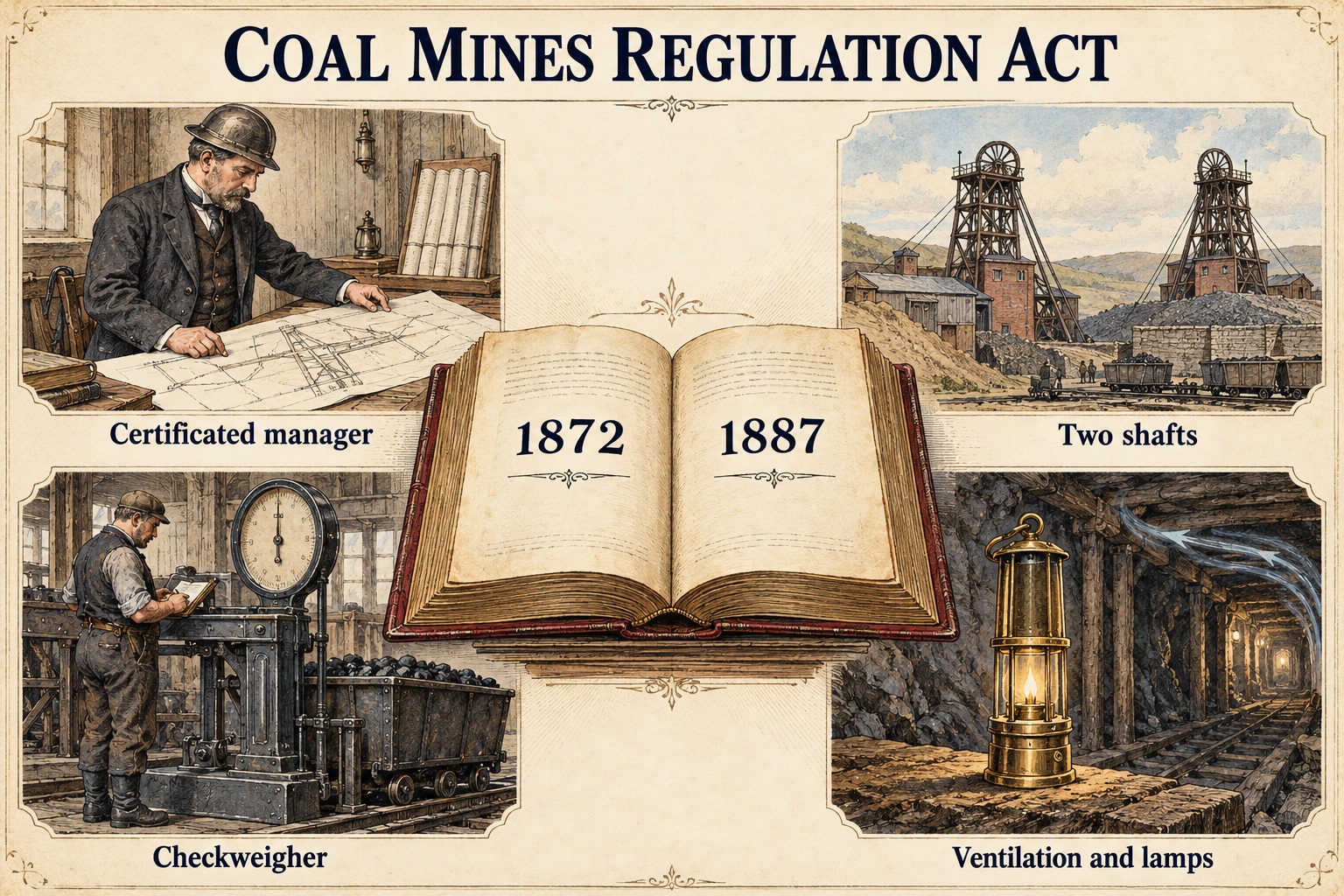
The two Acts of Parliament, of 1872 and 1887, that governed British coal mines between the first inspection Acts and the Coal Mines Act 1911. They fixed the ages and hours of boys, required a certificated manager at every mine, forbade single shafts, gave the men a check weigher and laid down general rules for ventilation, safety lamps and shot-firing.
Historical usage
The Coal Mines Regulation Act 1872 (35 & 36 Vict. c. 76) received the royal assent on 10 August 1872 and came into force in Great Britain on 1 January 1873 and in Ireland a year later, consolidating the Mines and Collieries Act 1842, the Mines Act 1860 and the Coal Mines Act 1862; the Metalliferous Mines Regulation Act passed beside it for the ore mines. It forbade the employment of any boy under ten below ground, required boys of ten to twelve to attend school for twenty hours a fortnight on certificates from the schoolmaster, and put every mine under the control and daily supervision of a certificated manager. The Coal Mines Regulation Act 1887 (50 & 51 Vict. c. 58), assented to on 16 September 1887 and in force from 1 January 1888, consolidated the Acts of 1872 and 1886 and the Stratified Ironstone Mines (Gunpowder) Act 1881 and was amended by the Check Weigher Act 1894, the Act of 1896, the Mines (Prohibition of Child Labour Underground) Act 1900, which raised the age below ground to thirteen, and others, until the Coal Mines Act 1911 repealed all but six of its sections from 1 July 1912. Those six, on weighing the coal and paying the men, lasted until the Wages Act 1986 took them off the book on 1 January 1987.
How it worked
Under the 1887 Act no boy under the statutory age and no woman or girl could work below ground, and boys were limited to fifty-four hours a week and ten a day; on the surface no child under twelve could be employed at all, and a register of every boy, girl and woman was kept at the mine office. Wages could not be paid in a public house, and where men were paid by weight the coal had to be truly weighed and they could appoint a check weigher by ballot, at their own cost, to watch the scales. Every seam at work needed two shafts or outlets at least fifteen yards apart, joined by a passage at least four feet wide and three high, with exemptions for mines of twenty men or fewer. A mine employing more than thirty below ground had to be under a manager holding a first-class certificate of competency, with daily supervision by him or by a certificated under-manager; certificates needed five years' practical experience, or an approved diploma and three, were granted on examination by boards of owners, workmen, engineers and an inspector, and could be cancelled for incompetence or gross negligence. General Rule 8 allowed no lamp or light other than a locked safety lamp wherever the Act required one, Rule 10 had every lamp examined and found securely locked before it went into the workings and forbade anyone but the examiner or the shot-firer to carry a means of opening a lock, Rule 11 kept the lamp stations out of the return air, and in such places a shot could be fired only by an appointed person after examining the place.
Why it was used
The nineteenth century's explosions and inundations drove the law, and each Act consolidated what had gone before and added the lessons of the latest inquiries: a certificated manager so that a mine was run by someone who had passed an examination, two shafts so that one blocked shaft could not seal a pit, as the single shaft at Hartley had in 1862, locked lamps so that a man could not open his lamp at the face, and a check weigher so that the men's earnings were not at the owner's discretion.
Risks & limitations
The Acts had exemptions at every turn. Small mines of twenty or thirty men escaped the two-shaft and manager rules unless an inspector insisted, a Secretary of State could exempt whole classes of mine, and a mine could be divided on paper into separate mines unless he objected. Enforcement rested on a handful of inspectors and on prosecutions for fines of pounds. The lamp rules required locks and examinations but left the type of lamp to the special rules of each district, and a locked lamp in one place was no protection where naked lights were allowed between it and the return airway. The Royal Commission on Mines of 1906 to 1911 found the structure wanting and the Coal Mines Act 1911 replaced it.
Regional variation
The Acts applied to the United Kingdom, with Ireland coming under the 1872 Act a year after Great Britain and with Irish exemptions on Saturday working written into the 1887 Act. The Metalliferous Mines Regulation Act 1872 governed the lead, tin and copper mines separately.
Related terminology
Coal Mines Act 1911, HM Chief Inspector of Mines, Locked Lamp, Royal Commission, Safety Lamp, Shaft, Undermanager
Mines associated with this term
Included only where MineArchive's own research gives a reasonable evidential basis — not every mine where this might plausibly apply.
- Auldhouseburn Colliery — East Ayrshire (well documented example)
Named in this record’s history: “…it found the inrush was due to a failure to observe Rule 13 of the Coal Mines Regulation Act, the rule requiring boreholes to be kept in advance of the face. The…”
Disasters associated with this term
5 examples chosen from 21 linked records, most direct relationship first.
- Abram Colliery explosion, 1881 (contextual relationship)
Named in this record’s contributing factors: “…workforce, and that told the manager and the men to comply with the Coal Mines Regulation Act only so far as was 'reasonably practicable'.” - Auldhouseburn Colliery inundation, 1898 (contextual relationship)
Named in this record’s investigation: “…the influx of water was due to a failure to observe Rule 13 of the Coal Mines Regulation Act, the general rule requiring boreholes to be kept in advance of the…” - Bamfurlong Colliery fire, 1892 (contextual relationship)
Named in this record’s aftermath: “Hall proposed a special rule under section 52 (2) of the Coal Mines Regulation Act requiring every underground oil lamp to have a proper safety burner,…” - Cadeby Main haulage accident, 1909 (contextual relationship)
Named in this record’s narrative: “…Main Colliery on behalf of the workmen, as General Rule 38 of the Coal Mines Regulation Act allowed the men to do through inspectors of their own choosing.…” - Dinas Colliery explosion, 1879 (contextual relationship)
Named in this record’s aftermath: “…by the Right Honourable Home Secretary under Section 32 of the Coal Mines Regulation Act, 1872'. The question was raised in Parliament by the miners' member…”
Sources
- (primary) Coal Mines Regulation Act 1872, as enacted (35 & 36 Vict. c. 76) — legislation.gov.uk
- (primary) Coal Mines Regulation Act, 1887: full text — Irish Statute Book
- (secondary) Coal Mines Regulation Act 1872 — Wikipedia
- (secondary) Coal Mines Regulation Act 1887 — Wikipedia
- (secondary) Mining lamp — Wikipedia
Record created: 18 October 2026 · Last researched: 18 October 2026