 MineArchive
Locked Lamp
| Also known as | Lead Rivet Lock, Lamp Lock, Lead Plug (North East England) |
|---|---|
| Category | Structures & Machinery |
A flame safety lamp fitted with a lock so that the man carrying it cannot open it underground: a lead rivet clinched through lugs with special pincers, or a screw lock, opened only at the lamp station. Locking turned the safety lamp from a precaution the miner could defeat into one he could not.
Historical usage
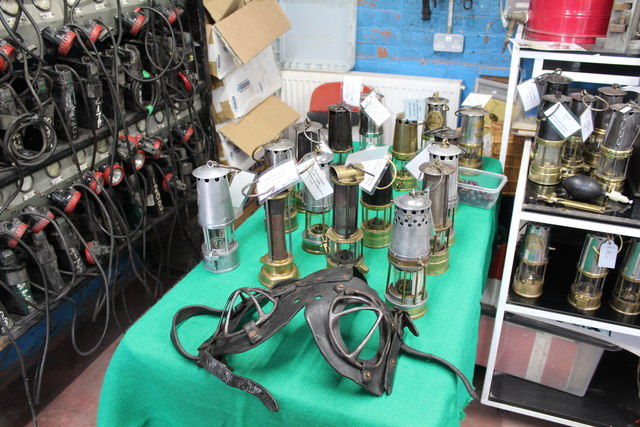
The temptation to relight a lamp at the working place was the safety lamp's weak point from the start, and safety devices against careless or improper use were increasingly employed. Mr Mackworth, one of H.M. Inspectors of Mines, brought out a lamp in about 1852 with a lead lock of his own invention: a lead rivet set in lugs on the oil vessel and the case and clinched with pincers carrying a device on one jaw, so that any tampering could be detected. The Coal Mines Regulation Act 1872 required locked lamps under certain conditions, the Royal Commission on Accidents in Mines tested lamps and reported in 1886, and the Act of 1887 laid down general rules on their construction, examination and use. At Wingate Grange in 1906 the workmen's Marsaut and Donald lamps were locked with a lead plug and the officials' tin-can Davy lamps secured by a screw lock. The Protector Lamp Company's aluminium bonneted Prestwich lamps of the early twentieth century carried a lead rivet lock.
How it worked
Under General Rule 10 of the 1887 Act a competent person examined every lamp at the surface or at the appointed lamp station immediately before it went into the workings and saw that it was in safe working order and securely locked; a lamp could be unlocked only at the lamp station or by the shot-firer to fire a shot, and no one but the examiner and the shot-firer might have in his possession any contrivance for opening a lock. Rule 11 kept the lamp stations out of the return air, so a lamp was never opened where gas might be. With the lead lock the lamp was closed by clinching the rivet through the lugs; opening it meant cutting the lead, which could not be hidden from the lamp room.
Why it was used
An unlocked safety lamp is only as safe as its carrier. A man who opened his lamp for more light or to light his pipe was a recognised cause of explosions once gauze lamps were in general use, and the lock put the decision out of his hands and into the lamp room's.
Risks & limitations
A locked lamp cannot be relit when it goes out, which is why relighter lamps were later devised. The lead could be cut and rivetted again by anyone with pincers, so the rules made possession of a means of opening a lock an offence. A lock did nothing for the lamp's poor light or for a gauze that could pass flame in a strong current, and a locked lamp in one part of a district was no protection where naked lights were allowed between it and the return. Museum Wales records a Prestwich lamp that cannot be opened even when unlocked.
Regional variation
At Wingate Grange the Durham workmen carried lead-plugged Marsaut and Donald lamps while the officials' Davy lamps had screw locks; the Protector Lamp Company's Prestwich lamps used the lead rivet.
Related terminology
Coal Mines Regulation Act, Firedamp, Relighter Lamp, Safety Lamp
Mines associated with this term
Included only where MineArchive's own research gives a reasonable evidential basis — not every mine where this might plausibly apply.
- Dean Lane Colliery — Bristol (well documented example)
Named in this record’s history: “…men working there; afterwards new ventilation roads were driven and locked lamps adopted. Employment had fallen to 144 by 1905, and the colliery…”
Disasters associated with this term
5 examples chosen from 15 linked records, most direct relationship first.
- Abram Colliery explosion, 1881 (contextual relationship)
Named in this record’s changes to practice: “…a safer lamp than the Davy in the Wigan district. He also urged that locked lamps be made compulsory in a mine like Abram rather than left to the…” - Aldwarke Main Colliery explosion, 1875 (contextual relationship)
Named in this record’s investigation: “…Frank N. Wardell, attributed the gas to the goaf and recommended locked lamps and better keeping of the statutory record books. The coroner, D.…” - Bedwellty Pits explosion, 1880 (contextual relationship)
Named in this record’s investigation: “…fired by naked lights, and pressed the managers to work the pit with locked lamps.” - Bignall Hill Colliery explosion, 1874 (contextual relationship)
Named in this record’s summary: “…lights in a seam where gas had been found that morning and urged locked lamps throughout the district's Bullhurst and Banbury seams.” - Birley Vale Colliery Explosion, 1876 (contextual relationship)
Named in this record’s narrative: “…at the end by wooden pipes and worked, until that week, under locked lamps. When the men went in on the Monday morning carrying naked lights,…”
Sources
- (primary) Coal Mines Regulation Act, 1887: full text — Irish Statute Book
- (secondary) Mining lamp — Wikipedia
- (secondary) Prestwich flame safety lamp — Museum Wales
- (secondary) Safety lamp, Mackworth, with lead rivet lock and pincers, 1856 — Science Museum Group
- (secondary) Wingate Grange Colliery Explosion – Wingate – 1906 — Northern Mine Research Society
Record created: 18 October 2026 · Last researched: 18 October 2026