 MineArchive
HM Chief Inspector of Mines
| Also known as | Chief Inspector of Mines, HM Inspector of Mines, Inspector of Mines, HM Inspectorate of Mines, Mines Inspectorate |
|---|---|
| Category | Law & Custom |
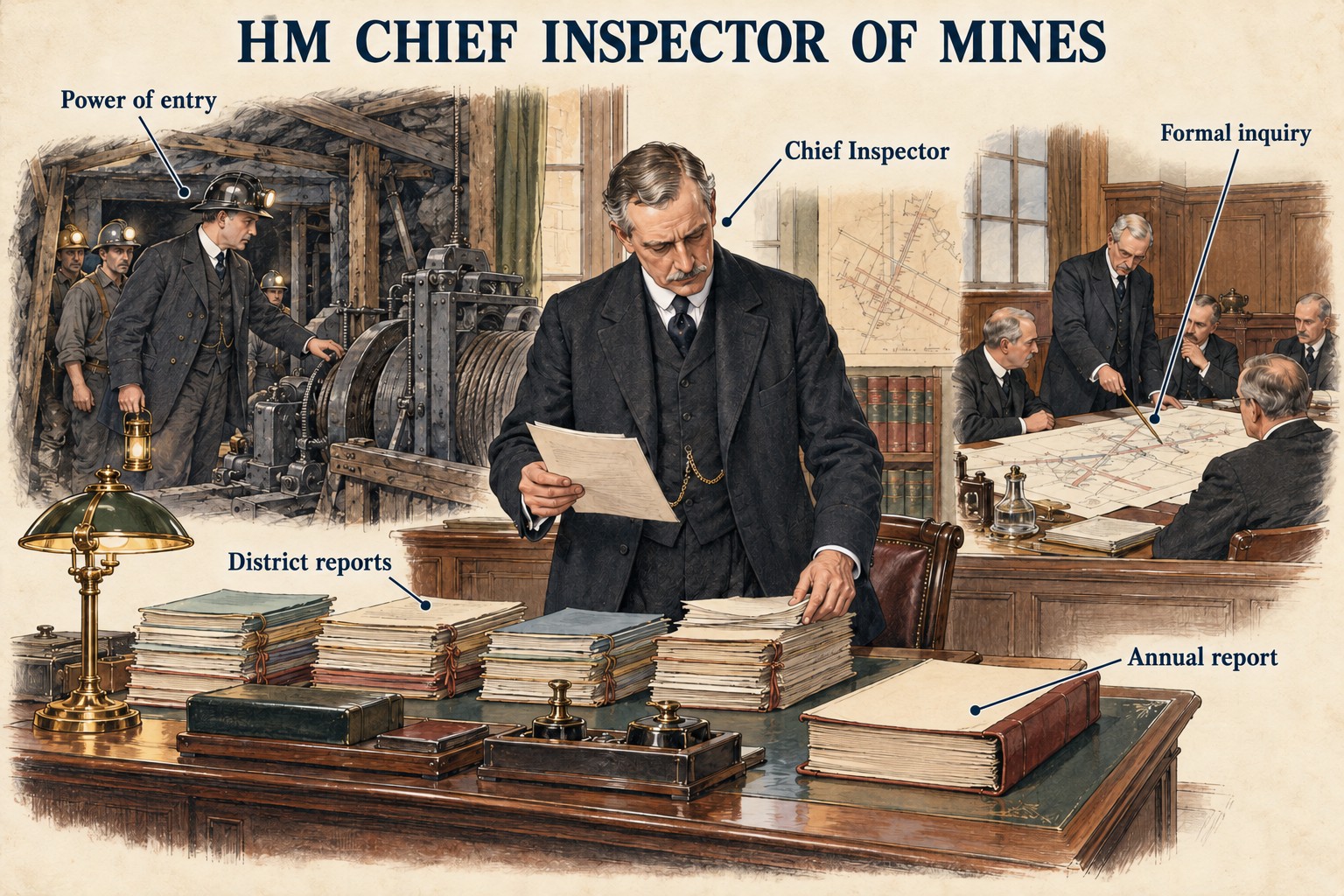
The head of His (or Her) Majesty's Inspectorate of Mines, the government officers who from 1850 had the right to enter any mine, examine its workings and machinery, and report on its accidents. The post of Chief Inspector was created in 1908, over the district inspectors who had reported separately to the Home Secretary since the first Coal Mines Inspection Act, and its holder led the investigation of the great disasters of the twentieth century and wrote the annual report that recorded the industry's deaths.
Historical usage
Government inspection began before the inspectors. The Act of 1842 that put children and women out of the pits gave Hugh Seymour Tremenheere a commission, from 1843, to report on the mining districts, but not to go underground. The Coal Mines Inspection Act of 1850 let the Secretary of State appoint inspectors of coal mines with power to enter and examine any colliery, required notice of every fatal accident and punished obstruction; four men were appointed — Mathias Dunn, Herbert Mackworth, Charles Morton and Kenyon Blackwell — to cover the whole of Great Britain between them, each losing ground to new appointments until there were twelve districts by 1855, when annual reports to Parliament were made a duty. Metalliferous mines came under inspection from 1872–73 and quarries from 1894. A Chief Inspector's report covering all mines and quarries was first published for 1897, but the office itself dates from 1908, when Richard Redmayne, professor of mining at Birmingham, left the university for the Home Office as the first Chief Inspector of Mines under the Coal Mines Regulation Act of that year; between 1908 and 1913 he was also commissioner of inquiry into the disasters at Hamstead, Maypole, South Moor, Whitehaven, Little Hulton, Cadeby and Senghenydd. Redmayne resigned in 1919; Sir Thomas Mottram followed, and in 1924 Henry Walker, who had come up through the Southern, Durham and Scottish districts, took the office he held through the Gresford inquiry of 1934. From 1921 to 1938 the Chief Inspector's report was folded into the Secretary for Mines' annual report; it stood alone again from 1948, under the Mines and Quarries Act of 1954 and, from 1975, the Health and Safety Executive.
How it worked
A district inspector went down after a fatal accident, gave evidence at the inquest and wrote up the year's deaths for his division; the Chief Inspector read the divisions' reports, wrote the overview, and after a disaster large enough to warrant it was appointed to hold a formal inquiry under the Act and report to the Secretary of State. The reports are the archive's most valuable primary source for a colliery's accidents: from 1855 there is a report for every district, for every year, naming the dead and the cause.
Why it was used
Inspection was Parliament's answer to explosions the owners could not or would not prevent. It gave the state a man on the ground who could enter a pit, question its management under oath, and publish what he found; the Chief Inspector's inquiries after Senghenydd and Gresford put the causes of the century's worst disasters on the public record.
Risks & limitations
Four men for the whole of Britain in 1850 could not inspect much, and the inspectorate was for decades small, dependent on the owners for access and drawn from their own class of mining engineers; historians have argued over how far its inquests leaned towards employers in the later nineteenth century. Its reports record what was found after the event far more fully than what was prevented before it.
Regional variation
The districts were the inspectorate's units — Northumberland and Durham, South Wales, Scotland and the rest — each with its own inspector and report; a colliery's accidents are found under its district, not under the Chief Inspector, until the national report begins in 1897.
Related terminology
Coal Mines Act 1911, Coal Mines Regulation Act, Royal Commission, Undermanager
Mines associated with this term
5 examples chosen from 54 linked records — the term page is not an index.
- Nixon's Navigation Colliery — Rhondda Cynon Taf (well documented example)
Named in this record’s history: “…then winding from both seams using two winding engines. By the Inspector of Mines list of 1896 the owners were Nixon's Navigation Coal Co. Ltd,…” - Alvecote Colliery — Warwickshire (well documented example)
Named in this record’s history: “…killing one man and seriously injuring eighteen others; H.M. Inspector of Mines put the accident down to managerial neglect of machinery maintenance…” - Bedlinog Colliery — Merthyr Tydfil (well documented example)
Named in this record’s history: “…underground for twenty-four hours (see Disasters, below). By the Inspector of Mines list of 1896 the two pits employed 1,402 people between them,…” - Bilsthorpe Colliery — Nottinghamshire (well documented example)
Named in this record’s history: “…Alcock, 50, and under-manager David Shelton, 31; a 1994 report by HM Inspectorate of Mines attributed the collapse to unsafe roof bolting. Shelton was…” - Black Park Colliery — Wrexham (well documented example)
Named in this record’s history: “…surface in 1894 and rather fewer through the following decade. The Inspector of Mines list for 1896 gives 460 men in all, fifty of them on the surface.…”
Disasters associated with this term
5 examples chosen from 175 linked records, most direct relationship first.
- Grassmoor Colliery Explosion, 1933 (rescue/recovery concept)
The public inquiry was held by the Chief Inspector of Mines under section 83 of the Coal Mines Act 1911, and Sir Henry Walker reported in March 1934. - Aberaman Colliery shaft accident, 1883 (contextual relationship)
Named in this record’s narrative: “…all the way round the shaft above the Nine Feet, and the deputy inspector of mines, W. Randall, said the shaft was practically unwalled and in places…” - Abercynon Colliery Haulage Accident, 1906 (contextual relationship)
Named in this record’s investigation: “…on 1 May 1906, with all interested parties represented: F. A. Gray, chief inspector of mines, and Mr Trump, assistant inspector, for the Home Office; Tom…” - Aberpergwm Colliery runaway tram, 1901 (contextual relationship)
Named in this record’s narrative: “…Griffith Lloyd, said safety points might have prevented it, and the Inspector of Mines, Mr Robson, said a banksman should have been stationed at the top of…” - Agecroft Colliery shaft accident, 1859 (contextual relationship)
Named in this record’s investigation: “…Lancashire District for 1859, compiled by Joseph Dickinson, H.M. Inspector of Mines.”
Sources
- (primary) Durham Mining Museum: Inspection of Coal Mines Act, 1850 — Durham Mining Museum
- (secondary) Government and Mining: Legislation, Inspection, Enquiries (North of England Institute of Mining and Mechanical Engineers) — North of England Institute of Mining and Mechanical Engineers
- (secondary) Henry Walker (mines inspector) — Wikipedia
- (secondary) Mines Inspectors reports (North of England Institute of Mining and Mechanical Engineers) — North of England Institute of Mining and Mechanical Engineers
- (secondary) Richard Redmayne — Wikipedia
Record created: 8 September 2026 · Last researched: 8 September 2026