 MineArchive
Agecroft Colliery shaft accident, 1859
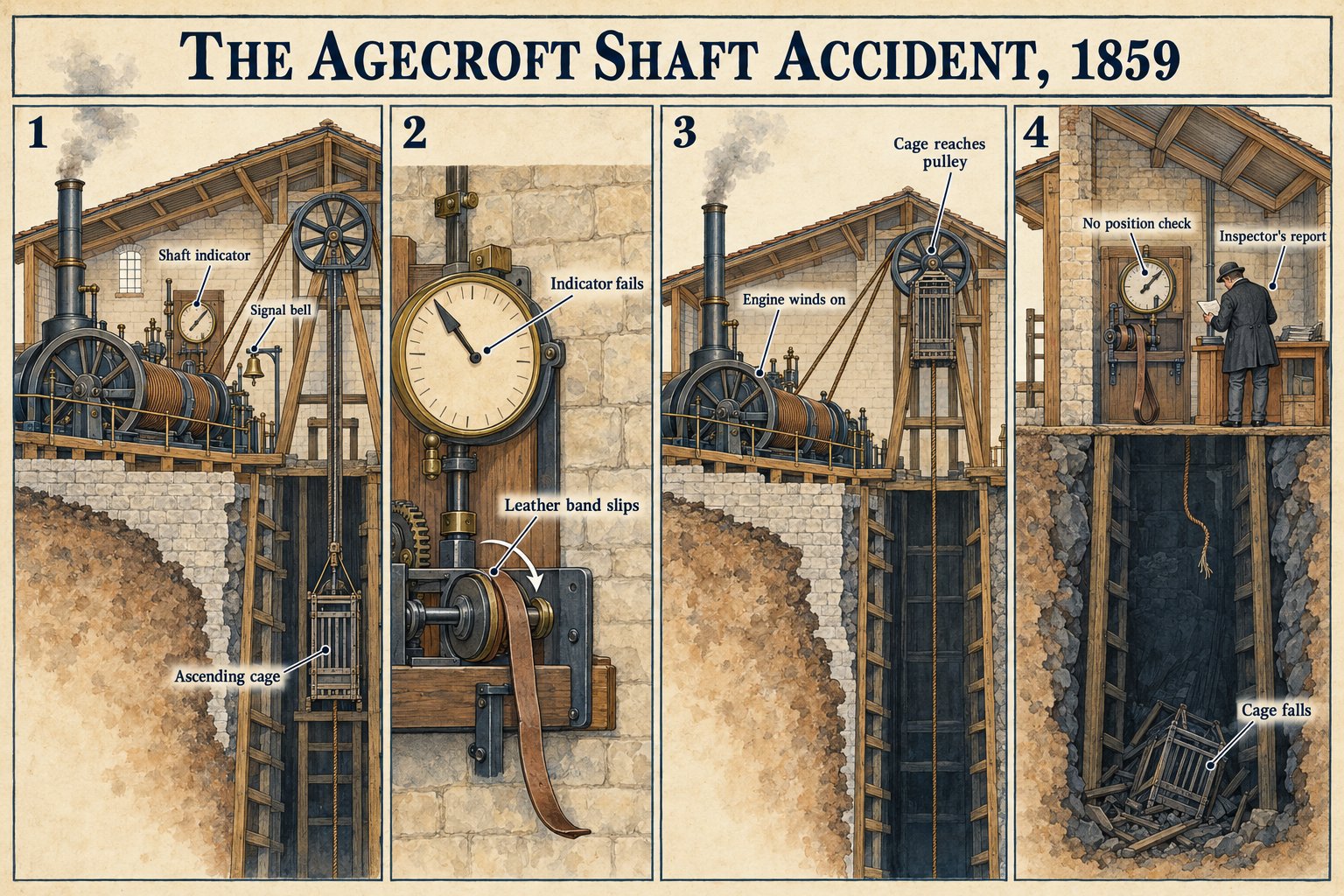
Seven men and boys were drawn against the winding pulley and fell down the shaft at Agecroft Colliery on 4 January 1859, after a shaft-position indicator's signal band slipped loose and the engineman, with no other way to judge the cage's position, relied on hearing the signal bell alone.
| Date | 4 January 1859 |
|---|---|
| Mine | Agecroft Colliery |
| Region | Greater Manchester |
| Type | Winding / Shaft Accident |
| Fatalities | 7 (The seven killed were Thomas Edge, John Foster, James Green, Thomas Lancaster and Luke Thomas (all recorded only as 'boy'), William Latham (20) and Benjamin Tomlinson (60).) |
| Context | During active mining |
Cause
The leather band of the shaft indicator, which had been refixed about an hour and a half earlier, slipped loose; without a working indicator the engineman was trusting solely to hearing the signal bell to judge the cage's position, and continued winding as the men were drawn up against the pulley at the shaft top and precipitated down the shaft.
Contributing factors
The recent, apparently inadequate refixing of the indicator band shortly before the accident, and the absence of any independent check on the cage's position beyond the audible signal, were both directly implicated.
What happened
On 4 January 1859 seven men and boys were being wound up the shaft at Agecroft Colliery, Andrew Knowles and Sons' pit at Pendlebury, when the engine failed to stop. The shaft indicator, the device that showed the engineman where the cage was, worked by a leather band, and that band, refixed only an hour and a half earlier, had slipped loose. Without it the engineman was trusting solely to hearing the signal bell to judge the cage's position. He wound on: the cage was drawn up against the pulley at the top of the headgear and its occupants were precipitated down the shaft. All seven died. The Durham Mining Museum's register names them as Thomas Edge, John Foster, James Green, Thomas Lancaster and Luke Thomas, each recorded only as a boy, William Latham, 20, and Benjamin Tomlinson, 60. The colliery was then fifteen years old, its two shafts having been sunk by Andrew Knowles and Sons in 1844.
Investigation & inquiry
The accident was recorded in the Mines Inspector's Report for the North and East Lancashire District for 1859, compiled by Joseph Dickinson, H.M. Inspector of Mines.
Recorded claims
Individual factual claims, each attached to the source(s) that support it below. Where sources disagree, both are kept.
- The shaft indicator's leather band, refixed about ninety minutes earlier, slipped loose; with no working indicator, the engineman relied solely on the signal bell and continued winding as the men were drawn against the pulley and fell down the shaft. 1
- Seven men and boys died: Thomas Edge, John Foster, James Green, Thomas Lancaster, Luke Thomas, William Latham (20) and Benjamin Tomlinson (60). 1
Related terminology
Mining terms this disaster is structurally linked to, with the nature of the relationship.
- Cage (contextual relationship)
Named 3 times in this record, first in the summary: “…band slipped loose and the engineman, with no other way to judge the cage's position, relied on hearing the signal bell alone.” - Colliery (contextual relationship)
Named in this record’s summary: “…drawn against the winding pulley and fell down the shaft at Agecroft Colliery on 4 January 1859, after a shaft-position indicator's signal band…” - HM Chief Inspector of Mines (contextual relationship)
Named in this record’s investigation: “…Lancashire District for 1859, compiled by Joseph Dickinson, H.M. Inspector of Mines.” - Headgear (contextual relationship)
Named in this record’s narrative: “…wound on: the cage was drawn up against the pulley at the top of the headgear and its occupants were precipitated down the shaft. All seven died.…” - Shaft (contextual relationship)
Named 4 times in this record, first in the summary: “…men and boys were drawn against the winding pulley and fell down the shaft at Agecroft Colliery on 4 January 1859, after a shaft-position…”
Sources
- (primary) Agecroft Colliery — Durham Mining Museum
- (secondary) Agecroft Colliery — Wikipedia
Record created: 27 August 2026 · Last researched: 16 September 2026