 MineArchive
Agecroft Colliery
| Location | Pendlebury, Salford, Greater Manchester — 53.5026, -2.2934 (exact) |
|---|---|
| Commodity | Coal |
| Type | Coal |
| Worked | 1844–March 1991 |
| Maximum depth | No.3 and No.4 shafts: 700 yards to the Trencherbone mine; No.5 shaft: 2,000 feet, 24 feet in diameter |
| Operators | Andrew Knowles and Sons (1823–1929), Manchester Collieries Ltd (1929–1947), National Coal Board (1947–1991) |
Overview
Andrew Knowles and Sons' 'premier pit' at Pendlebury, worked for over 150 years and later linked directly to the adjoining Agecroft Power Station by conveyor, whose closure in 1991 ended coal mining in Salford.
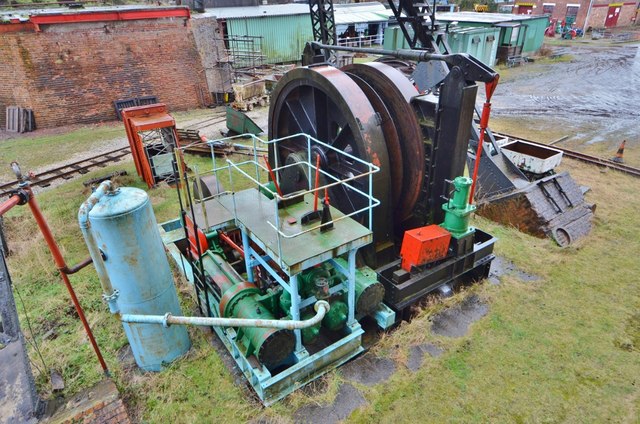
History
Andrew Knowles acquired the lease at Pendlebury in 1823, and his firm, Andrew Knowles and Sons, sank the original No.1 and No.2 shafts in 1844; Knowles's Salford pits were regarded locally as his 'premier' operation, their coal shipped initially by canal and, increasingly through the 19th century, by the Lancashire and Yorkshire Railway. A second phase of sinking added No.3 and No.4 shafts from 1894 to 1900, reaching 700 yards to work the Trencherbone seam. Andrew Knowles and Sons was merged into Manchester Collieries in 1929, and the colliery passed to the National Coal Board on the 1947 nationalisation of the coal industry.
Agecroft's worst single accident came early in its history: on 4 January 1859, seven men and boys were killed in a shaft accident (see Disasters, below). Sinking continued into the colliery's later life too — a new No.5 shaft, 2,000 feet deep and 24 feet in diameter, was sunk in the late 1950s as part of a major post-war redevelopment, with an estimated 80 million tonnes of workable coal identified across the site by a 1953 survey. From this period the colliery supplied coal directly to the adjoining Agecroft Power Station, at first by steam train and later via a purpose-built conveyor belt carried on a bridge over Agecroft Road.
Agecroft Colliery closed in March 1991, bringing over 150 years of coal mining in the Salford area to an end.
Geology
Agecroft worked seams of the Middle Coal Measures of the Lancashire Coalfield, including the Trencherbone, Five Feet and Roger seams, individual seams ranging from around 2 feet 2½ inches to 7 feet in thickness; a 1953 survey estimated some 80 million tonnes of workable coal remained across the site.
Workings
The colliery's five shafts were sunk in three phases: No.1 and No.2 in 1844, No.3 and No.4 from 1894 to 1900 (reaching 700 yards to the Trencherbone seam), and a new No.5 shaft in the late 1950s, 2,000 feet deep and 24 feet in diameter, as part of a major post-war redevelopment. From that redevelopment onward, roughly half the colliery's output was delivered directly to the adjoining CEGB power station, latterly via an enclosed conveyor belt on a bridge over Agecroft Road.
Closure
Agecroft Colliery closed in March 1991, ending over 150 years of coal mining in the Salford area.
What remains
A business and enterprise park opened on part of the former colliery site in the late 1990s; much of the wider site has remained undeveloped since.
Nearby mines
- Pendleton Colliery — 0.2 miles (0.4 km) N
- Clifton Hall Colliery — 1.2 miles (2.0 km) NW
- Pendlebury Colliery — 1.5 miles (2.4 km) NW
- Wet Earth Colliery — 2.9 miles (4.7 km) NW
- Sandhole Colliery — 3.5 miles (5.6 km) W
Straight-line distance, within 9 miles (15 km). Show on the map.
Disasters & major incidents
-
Agecroft Colliery roof fall, 1853
1 December 1853 · Collapse / Roof Fall · 2 fatalities
On 1 December 1853 two men were killed by a fall of roof at Agecroft Colliery, near Pendlebury in Lancashire. -
Agecroft Colliery shaft accident, 1859
4 January 1859 · Winding / Shaft Accident · 7 fatalities
Seven men and boys were drawn against the winding pulley and fell down the shaft at Agecroft Colliery on 4 January 1859, after a shaft-position indicator's signal band slipped loose and the engineman, with no other way to judge the cage's position, relied on hearing the signal bell alone. -
Agecroft Colliery shot-firing accident, 1859
6 September 1859 · Explosion · 2 fatalities
On 6 September 1859 two colliers were fatally burned at Agecroft Colliery, near Pendlebury in Lancashire, by a heavily charged shot that blew out its stemming. -
Agecroft Colliery roof fall, 1890
13 June 1890 · Collapse / Roof Fall · 2 fatalities
Two miners taking down top coal at Agecroft Colliery, Pendlebury, were killed on 13 June 1890 when it fell on them unexpectedly from slips. -
Agecroft Colliery fire suffocations, 1891
2 December 1891 · Gas / Asphyxiation · 4 fatalities
On 2 December 1891 four men were suffocated by gases while shutting off an underground fire at Agecroft Colliery, near Pendlebury in Lancashire. -
Agecroft Colliery roof fall, 1896
6 March 1896 · Collapse / Roof Fall · 2 fatalities
On 6 March 1896 two colliers of the same name were killed by a fall of roof at Agecroft Colliery, near Pendlebury in Lancashire. -
Agecroft Colliery shot accident, 1899
1 February 1899 · Explosion · 3 fatalities
A shot went off while it was being charged in the No. 4 pit sinking at Agecroft on 1 February 1899, killing a chargeman and two sinkers.
Recorded claims
Individual factual claims, each attached to the source(s) that support it below. Where sources disagree, both are kept.
- Andrew Knowles acquired the Pendlebury lease in 1823, sinking No.1 and No.2 shafts in 1844; No.3 and No.4 shafts followed from 1894 to 1900, reaching 700 yards to the Trencherbone seam. 1,2
- Andrew Knowles and Sons merged into Manchester Collieries in 1929, and the colliery passed to the National Coal Board on the 1947 nationalisation of the coal industry. 1,2
- A new No.5 shaft, 2,000 feet deep and 24 feet in diameter, was sunk in the late 1950s as part of a major redevelopment, after which roughly half the colliery's output was delivered directly to the adjoining power station, latterly via a conveyor belt on a bridge over Agecroft Road. 2
- A 1953 survey estimated some 80 million tonnes of workable coal remained across the redeveloped site. 2
- Agecroft Colliery closed in March 1991, ending over 150 years of coal mining in the Salford area. 1,2
- Located at about 53.503 N, 2.293 W. 2
Sources
- (primary) Agecroft Colliery — Durham Mining Museum
- (secondary) Agecroft Colliery — Wikipedia
Record created: 27 August 2026 · Last researched: 27 August 2026