 MineArchive
Wet Earth Colliery
| Location | Clifton, near Manchester, Greater Manchester — 53.5331, -2.3422 (exact) |
|---|---|
| Commodity | Coal |
| Type | Metal |
| Worked | 1740s–1928 |
| Operators | John Heathcote (1740–1756), James Brindley (1750–1756), Matthew Fletcher (?–1880), Clifton and Kersley Coal Company (1880–1928) |
Overview
Wet Earth Colliery, sunk by landowner John Heathcote in the 1740s, would be an unremarkable early Lancashire coal pit but for one thing: the ingenious inverted siphon and waterwheel-pumping system the young engineer James Brindley built here in the 1750s to solve its flooding — the project that first made his name, years before he became Britain's most celebrated canal builder.
History
John Heathcote made the first attempt to sink a deep colliery on the site in the 1740s, but the workings persistently flooded from the nearby River Irwell via the Pendleton Fault, and formal working only began in earnest from 1751. With no flowing water on site to power drainage machinery, and the pithead standing 23 feet above the river, Heathcote called in the young millwright James Brindley in 1750 to find a solution. Brindley's answer, built between 1752 and 1756, was remarkable: a weir upstream fed an 800-yard tunnel driven through rock across a bend in the Irwell to Giant's Seat, where two shafts were linked by a 73-yard tunnel running directly beneath the riverbed itself — an inverted siphon that carried water under the river rather than over it. From there the water ran along a leat to power a 23-foot overshot waterwheel, which drove the pumps that finally kept the colliery dry. The basic system Brindley built remained in continuous use for around 170 years, with the original wheel replaced by a water turbine in 1867; the project was an early proof of the engineering ability that would later make Brindley the driving force behind the Bridgewater Canal and much of Britain's canal network. The colliery worked on for nearly two centuries after Brindley's scheme, closing in 1928. Its safety record was, on the whole, unremarkable for a mine of its age — mostly minor injuries rather than large-scale disaster — though it was not free of tragedy: on 17 May 1874, after miner Thomas Entwistle was badly burnt in an explosion triggered by a blockage of air, William and John Ivill, a father and son who went to his aid, were themselves overcome by blackdamp and fell 300 feet from the cage to their deaths. A further fatal accident, in which colliery manager George Jones was killed in a shaft accident, is recorded on 20 December 1918.
Geology
The colliery worked coal seams of the Manchester Coalfield, drained by exploiting the natural head of the adjacent River Irwell rather than the steam pumping technology more commonly used elsewhere on the coalfield by the mid-18th century.
Geological setting: Sedimentary Beds and Seams (well documented example)
Workings
Brindley's 1752-56 hydraulic system connected an 800-yard leat tunnel and a 73-yard inverted-siphon tunnel beneath the River Irwell to a 23-foot overshot waterwheel, which powered the pumps draining the colliery; the system remained in use, latterly with a water turbine replacing the original wheel in 1867, for around 170 years.
Closure
The colliery closed in 1928 after nearly two centuries of continuous working, one of the longest-lived pits on the Manchester Coalfield.
What remains
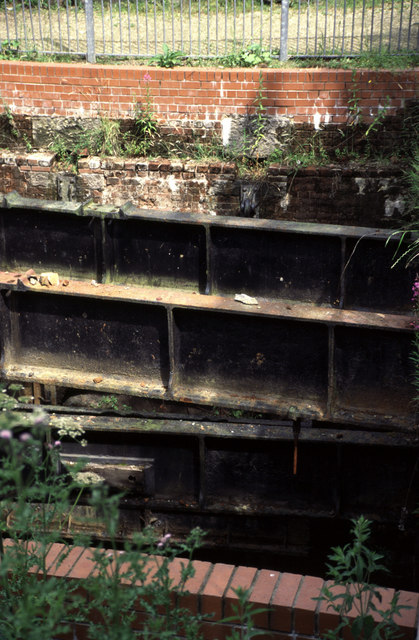
Part of Clifton Country Park: the excavated wheelpit, the turbine house, the capped Gal Pit and stretches of Brindley's siphon and Fletcher's Canal can be seen from the visitor trail.
The site is now Clifton Country Park; a visitor trail passes Fletcher's Canal, the remains of Brindley's siphon workings and waterwheel pit, and the capped Gal Pit shaft.
Nearby mines
- Outwood Colliery — 1.1 miles (1.8 km) N
- Linnyshaw Colliery — 1.5 miles (2.4 km) W
- Pendlebury Colliery — 1.5 miles (2.4 km) SE
- Clifton Hall Colliery — 1.7 miles (2.7 km) SE
- Sandhole Colliery — 1.7 miles (2.8 km) SW
Straight-line distance, within 9 miles (15 km). Show on the map.
Recorded claims
Individual factual claims, each attached to the source(s) that support it below. Where sources disagree, both are kept.
- Brindley's 1752-56 hydraulic system, including an 800-yard leat tunnel and a 73-yard inverted siphon beneath the River Irwell, remained in continuous use for around 170 years, with the original waterwheel replaced by a water turbine in 1867. 1,2
- On 17 May 1874, William and John Ivill, a father and son, died falling 300 feet down the shaft after being overcome by blackdamp while going to the aid of a colleague badly burnt in an explosion. 1
- Matthew Fletcher took the colliery from Heathcote and his nephew Ellis Fletcher sank a second shaft in January 1804; the Fletchers' canal, begun in 1791, was navigable to Botany Bay Colliery by 1800; the family sold to the Pilkington brothers in 1880, who doubled output and formed the Clifton and Kersley Coal Company, and the colliery was run down and closed in 1928. 1
- The Mining Remediation Authority's abandonment plans for Wet Earth cover the Hell Hole or Wigan Four Feet seam at 30 yards to the inch (NW1026) and, with Newtown, the Cannel (NW1034, NW1035), with older plans grouping Wet Earth with Robin Hood, Botany Bay and Newtown No. 1. 3,4
- Located at about 53.533 N, 2.342 W. 1
Sources
- (secondary) Wet Earth Colliery — Wikipedia
- (primary) Brindley at Wet Earth Colliery: an engineering study — Internet Archive (Banks & Schofield)
- (primary) Wet Earth Colliery mine plans (BGS Mine Plans Catalogue) — British Geological Survey / The Coal Authority
- (primary) Wet Earth abandonment plans NW1026 (BGS mine plans catalogue) — British Geological Survey / Mining Remediation Authority
Record created: 23 August 2026 · Last researched: 24 September 2026