 MineArchive
Millwright
| Category | Labour & Roles |
|---|
A skilled tradesperson who designed, built and maintained the water- or wind-powered machinery — waterwheels, gearing, pumps, shafts — that drove mills, mines and early factories, and one of the direct professional ancestors of the modern civil and mechanical engineer.
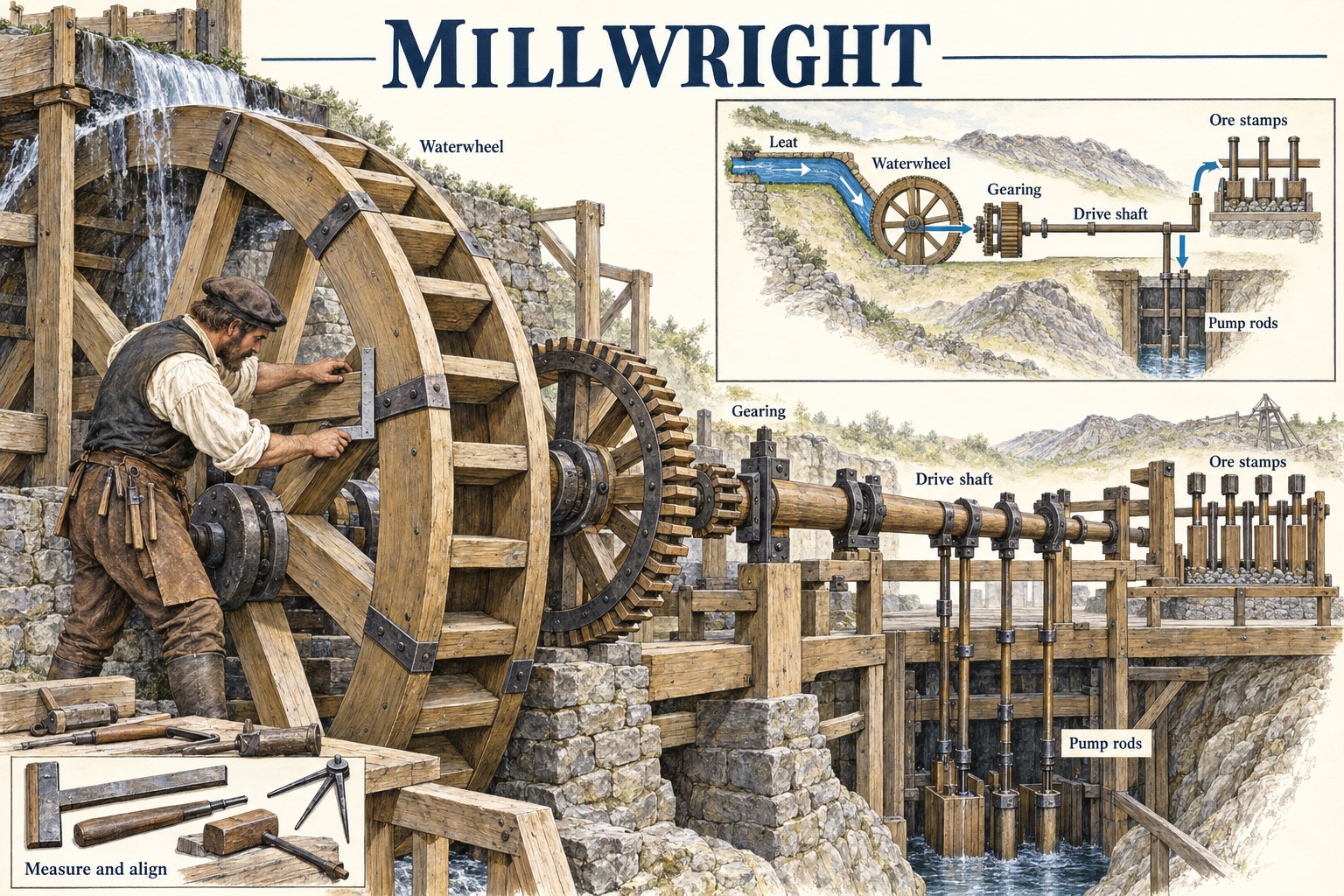
Historical usage
The trade traces back to the Middle Ages, when millwrights built and maintained the watermills and windmills essential to grinding grain, sawing timber and draining marshland. As mining and manufacturing expanded from the 17th century onward, millwrights' skills were increasingly called on well beyond agriculture: driving pumps to drain flooded workings, powering ore-crushing and dressing machinery, and later building the machinery of factories and textile mills. Several of Britain's most celebrated early civil engineers, including James Brindley and John Rennie, trained and began their careers as millwrights before going on to design canals, bridges and other major infrastructure; Brindley's first major commission, the ingenious inverted-siphon drainage scheme he built at Wet Earth Colliery in the 1750s, was explicitly a millwright's job before it became the calling card that made his wider engineering career.
How it worked
A millwright combined the skills of a carpenter, a mechanic and, increasingly, a metalworker: designing and cutting gearing, shaping and balancing waterwheels, laying out shafts and leats to bring water to a site with the right head and flow, and fitting the whole system together to precise mechanical tolerances using little more than hand tools. At a mine, this expertise was most often applied to pumping — keeping deep workings free of water — and to powering ore-crushing, stamping and dressing machinery.
Why it was used
Before steam power became widely affordable, water was the only practical source of continuous mechanical power available to most mines, and only a millwright had the combined carpentry, mechanical and hydraulic knowledge needed to harness it reliably — sizing a wheel and its gearing correctly, and routing water to it, took real skill that a general carpenter or blacksmith alone could not supply.
Risks & limitations
A millwright's solutions depended entirely on a reliable head of water, which not every mine site had naturally — the more ambitious schemes, like Brindley's at Wet Earth, required diverting water considerable distances, at real expense, to sites with no natural watercourse of their own. As steam power became cheaper and more reliable through the 19th century, dedicated engine-builders and mechanics gradually displaced millwrights from much of the work water power alone had once demanded of them.
Related terminology
Mines associated with this term
Included only where MineArchive's own research gives a reasonable evidential basis — not every mine where this might plausibly apply.
- Goonvean Pit — Cornwall (well documented example)
Named in this record’s current condition: “…beam engine it held was dismantled in September 2008 by Century millwrights and put into store, in the hope of re-erection at Hayle.” - Wet Earth Colliery — Greater Manchester (well documented example)
The mine's own recorded history explicitly describes James Brindley as 'the young millwright' called in to solve the colliery's flooding problem.
Sources
- (secondary) Millwrighting — Heritage Crafts Association
- (secondary) The wheels of change: Human capital, millwrights, and industrialisation in 18th-century England — CEPR (VoxEU)
Record created: 23 August 2026 · Last researched: 23 August 2026