 MineArchive
Chokedamp
| Also known as | Blackdamp (More common name for the same gas mixture in most British coalfields), Stythe (North East England) |
|---|---|
| Category | Ventilation & Mine Gases |
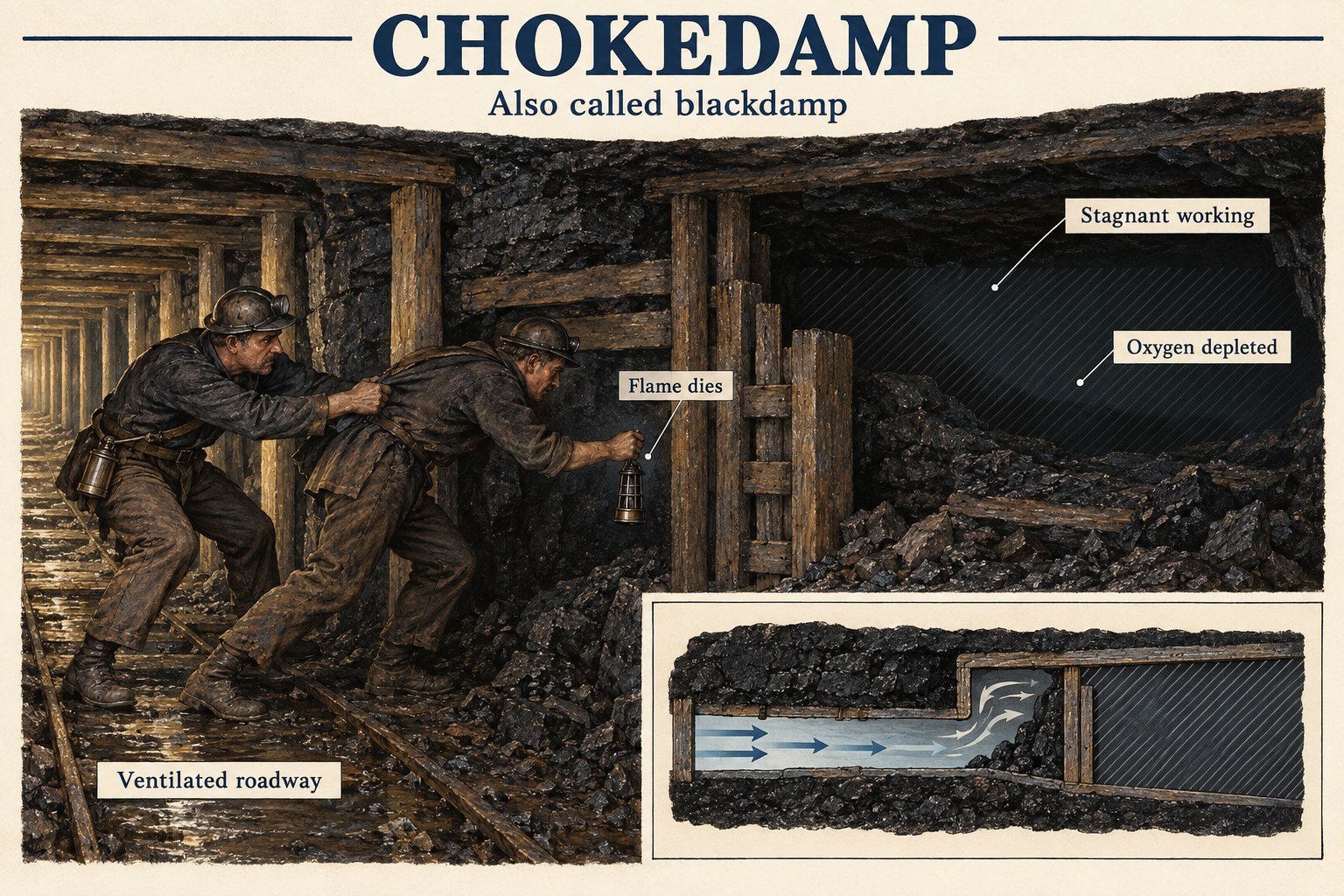
An asphyxiating mixture of gases — chiefly nitrogen and carbon dioxide, with the oxygen removed — that can silently accumulate in a mine; also called blackdamp, or stythe in parts of North East England.
Historical usage
The name 'blackdamp' is recorded from 1736 onward, and the closely related term chokedamp is used interchangeably with it in mining sources; both describe the same underlying hazard, distinct from the explosive firedamp and the carbon-monoxide-bearing afterdamp that follows an explosion or fire.
How it worked
Blackdamp typically forms as coal, once exposed to air in a working mine, slowly absorbs oxygen from the surrounding atmosphere while releasing carbon dioxide and water vapour of its own; over time in a poorly ventilated space this steadily depletes breathable oxygen, leaving a mixture — commonly around 10-15% carbon dioxide and 85-90% nitrogen — that cannot support life, though it will not itself burn or explode. It also forms as part of the aftermath of a mine fire or explosion, making it a close relative of afterdamp.
Why it was used
Because chokedamp gives no visible warning and does not burn, it could not be detected the same way as firedamp; miners instead relied on a simple flame test (see this site's own Bad Air term page) — a candle or lamp flame burning low and finally dying well before conditions became lethal to a person.
Risks & limitations
Chokedamp is entirely undetectable by human senses alone and gives no warning until a miner is already dangerously short of oxygen, making good ventilation — rather than any warning system — the only real defence against it.
Regional variation
'Stythe' or 'stithe' was the everyday dialect word for the same hazard in Northumberland and County Durham, while 'blackdamp' and 'chokedamp' were used more widely across British coalfields; all belong to the broader family of 'damp' terms this site's Firedamp and Afterdamp pages also cover. Barrowman's 1886 Scottish glossary files stythe under the smell of spontaneous combustion, running chokedamp and afterdamp together with it, and gives ill air as the general Scottish word for noxious gas from underground fires or chokedamp, or simply for stagnant air. Healey Hero's account of stythe is the most vivid: where the emission of carbonic gas is strong and the ventilation poor, the whole space fills, 'causing the extinction of the candles, and finally life itself'.
Related terminology
Mines associated with this term
5 examples chosen from 14 linked records — the term page is not an index.
- Cae Glas Colliery — Merthyr Tydfil (notable incident)
The 1958 deaths of the mine's licensee and two workmen (see Disasters, below) were caused by blackdamp encountered checking flood water in old workings. - Wet Earth Colliery — Greater Manchester (notable incident)
The mine's own recorded history explicitly describes two men being overcome by blackdamp and falling to their deaths during the 1874 accident. - Brownrigg Colliery — Northumberland (well documented example)
Named twice in this record, first in the history: “…throughout: a sinker, William Elliott, aged 21, was killed by stythe (foul air) while sinking the pit on 13 August 1869, and a hewer,…” - Gilmerton Colliery — Midlothian (well documented example)
Named in this record’s history: “…1890 two sinkers, John King and Thomas Sharpe, were suffocated by chokedamp. Mining in the area largely ceased in 1894, leaving only small…” - Glynogwr Colliery — Rhondda Cynon Taf (well documented example)
Named in this record’s history: “…it had its own washery. In July 1925 Emlyn Tudor was suffocated by blackdamp in a fenced-off heading, and the same year Arthur Mayling died of…”
Disasters associated with this term
5 examples chosen from 22 linked records, most direct relationship first.
- Cae Glas Colliery Gassing, 1958 (direct cause)
Both sourced accounts of this incident describe the gas encountered in the old, flooded workings as blackdamp (one names it methane instead); Chokedamp is the term page's own heading, with Blackdamp recorded there as its standard alias. - Auchengeich Colliery explosion, 1931 (hazard involved)
Black damp gathered behind the explosion once the air tubes were burst, and is what disabled the five men who went back in. - Morfa Colliery explosion, 1863 (hazard involved)
Most of the dead died of chokedamp. - Pelsall Hall Colliery inundation, 1872 (hazard involved)
Ten of the dead were killed by chokedamp in a dry refuge. - Udston Colliery explosion, 1887 (hazard involved)
Men in the Main Coal died of chokedamp from the Splint.
Sources
- (primary) Definition of chokedamp — Mindat
- (primary) Glossary of Mining and Geordie Words — Durham Mining Museum
- (primary) Glossary of Scotch Mining Terms — James Barrowman (1886), via Scottish Mining Website
- (secondary) Blackdamp — Wikipedia
- (secondary) Pit Terminology — Healey Hero
Record created: 21 August 2026 · Last researched: 14 September 2026