 MineArchive
Afterdamp
| Category | Ventilation & Mine Gases |
|---|
The toxic mixture of gases — chiefly carbon monoxide, alongside carbon dioxide and nitrogen — left behind in a mine after an explosion or fire, distinct from firedamp (the methane that often causes the explosion in the first place).
Historical usage
The term is most associated with coal mining, where a firedamp (methane) explosion, sometimes followed by a much larger secondary coal-dust explosion, left afterdamp behind in the workings — but the same carbon-monoxide poisoning mechanism can follow any mine fire, whatever the ore being worked.
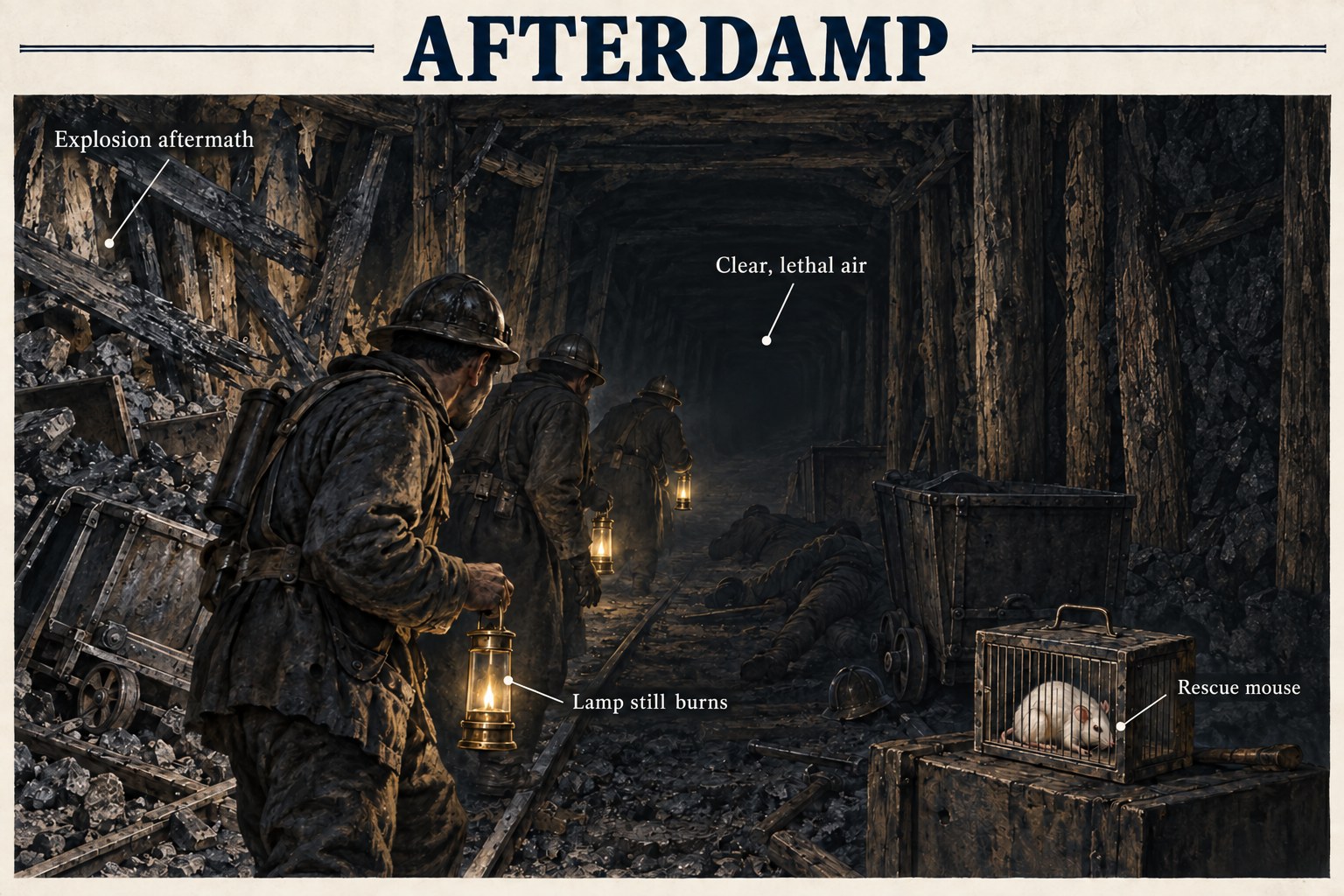
That afterdamp, rather than blast or burns, was what actually killed most men in a colliery explosion was established by John Scott Haldane in a report to the Home Secretary in 1896, written after the Tylorstown explosion in the Rhondda Fach. Ninety men were below when the pits fired at half past five in the morning; 57 were killed and 33 brought out alive. Haldane and Dr Morris examined every one of the bodies. Five men had been killed instantly by violence, one of them with his head, legs and arms torn from his body. The other 52 — 91 per cent of the dead — had been killed by afterdamp, their blood carmine red and, under the microscope days later, full of pink crystals of carboxyhaemoglobin. The horses died the same way: the mule Haldane sampled had haemoglobin 59 per cent saturated with carbon monoxide.
How it worked
The carbon monoxide in afterdamp is what actually kills: it binds to haemoglobin in the blood far more readily than oxygen does, starving the body of oxygen even at concentrations too low to see or smell. This is exactly the mechanism recorded in several of this site's own disaster records, including the 1952 Greenside Mine fire.
Haldane put figures to it. Along the track of the Tylorstown explosion the mixture left behind held on average about 1 to 1½ per cent carbon monoxide, with 50 to 70 per cent air and a few per cent carbon dioxide; an explosion of firedamp alone, without dust, might leave 3 or 4 per cent. Very much less than that will do. Haemoglobin forms a far more stable compound with carbon monoxide than with oxygen, and — as Claude Bernard had shown — haemoglobin saturated with carbon monoxide cannot carry oxygen at all. A man at rest breathing air with a tenth of one per cent of carbon monoxide in it absorbs about 60 per cent of what he inhales, and would take some two and a half hours to half-saturate his blood; a man walking breathes three times as much air, and is poisoned three times as fast. The gas is not a suffocant in the ordinary sense — the air can be perfectly breathable and still be lethal.
Why it was used
Recognising afterdamp as a distinct, separate danger from firedamp mattered because it meant a mine could remain lethal even once any flames or explosion were over and the immediate fire risk had passed — rescuers and returning miners faced a second, invisible hazard in air that could look and smell clear.
It was that last point Haldane's investigation settled. The rescuers' lamps at Tylorstown went on burning, which meant at least 18 per cent oxygen in the air, so the symptoms one of them described — dizziness, watering eyes, legs going unsteady — could not be oxygen starvation and could only be carbon monoxide. The safety lamp, the one instrument every man underground carried, was blind to the gas most likely to kill him. Afterdamp is also patchy rather than uniform: in the Tylorstown No. 8 pit, where every man was found dead, the explorers saw mice running about unharmed at several points.
Risks & limitations
Afterdamp is essentially undetectable by human senses alone, which is why small animals — far more sensitive to carbon monoxide than people — were introduced into British collieries at the urging of physiologist John Scott Haldane, and remained in use as a living gas detector well into the 20th century.
The canary came later; what Haldane actually recommended in 1896 was a mouse, 'or other equally small warm-blooded animal', carried in a small cage or a lamp chimney closed at both ends with wire gauze. The reasoning is arithmetic rather than sentiment: a mouse's respiratory exchange is about twenty times as rapid as a man's, so it takes up the gas twenty times faster and shows it — panting, then weakness in the legs — while the men around it are still safe. He suggested a few white mice be kept in the winding-engine room at the top of the downcast shaft, ready to go down with the rescue party, so that rescuers could 'go forward with rapidity and confidence' instead of guessing. He also wanted electric lamps kept near the face for escape, since a lamp put out by firedamp leaves trapped men in the dark as well as in danger.
Regional variation
"Damp" is a generic historical term for a dangerous mine atmosphere (from the German Dampf, vapour), giving a family of related terms — firedamp (methane), blackdamp/chokedamp (oxygen-deficient, carbon dioxide-rich air) and whitedamp (carbon monoxide specifically) — of which afterdamp, the mixture left after an explosion or fire, is one.
Related terminology
Canary, Return Airway, Shot-firing
Mines associated with this term
5 examples chosen from 12 linked records — the term page is not an index.
- William Pit — Cumbria (notable incident)
The pit's defining hazard, and the reason its 1947 death toll was so high: only fourteen of the hundred and four killed died in the blast itself, the rest overcome by the carbon monoxide it left behind in workings two and a half miles from the shaft. - Bowhill Colliery — Fife (well documented example)
Named in this record’s history: “…1909. On 31 October 1931 an underground firedamp explosion and the afterdamp it generated killed ten men working in the Dunfermline Splint seam…” - Trimdon Grange Colliery — County Durham (well documented example)
Named twice in this record, first in the history: “…of 16 February 1882 killed 74, including rescuers overcome by afterdamp that travelled through the connection into the East Hetton workings…” - Annesley Colliery — Nottinghamshire (well documented example)
Named in this record’s history: “…tubs through the 1880s, and in June 1877 seven men suffocated by afterdamp while clearing the site of an underground fire (see Disasters,…” - Black Vein Colliery — Caerphilly (well documented example)
Named in this record’s history: “…brought down a huge fall that cut the ventilation, trapping the afterdamp that killed most of the victims. It was the worst mining disaster…”
Disasters associated with this term
5 examples chosen from 104 linked records, most direct relationship first.
- Easington Colliery explosion, 1951 (direct cause)
Two rescue workers died from the effects of afterdamp during the 257-hour rescue operation. - Greenside Mine fire, 1952 (direct cause)
Four miners were killed by carbon monoxide gas released when a fire in timbering fanned into life; textbook afterdamp poisoning following a mine fire rather than an explosion. - Magpie Mine suffocation of three Maypitt miners (direct cause)
Fires deliberately lit underground during a dispute over the Great Redsoil vein produced toxic smoke that suffocated three miners from the neighbouring Maypitt mine — the same post-fire gas hazard afterdamp describes, from an arson fire rather than an explosion. - Snaefell Mine disaster (direct cause)
Smouldering support timbers filled the workings with carbon monoxide; investigator Dr Haldane — later responsible for introducing mine-rescue canaries against exactly this gas — examined the disaster and measured how quickly it could disable a person. - William Pit Explosion (direct cause)
The clearest case in the archive of afterdamp rather than the blast being the killer: fourteen men died in the explosion and ninety in the carbon monoxide it left behind.
Sources
- (primary) Report to the Secretary of State for the Home Department on the causes of death in colliery explosions and underground fires, with special reference to the explosions at Tylorstown, Brancepeth and Micklefield — John Scott Haldane, HMSO, 1896
- (secondary) Afterdamp — Wikipedia
Record created: 20 August 2026 · Last researched: 20 August 2026