 MineArchive
William Pit Explosion
A shot fired in the No. 2 Dip face of the undersea workings at Whitehaven ignited firedamp and coal dust, two and a half miles out from the shaft. Fourteen men were killed by the blast. Ninety more survived it and then died of the carbon monoxide it left behind, before rescuers working through more than twenty hours could reach them.
| Date | 15 August 1947 |
|---|---|
| Mine | William Pit |
| Region | Cumbria |
| Primary type | Explosion |
| Associated types | Entrapment, Gas / Asphyxiation, Rescue |
| Fatalities | 104 (One hundred and four of the 117 men underground were killed. Only fourteen died in the explosion itself; the great majority were overcome afterwards by carbon monoxide — afterdamp — with others dying of burns or gassing. Three men were found alive more than twenty hours later: John Birkett, aged 50, Daniel Hinds, 40, and James Weighman, 23.) |
| Injuries | Beyond the three survivors brought out alive after twenty hours, the surviving men underground escaped the affected districts; the mine's remoteness from the shaft meant that those not killed outright were either overcome where they were or got out before the afterdamp reached them. |
| Context | During active mining |
Cause
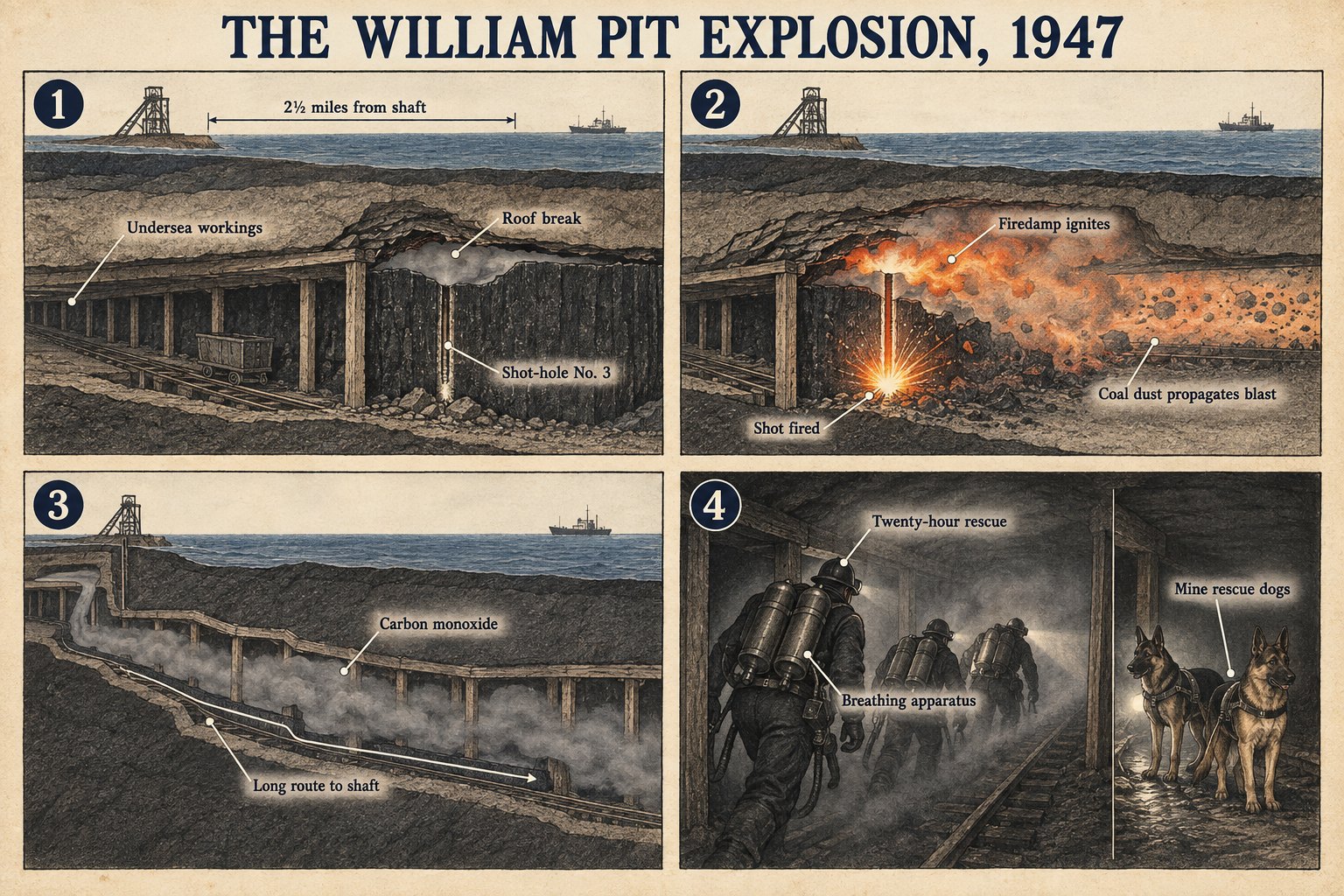
Shot-firing in the waste at the No. 2 Dip longwall face. The inquiry found that a shot fired by the deputy in shot-hole No. 3 ignited firedamp lying in a break — a cavity in the roof — and the flame was then propagated through coal dust.
Contributing factors
The inquiry identified breaches of the Coal Mines Regulation Act on ventilation, and firedamp accumulating in places despite the ventilation arrangements. It also found the shot-firing workload excessive, a single deputy firing forty or more shots in a day, with inadequate supervision, poor communication between overmen and deputies, and insufficient gas testing. The working district lay about two and a half miles from the shaft, at the far end of the undersea workings, which lengthened every stage of the rescue.
What happened
At about twenty to six on the evening of 15 August 1947, one hundred and seventeen men were underground in William Pit, most of them in the No. 2 Dip district, roughly two and a half miles out beneath the Irish Sea. The deputy fired a round of shots in the waste at the longwall face. One of them, in shot-hole No. 3, ignited firedamp lying in a break in the roof, and the flame ran on through coal dust along the main haulage road. Fourteen men were killed immediately. Ninety others survived the blast itself and were then trapped in workings filling with carbon monoxide, far beyond the reach of anyone who could get to them quickly.
Rescue & recovery
Rescue brigades came from Cumberland, Durham, Northumberland and Lancashire and worked continuously for more than twenty hours. Three men were brought out alive after that time — John Birkett, Daniel Hinds and James Weighman. Three trained Alsatian dogs from the RAF Police Dog School were brought in on the Tuesday to search for bodies under falls, the first time dogs had been used in a British mine rescue; the National Coal Board afterwards set up formal arrangements for training rescue dogs. Recovery of the dead continued through the Tuesday evening.
Investigation & inquiry
A public inquiry was held under Professor A. M. Bryan, Chief Inspector of Mines. It found no blame that could be fixed on any individual or on any particular system, but identified breaches of the ventilation provisions of the Coal Mines Regulation Act, an excessive shot-firing workload, inadequate supervision and communication between overmen and deputies, and insufficient testing for gas. The coroner's jury returned a verdict of accidental death; the coroner observed that pit discipline, by which he meant self-discipline, was the greatest safeguard.
Legal & regulatory aftermath
No prosecution followed the accidental-death verdict. The inquiry recommended the appointment of a qualified ventilation engineer and improvements to the airway system. The disaster came seven months after nationalisation, and was the worst British mining accident of the post-war period.
Changes to practice & legislation
The use of RAF police dogs to search the workings was a British first and led the National Coal Board to establish formal rescue-dog training arrangements. The inquiry's findings on shot-firing supervision, ventilation engineering and gas testing fed into the tightening of colliery practice under the new National Coal Board.
Memorials & commemoration
The dead are commemorated in Whitehaven, and a memorial service marked the 75th anniversary of the disaster in August 2022. The Durham Mining Museum holds the names, ages, occupations and home addresses of all those killed.
Recorded claims
Individual factual claims, each attached to the source(s) that support it below. Where sources disagree, both are kept.
- The inquiry found that a shot fired in shot-hole No. 3 on the No. 2 Dip longwall face ignited firedamp lying in a break in the roof, the flame then being propagated by coal dust. 1,2
- One hundred and four of the 117 men underground were killed; only fourteen died in the blast itself, the majority being overcome afterwards by carbon monoxide. 2
- Rescue brigades from Cumberland, Durham, Northumberland and Lancashire worked for more than twenty hours; three men — John Birkett, Daniel Hinds and James Weighman — were brought out alive. 2
- Three trained dogs from the RAF Police Dog School were used to search the workings, the first such use in a British mine rescue, and the National Coal Board afterwards established formal rescue-dog training. 2
- The public inquiry under Professor A. M. Bryan fixed no blame on any individual or system but found breaches of the Coal Mines Regulation Act on ventilation, an excessive shot-firing workload of forty or more shots a day for a single deputy, inadequate supervision and insufficient gas testing. 2
- The explosion happened about two and a half miles from the shaft, at the far end of workings running out under the Irish Sea. 1,2
Related terminology
Mining terms this disaster is structurally linked to, with the nature of the relationship.
- Afterdamp (direct cause)
The clearest case in the archive of afterdamp rather than the blast being the killer: fourteen men died in the explosion and ninety in the carbon monoxide it left behind. - Deputy (contextual relationship)
The inquiry traced the ignition to a shot fired by the deputy in shot-hole No. 3, which lit firedamp lying in a break in the roof. - Firedamp (direct cause)
Firedamp lying in a break in the roof was ignited by the shot in hole No. 3, and the flame was then carried on by coal dust. - HM Chief Inspector of Mines (contextual relationship)
Named in this record’s investigation: “A public inquiry was held under Professor A. M. Bryan, Chief Inspector of Mines. It found no blame that could be fixed on any individual or on any…” - Longwall (relevant method/equipment)
The explosion originated in shot-firing in the waste at the No. 2 Dip longwall face. - Shot-firing (direct cause)
The shot fired in hole No. 3 on the No. 2 Dip face is the ignition source the inquiry identified, and the inquiry's findings on shot-firing workload and supervision — a single deputy firing forty or more shots a day — are the clearest official statement of the problem this term describes.
Photographs & further reading
This page doesn't try to reproduce everything — these are the best original sources found for this disaster.
Names, ages, occupations and addresses of all those killed.
View sourceThe Mines Inspector's account and the inquiry findings.
View sourceSources
- (primary) William Colliery, Whitehaven — Durham Mining Museum — Durham Mining Museum
- (primary) William Pit Explosion — Whitehaven — 1947 — Northern Mine Research Society
Record created: 25 August 2026 · Last researched: 25 August 2026